
Thursday, December 11, 2025
spot_img
Home Blog Page 431

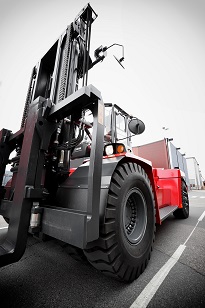
Kalmar launches its new-generation heavy forklift truck for the US market

0

Designed specifically for heavy-duty cargo handling in industrial applications, this Kalmar forklift has created the benchmark for cost efficiency and productivity.

With this heavy forklift truck, Kalmar has responded to customers’ increasing demands for enhanced safety, higher levels of performance and lower operating costs. The EGO cabin provides the operator with exceptional visibility, low noise levels and intelligent ergonomics, representing one of the most user-friendly environments currently available.

Additionally, the truck features three different drive modes, each optimised to meet operational requirements, depending upon the application. The driver can select between the ‘Power’ setting which maximises performance by increasing the number of tonnes moved per hour. The ‘Normal’ setting balances power and economy to optimise profitability. And if total cost of operations outweighs the need for performance, the ‘Economy’ mode is preferred, resulting in up to 15% fuel savings, when compared to previous models.

“The American launch of our new-generation heavy forklift is a highly anticipated event that we are really looking forward to. The Kalmar DCG180-330 has been very well received in Europe because, quite simply, it has exceeded the expectations of our customers,” said Peter Olsson, Sales Director, Forklift Trucks, Kalmar USA

“When it comes to productivity, coupled to the low cost of operation, this truck really sets the standard. Ultimately, equipment is judged on its return on investment and that’s where Kalmar consistently delivers. Good news travels fast and it seems like the American market has been eagerly anticipating this remarkable forklift. We are confident of its continued success, particularly for applications in the oil industry, ports, steel and heavy manufacture”.
TNPA makes headway dredging Durban berths

0

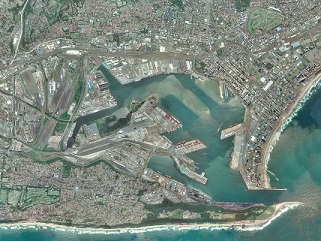
Durban Port Manager, Moshe Motlohi, explained: “The vessels calling at our ports have gotten bigger and therefore require deeper draughts. But they also cause challenges for ports because of the manner in which they more aggressively displace material from the sea bed, thus causing shallow spots. Shallower berths can cut into the vessel payloads of ship owners because it means they cannot sail into the port with their vessels fully laden and have to wait for high tide to sail or berth.”

Recently four container berths out of eight at Durban Container Terminal – namely 107, 200, 202 and 205 – have been called back to their original permissible draught of 12.2 metres.

Berth P at the Point Terminal, Berth MW9 at Maydon Wharf Terminal and bulk Berth BCA 4 in the Island View precinct have also been called back to their permissible draughts of 10.3m, 9.3m and 10m respectively.

“We are also expecting engineering sounding results that are likely to indicate more berths will be called back to their permissible draughts,” said Motlohi. “Ultimately the safety of vessels must take priority for us as TNPA, which is why the Harbour Master took the safety precaution to review the permissible draughts of some berths earlier this year.”

The permissible draught is the vertical distance between the sea bottom and the lowest part of the ship’s underside, otherwise known as the under keel clearance. In Durban it allows a 600mm clearance to minimise the chance of the vessel running aground in that area.

TNPA is pursuing various interventions to address the issue of diminishing draughts. The authority is continuing with maintenance dredging and pushing forward its R 2 billion dredging fleet replacement programme.

While the Impisi plough tug continues to dredge in the port, the short term plan is for the Italeni grab hopper dredger to continue to dredge along the berth pockets of Durban Container Terminal. Italeni will remain in Durban until the port takes delivery of a hired dredger dedicated to its dredging needs.

TNPA will also be taking delivery of its new Ilembe suction hopper dredger in December 2015. The Ilembe will be used for dredging larger areas such as the entrance channels. TNPA has also received approval to build a new grab hopper dredger dedicated to the port which should be delivered by the end of 2016.

The long-term intervention will be TNPA’s project to deepen and lengthen the berths to caterfor the bigger vessels now calling at the port. This project is expected to commence in 2016. Lengthening of the berths will allow the Port of Durban to berth three big vessels versus the two it is currently accommodating. This will immediately reduce the number of vessels waiting at anchorage, thereby improving port turnaround time. The other benefit is that the port will cease to be a tidal port, so that berthing and sailing will no longer depend on high tide. This will optimise the capacity of the port and improve the total vessel stay in South African waters.

The challenges presented by megaships calling at ports is presently a global phenomenon, as highlighted in a recent report by the International Transport Forum, which said “mega-containerships contribute to congestion and add to the need for costly infrastructure upgrades (bridge height, river width/depth, quay wall strengthening, berth deepening, canals/locks and port equipment)”.

ICTSI Colombia gears for start in 2016 with new container handling equipment

0

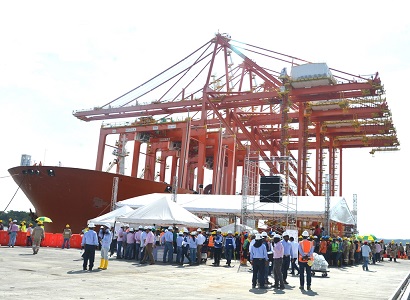
Manufactured by Shanghai Zhenhua Heavy Industry Co., Ltd. (ZPMC), the QCs have an individual lifting capacity of 60 tons, and feature twin lift spreaders. They can reach up to 65 meters into the water and perform up to 40 moves per hour. With a maximum lift height of 46 meters, the QCs are capable of servicing 18,000-TEU Triple E class vessels.

The RTGs, on the other hand, feature single spreader lifts and a 41-ton capacity. Estimated to cost around USD50 million, the equipment purchase is part of ICTSI’s USD545 million total investment in the Port of Buenaventura.

Development of the AMCT is divided into three phases. The first phase, which is slated for completion by April next year, will yield an annual capacity of around 600,000 TEUs. First phase development includes a 600-meter berth length with a 14.5-meter controlling depth, an 11-hectare container yard, a 250-meter coal bulk dock, conveyor belt-equipped silos and a 21-kilometer access road leading to the terminal. It also includes the construction of warehouses and inspection areas, as well as the deployment of automation and other state-of-the-art port technologies.

In July 2007, ICTSI won the 30-year concession for the construction and operation of a container terminal and grains and coal-handling facility at the Port of Buenaventura. ICTSI acquired stakes in two Panamanian companies to gain effective control of SPIA, which owns 240 hectares of land in the Aguadulce Peninsula and its surroundings.

In 2013, ICTSI and PSA International Pte. Ltd of Singapore entered into an agreement to jointly develop and operate the container terminal and its ancillary facilities. Upon completion, the Greenfield project is expected to become a catalyst for Colombian trade growth.

Navis furthers TOS Innovation with launch of N4 3.1

0

As a growing number of container terminals globally evaluate and adopt automation to address complex industry challenges, it is essential that terminal operating systems (TOS)—often the heart of the terminal—evolve in order to support new operational requirements. In response to this market need, N4 release 3.1 demonstrates Navis’ continued commitment to continuously improve the TOS’ usability, enhancing operational efficiency for its customers, delivering a platform that is extensible and flexible enough to meet terminal needs now and in the future. “As operational challenges mount for the global container shipping community, the industry as a whole is actively seeking out solutions—in the form of innovative technology, equipment and best practices—that can help improve performance at the terminal and keep up with the increasingly complex challenges that our industry faces. At the same time, we are focused on improving the service delivery for our customers,” said Andy Barrons, SVP and CMO of Navis. “For nearly three decades, Navis has, andcontinues to be, the trusted partner for terminals globally. N4 3.1 represents
a culmination of unmatched technology excellence and industry-leading experience from Navis that provides terminals of all shapes and sizes with the tools needed to succeed in the new world of shipping.”