
Monday, December 8, 2025
spot_img
Home Blog Page 438

APMT in Massive Operator Acquisition

0

. Grup Maritim TCB has 11 container terminals with an annual throughput capacity of 4.3 million TEUs and an estimated annual container volume of 3.5 million TEUs. The transaction is expected to close by the end of the year and is subject to certain conditions precedent, including relevant approvals. Terms and price were not disclosed.

Grup Maritim TCB consists of Spanish container terminal concessions in Barcelona, Valencia and Castellon, on the Mediterranean coast, along with the concessions in Gijon, on the Bay of Biscay, and in the Canary Islands: Santa Cruz on Tenerife and La Palma on Gran Canaria. Outside of Spain, Grup Maritim TCB’s terminal operations include Izmir, Turkey; Yucatan, Mexico; Quetzal, Guatemala (under construction, opening 2016); Buenaventura, Colombia, on the Pacific Coast; and Paranagua, Brazil.

APM Terminals CEO Kim Fejfer said “This is an exciting investment for APM Terminals, which adds complementary locations to our portfolio in high growth markets throughout Latin America, in Turkey and a strong gateway presence in Spain. Equally important, Grup Maritim TCB is one of the best run terminal businesses in the market with a history dating back to 1972, when it was first established by the Perez-Maura family in Barcelona. The company has earned a reputation for excellent service and professional people. Being a family company with these attributes makes a combination with APM Terminals a natural fit. I want to thank the Perez-Maura family for entrusting APM Terminals with the legacy of Grup Maritim TCB and look forward to exploring further opportunities of collaborating.”

Grup Maritim TCB CEO, Xavier Soucheiron stated “This agreement with APM Terminals marks a landmark moment in the Grup Maritim TCB journey. We share the same core values and views on how to build on our market momentum, where to invest in port upgrades and improve the entire TCB portfolio for clients. Together we can achieve even more potential in the APM Terminals family.
TPS announce two Model 4 cranes for Brazil and a Model 6 crane each for Haiti and Sint Maarten

0

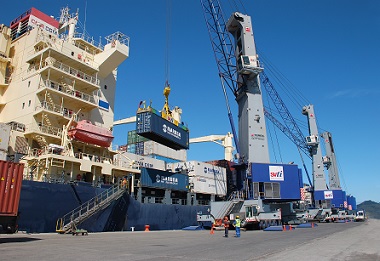
In the past few months, terminal operators from Brazil, Haiti and Sint Maarten have purchased a total of four diesel-electric Terex® Gottwald® mobile harbour cranes – two Model 4 cranes in the G HMK 4406 B four-rope-grab variant and two Model 6 cranes in the G HMK 6507 two-rope-grab variant.

The versatile Model 4 cranes, supplied with mechanical grabs and automatic single-lift spreaders primarily handle coal and load and unload containers in the Brazilian Port of Açu. In the port located to the north of Rio de Janeiro, the machines with a radius up to 46 m, a maximum
lifting capacity of 100 t and a 40-t grab curve, are part of what is currently one of the largest and most advanced port infrastructures in the
world. Since 2012, Açu has played a major role in fast growing Brazilian-Chinese maritime trade. Like all Terex Gottwald mobile harbour cranes
in the four-rope-grab design, the cranes boast a high classification providing a long service life. The cranes also offer high handling rates enabling fast loading and unloading of ships.

The two G HMK 6507 cranes are used in Sint Maarten and Haiti for container and general cargo handling and offer a radius up to 51 m, a maximum lifting capacity of 125 t and hoisting speeds up to 120 m/min. The crane for Sint Maarten will work together with two existing Terex Gottwald mobile harbour cranes in the port of the capital Philipsburg, a hub of maritime trade in the North-East Caribbean. Sint Maarten is an
autonomous part of the Netherlands and geographically the southern part of a Caribbean island. The crane for Haiti is also intended for its capital. This crane will be used in the Port of Port-au-Prince, which was badly destroyed by the earthquake of 2010 and has since been systematically rebuilt. While the G HMK 6507 for Haiti was completely assembled in a North Sea port and is currently en route to its place of operation on a heavy load ship, the G HMK 6507 for Sint Maarten is being assembled on site.

With the four new cranes, TPS is continuing a long-term positive trend in Latin America. Holger Schauer, Regional Sales Manager Harbour Cranes TPS: “We have been on a consistent growth course in Brazil for around 15 years, but also increasingly in other countries in South and Central America. We are pleased to have been selected by another, very ambitious Brazilian customer and to be represented with two additional cranes in the Caribbean. This shows that our technology provides excellent solutions for the diverse requirements of customers in this region of the world.”

DP World Chairman welcomes President Joko Widodoof Indonesia to Jebel Ali Port

0

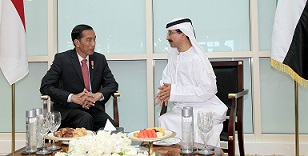
President Widodo and his high-level delegation including Darmin Nasution, Coordinating Minister of Economics of Indonesia, Retno Lestari Priansari Marsud, Indonesian Foreign Minister, Sofyan Djalil, National Development Planning Minister, Pramono Anung, Cabinet Secretary, Thomas Lembong, Minister of Trade and other Indonesian cabinet ministers and diplomats, inspected the technology-driven efficiencies that support the gateway facility – classed as the most productive port in the world by the Journal Of Commerce.

They were accompanied by senior DP World officials including Vice Chairman HE Jamal Majid Bin Thaniah, Senior Vice President and Managing Director, UAE Region, Mohammed Al Muallem, Chief Operating Officer Anil Watts, and William Khoury, Vice President, Director PT Terminal
Petikemas Surabaya, among others.

HE Sultan Ahmed Bin Sulayem, DP Chairman, welcomed President Widodo to the UAE as part of his official visit to Saudi Arabia, the United Arab Emirates and Qatar.

He said: “We are honoured that the President included a visit to our flagship facility Jebel Ali Port in his programme which demonstrates his belief in DP World’s expertise and his focus on boosting Indonesia’s maritime sector.

“DP World is a longtime partner of the Indonesian government through their joint venture in PT. Terminal Petikemas Surabaya (TPS), the largest terminal in Surabaya Tanjung Perak and the second largest in the country. We are committed to our operations there and look forward to cementing our relationships. With our global experience we work closely with our partners to support the development and economic growth of the countries and communities in which we operate. The President’s visit builds on already existing amicable relations and lasting partnerships that benefit both countries.”

HE Bin Sulayem added that Dubai’s trade with Indonesia amounted to AED 3.92 billion in the first six months of 2015.

DP World has managed PT Terminal Petikemas Surabaya (TPS) terminal since its acquisition of P&O in 2006. It is a joint venture with a 51% shareholding held by the state owned company Pelabuhan Pelindo III and 49% held by DP World.

The terminal is located on the northern shore of eastern Java along the edge of Madura Strait and is the gateway to Eastern Indonesia, serving international and domestic trade for a wide-ranging hinterland. By virtue of its geographical location close to cargo catchment areas with good connectivity to the hinterland by sea, rail and direct toll-way access, TPS is ideally located to act as an international and domestic transhipment point for all of North and East Indonesia.

It is an origin and destination cargo container terminal with a 1.8 million TEU capacity and an annual throughput of 1.4 million TEUs.


August TEUs have Port of Virginia tracking 9% ahead of 2014

0

The TEU increase for the month was 2.7 percent above August 2014. During August, truck volume was up .3 percent; rail volume up 3 percent; container volume at Virginia Inland Port up 27 percent; and vehicle units up 94 percent vs. prior year (all categories). “We are entering the peak of the retail season and we are handling the volume with greater efficiency and consistency than we did at this time last year,” said John F. Reinhart, CEO and executive director of the Virginia Port Authority. “We set a record for volume in 2014 (2.5 million TEUs) and we anticipate we’ll set a new mark in calendar year 2015. We have had some difficult moments and continue to face challenges, but each month we continue to get better at handling these increasing monthly volumes.”

Two-thirds of the way through 2015, The Port of Virginia’s TEU volume is 9 percent – 141,000 TEUs – ahead of where it was at the same point last year. On a calendar-year comparison basis, the port grew in both truck and rail volumes, 10 percent and 8 percent, respectively. Moreover, vehicle units were up 60 percent when compared with the same period last year.

“The strategy of investing in people, technology and cargo conveyance equipment that we implemented last year is beginning to show returns,” Reinhart said. “Now our efforts will be to continue to reinvest in all of our areas of operation, make the necessary changes to improve delivery of service, create sustainability and maintain profitability. We are in the early stages of executing a long-term plan to assure those things happen.”

Reinhart estimates that it will take an investment of at least $2 billion over the course of the next decade to provide the necessary infrastructure to increase capacity, remain competitive with its US East Coast peers, cultivate reasonable, sustained growth and contribute to economic development within the Commonwealth.

In May, the Virginia Port Authority Board of Commissioners approved a $135 million capital spending plan and in doing so kick-started the capital reinvestment process. The budget is centered on investing in people, technology, container handling equipment and reinvestment in facilities.

The port started work on the first of those capital projects in July, when it broke ground on the expansion of the North Gate at Norfolk International Terminals, a project that will tie-in to I-564 Intermodal Connector project. Combined, the projects will increase truck velocity through NIT’s north gate, remove a significant amount of daily truck traffic from Norfolk city streets and provide motor carriers with direct, safe access to Interstate 564.