Thursday, December 11, 2025
spot_img
Home Blog Page 440

Necotrans wins bid for multipurpose terminal at Kribi port in Cameroon

0

Located 150 kilometres south of Douala, the new port at Kribi has a draught of 17 metres. The multipurpose terminal conceded by the Government of Cameroon will initially have a quay measuring 265 metres (with 2 berths) equipped with two cranes on rails and six truck mounted cranes. After the official publication of the notification by the Prime Minister and Head of the Government of Cameroon, Philemon Yang, on 26 August, the precise terms of the contract remain to be discussed with the authorities in Cameroon. Estimates point towards a concession of 20 years, investment of 26.2 million euros and licence fees paid to the State of Cameroon by Necotrans/KPMO.

“We are particularly proud to have joined our colleagues from Cameroon in a win-win partnership, and to have gained the trust of the authorities in the country. Kribi is the only deep-water port in Central Africa, and as such is destined to become the economic driving force of Cameroon and the sub-region, especially Chad and Central Africa”, explained Grégory Quérel, Chairman of Necotrans.

After a first phase of fiveyears with an activity estimated at 1.4 million tons of freight per year from the second year, the second phase of 15 years foresees the provision of an adjacent quay measuring 350 metres and complementary facilities and equipment for an activity that will surpass 3 million tons per year.

“Our investment will enable us to increase the pace of handling and the storage zones so that Kribi can be as competitive as possible, complementing the port of Douala”, added Grégory Quérel. The multipurpose terminal at Kribi will provide work for over 250 people. The main goods handled will be vehicles, wood, cotton, mineral ore and Oil & Gas equipment, together with the materials used for the construction of the industrial zone and the future power plant that will be right next to the Kribi port.

.

ICTSI Manila rolls out container booking system

0

. Largely seen as a proactive alternative to counterproductive truck bans, TABS is an electronic platform for booking containers in the two international ports of Manila. Designed to optimize the entry and exit of containerized cargo to and from MICT, TABS was developed in response to restrictive road policies that were introduced to combat the congestion of Manila ports in 2014
as a result of the truck ban imposed by the Manila City Government.

“The implementation of TABS is a move in the right direction. It is the port sector’s contribution to easing road congestion in the Philippine capital by implementing a system that will schedule movements of trucks in and out of the Port,” says Mohamed Ghandar, MICT General Manager.

He continues: “With a booming economy and the ongoing major infrastructure projects in the metropolis comes the issue of road capacity. Movement of trade in the Port of Manila, specifically that of container-handling trucks, has to co-exist with the movement of the commuting public.”

TABS will address the current unpredictable surge of trucks that ply the roads by scheduling the time slots for container pickup and drop-offs.
Truckers can increase their trips per day, cargo owners can move their goods more promptly, and terminals can allocate resources more efficiently due to the predictable volume and schedule.

With the system in place, the Manila port community should expect more organized truck movement and experience a managed and consistent flow of trucks spread across the entire day.

TABS is scheduled for officially launch in October 2015. The soft launch comes ahead of the expected surge in economic productivity in Manila in September as shipments increase in preparation for the holiday season.

The system was made possible through the collaborative efforts of the supply chain stakeholders, the Manila City Government and Australia’s 1-Stop Connections Pty. Ltd.

World's largest port operators join forces for the environment

0

The campaign will take place between 14 – 21 September this year with focus on three main themes: re-use and recycling, climate change and the communities in which the industry giants operate. A range of activities covering all three themes will be organised by the participating port operators’ local business units to tackle and raise awareness globally. The campaign will also identify local partners in the effort to improve
the environment. Creating and upgrading local green spaces, launching educational programmes, adopting waste recycling measures and community engagement are some of the activities that will take place.

DP World Chairman HE Sultan Ahmed Bin Sulayem said:

“Safeguarding the environment is the responsibility of all of us and by joining forces across the industry this initiative will make greater impact
worldwide. International efforts require partnerships to make them a success and by coming together we can all make a sustainable difference in the communities in which we operate. By continuing to focus on our ecosystem using innovation, new technologies and seeking behavioural change, the industry can make a major contribution to the wellbeing of our planet. This campaign is a watershed for marine terminal operators – it marks the beginning of a joint effort to bring about positive change to the lives of our people.” Hutchison Port Holdings Limited Group Managing Director Eric Ip said:

“Sustaining the environment we live is one of the major concerns of the modern world and something no corporation can ignore. Environmental concerns pervade the entire HPH organisation, from the paper in our printers to the cranes in our yards. Riding on the success of last year’s campaign, it is heartening to see the initiative has gone from strength to strength. By putting our efforts together with other major port and maritime industry players for this worthy cause, we hope to lead by example and, in the process, do our bit to create a cleaner, greener world for everyone.”

APM Terminals CEO Kim Fejfer said:

“This is the right thing to do for the environment, for the communities we operate in, and our employees. Working together, we can address the critical issues facing the environment and act as a catalyst for global change.”

Group CEO of PSA International Tan Chong Meng said:

“In the big scheme of moving goods from door to door?, the container terminal operations component is a relatively small contributor of greenhouse
gas emissions. Notwithstanding, PSA continues to devote attention and resources to economising on the use of fuel and promoting recycling across our network of terminals. We are very positive that this joint effort with APM Terminals, DP World, HPH, SIPG
and Port of Rotterdam Authority will act as catalyst to ‘greenify’ our industry, the communities in which we are located, and ultimately the world at
large.”

Shanghai International Port Group Chairman Chen Xuyuan said:

“With Green Port Plan 2020, SIPG are bound to further consolidate what we have achieved as a green innovator all the way
along. Joining forces with DP world, PSA international, HPH and APM terminals, environmental sustainability will be jointly safeguarded as an initiative where Port and Maritime industry can mobilize all their resources to pursue the ideal of green port. Hand in hand, such environmental activities as go green is a substantive step that is to expand the influence we can make on our planet.”

Port of Rotterdam Authority CEO Allard Castelein said:

“It is good to see that the terminal operators are working together internationally to improve the environment. The Port of Rotterdam Authority is
pleased to support this initiative. It is in line with our ambition to make Rotterdam the cleanest port of its type in the world. I hope that the example
set by the terminal operators will not only be followed by port authorities.”

Upturn in container freight at the Port of Gothenburg

0

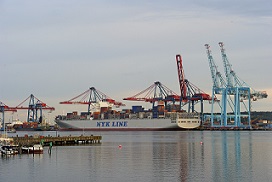
Exports and imports of new cars have also increased. This was revealed in the six-monthly report published today by the Port of Gothenburg. Around 30 per cent of Sweden’s imports and exports are shipped via the Port of Gothenburg. Shifts in the economy are clearly reflected in the flow of goods that pass through the port.

The Port of Gothenburg is the largest port in Sweden for container traffic, accounting for almost 60 per cent of the country’s volumes. The year began with a weak first quarter and a fall of five per cent in the number of containers shipped through the port. Volumes recovered during the
second quarter, ending two per cent up for the period. Some 418,000 containers*passed through the Port of Gothenburg during the first six months of the year.

Magnus KÃ¥restedt, Port of Gothenburg chief executive, said: “The container market has been weak for some time but we could see a
distinct improvement during the second quarter. Not a major improvement, but an improvement nevertheless. Things are looking brighter for Swedish foreign trade, a trend that has carried over into the second half of the year.”

Rise in car exports

Exports and imports of new cars rose by five per cent during the first six months of 2015 compared to the same period last year. The rise can be
attributed to a decision taken by Volvo at the beginning of the year to ship cars bound for Finland, Russia and China via Gothenburg.

Downturn in trailer traffic

So-called ro-ro traffic**, which involves the transport of freight loaded on trailers and trucks, fell by seven per cent compared to the corresponding period last year, closing at 265,000 units. Ro-ro traffic accounts for a large proportion of intra-European freight transport.

“The fall is a direct result of a downturn in the flow of paper between Sweden and Finland,” explained Magnus KÃ¥restedt.

Passenger traffic remained unchanged compared tothe corresponding period in 2014. A total of 769,000 passengers passed through the Port of Gothenburg during the first six months of this year. The vast majority of the passengers travel with Stena Line, which operates daily services to Kiel and Frederikshavn.

Half of all crude oil that enters Sweden does so via the Energy Port in Gothenburg. It is the largest energy port in the Nordic region with several
refineries and depot companies that refine and store crude oil into diesel, petrol and other oil-based products.

Oil and energy products have increased by seven percent. The mid-year figure was 9.8 million tonnes compared to 9.1 million
tonnes last year.