

Monday, December 8, 2025
spot_img
Home Blog Page 447

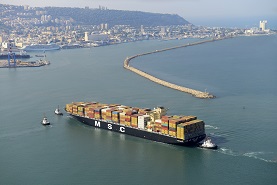
Giant Shipping Alliance 2M comes to Israel for the first time at Haifa Port

0

At 367 meters in length, with a maximum capacity of more than 10,000 TEU, the Gustav will be the largest container ship ever to dock at an Israeli port.
The 2M Alliance alliance was formed between the world’s two largest shipping companies: Maersk and MSC. The ship call represents the dawn of a new era for East Asian imports to Israel – Israel’s largest and most important trade route aside from Western Europe. According to the Israel Shipping & Ports Authority, these imports will total more than 200,000 containers annually once the 2M Alliance’s ships begin to call at Haifa Port on a weekly basis. The choice of Haifa Port as a port of call for the Alliance’s ships is no simple coincidence, as the port has already demonstrated the meticulous adherence to schedules and operational efficiency required by the Maersk and MSC managements, including a high average productivity of 30 containers per crane hour.

A month ago, Haifa Port set an all-time record for productivity during one shift – record output of 318.8 containers per ship hour was achieved by the Carmel Terminal’s six STS cranes, which were assigned to operate on the ZIM Los Angeles. All six cranes attained excellent productivity during the same shift, with the record for a single crane also being broken when the crew operating crane G21 averaged 74.7 containers per crane hour.

At the time these new records were set, Haifa Port CEO Mendi Zaltzman commented: “We welcome any opportunity to demonstrate our
outstanding capabilities to shipping line decision makers worldwide.” Today, the management of the Maersk/MSC Alliance announced
that it would indeed give the port this opportunity. From the beginning of October, the ships of the AE12TP2 line will begin calling at Haifa Port.
This line runs from the port of Busan in South Korea, through Shanghai, Ningbo, Chiwan, and Singapore, and from there to Port Said and Haifa Port. After calling at Haifa, the line’s ships continue on to several ports in the Adriatic: Koper (Slovenia), Trieste (Italy), and Rijeka (Croatia).

Mendi Zaltzman, Haifa Port CEO: “We are very proud of the fact we have been selected, and we are already preparing to accommodate this line in cooperation with other parties such as the Customs Authority and the cargo division of Israel Railways, so that we can provide the very best services to the shipping companies as well as importers and exporters. This is a great challenge for Haifa Port and all its workers. In recent years we have prepared ourselves to take on these challenges, and we have won full global recognition for this terminal’s ability to uphold the highest international standards.”

This selection and recognition by the 2M Alliance comes on top of Haifa Port’s other recent achievements: in April, Haifa Port won the “Community Impact” category in the global ports competition held by the technology giant Navis. This put the port on the same stage as the
major ports that won other categories: a terminal operated by APM Terminals; the UAE’s biggest terminal, Jebel Ali, which is run by DP World; and a New York terminal run by Global Container Terminals.


Liebherr mobile harbour cranes in over 100 countries

0

In 1974, the first year in the mobile harbour crane business, Liebherr delivered cranes to three countries in Europe. In 2014 alone, customers based in 35 countries across the globe opted for Liebherr mobile harbour cranes (LHM). Recently, three new countries have joined the reference list: Haiti,
Suriname and Luxemburg. In total, Spain is in the lead regarding deliveries per country. Since 1998, at least one mobile harbour crane per year has been supplied to a Spanish port, reaching a peak in 2007 and 2008 with even 13 deliveries per year. In total, Liebherr has delivered more than 100 units to Spain.

First deliveries to Haiti

A newly built port in the Caribbean is the first Liebherr mobile harbour crane customer in Haiti. In June 2015, Port Lafito received its first mobile harbour cranes. The port opted for two LHM 420s. With hoisting and lowering speeds of up to 120 metres per minute, each crane provides a capacity of more than 30 boxes per hour. To ensure efficient utilization, both cranes are equipped with Liebherr’s fleet management system LiDAT. The system allows for crane performance monitoring and key statistics analysis in order to ensure optimum turnover. Additionally, crane drivers benefit from simulation-based training programs which are offered in the Liebherr maritime training centre in Miami, USA.

Surinamese port chooses Liebherr

N.V. VSH Transport is based in Paramaribo, the capital of Suriname. The stevedoring company provides a wide range of services to its customers. In summer 2015, Liebherr delivered its first mobile harbour crane to the Port of Paramaribo which allows for more flexibility in cargo handling. The main task of the LHM 280 is container handling. Moreover, the crane is designed for efficient bulk and general cargo operations.

Luxport goes for LHM 420

In Europe, Luxport S.A. in Luxemburg opted for their first Liebherr mobile harbour crane. The LHM 420 started operation in Port de Mertert at the turn of the year. Equipped with a 124 tonnes winch and a 48 metres boom, the main task of the new machine is general cargo handling. Luxport decided to install the Vertical Line Finder. This Liebherr system supports the driver in avoiding inclined lifting and ensures that the load is perfectly vertical. This also prevents the load from swinging and provides greater safety. As a result, the system prolongs the lifetime of the crane. In addition to the new LHM, Luxport ordered a Liebherr reachstacker for its port operation.

With the LHM 420 for Luxport, Liebherr completes Benelux in regard to deliveries. For many years, Liebherr has been very successful in terms of
mobile harbour cranes in Belgium and the Netherlands. Finally, the first delivery for Luxemburg ensures that each of the Benelux countries benefits from the unique performance of Liebherr port equipment.

More potential for LHMs

A lot of new customers have opted for mobile harbour cranes over the last few years. The flexibility of this cargo handling solution is highly
demanded in fast developing economies. Therefore, in the near future, Liebherr expects more first-time deliveries to countries which have not yet used mobile harbour cranes.

Photo – The LHM 420 allows for highly efficient cargo handling in
Haiti and Luxemburg.

Major Taiwanese dredging contract for Van Oord

0

The client is the Port of Kaohsiung, Taiwan International Ports Corporation (TIPC). The contract value amounts to approximately EUR 130 million. The preparations have already started and the execution period runs until January 2018. The project involves the dredging and reclamation of 37 million m3 of sand for the extension of Kaohsiung Port. Van Oord will deploy one of its largest trailing suction hopper dredgers. Kaohsiung, located on the South China Sea, is the largest Taiwanese port and plays an important role in the Taiwanese export-oriented economy.

Long Beach sets cargo record

0

Previously, the Port’s best year was 2007, just before the Great Recession of 2008. Now, after a slow start at the beginning of 2015, the gains in July mark the fourth time in the last five months that cargo totals have climbed significantly higher.

The Port’s terminals moved 690,244 twenty-foot equivalent container units (TEUs) in July, an increase of 18.4 percent compared to July 2014. Imports jumped to 345,912 TEUs, a 16.2 percent increase from last July. Exports increased an impressive 15.9 percent to 143,875 TEUs despite the stronger U.S. dollar, which has made U.S. exports relatively expensive overseas.

“These exceptional results are great news for Long Beach and the nation’s economy,” said Port Chief Executive Officer Jon Slangerup. “We’ve worked closely with all of our stakeholders to prepare for our peak season, which is off to a great start with very strong back-to-school shipments and our best export month in a year. We applaud our partners for their role in these impressive results.”

July makes the fourth time in five months that the Port has seen import gains – July (18.4 percent), May (4.8 percent), April (7.3 percent), and March (42.1 percent) – an indication that the U.S. economy is growing, and the stronger dollar is giving retailers the confidence to order more products from overseas to stock their shelves for consumers. The National Retail Federation foresees at least 3 to 5 percent gains for the back-to-school and early holiday shopping seasons.

Through the first seven months of 2015, Long Beach cargo numbers are edging higher, with total cargo up 2.8 percent compared to the same period last year, imports up 1.4 percent and exports down 10.9 percent. Summer has been strong for Long Beach preparing us for the traditional fall peak.

With an ongoing $4 billion capital improvement program this decade to modernize and expand its facilities, the Port of Long Beach continues to invest in long-term, environmentally sustainable growth.