
Monday, December 8, 2025
spot_img
Home Blog Page 452

SCCT prepares for expanded Canal traffic growth

0

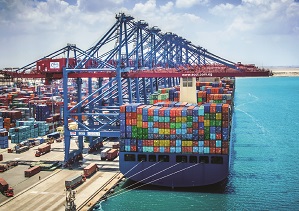
Four additional Super-Post-Panamax cranes scheduled for delivery to the terminal in mid-2016 will bring SCCT’s crane total to 24, increasing the terminal’s annual throughput capacity to 5.4 million TEU, and making it the largest container terminal by capacity on the Mediterranean Sea. “As one of the world’s most important waterways, the expanded Suez Canal will play an even greater role as a gateway of global trade, and we are proud to be a part of that ongoing progress for Port Said East, the people of Egypt, and the global shipping industry” said APM Terminals’ Chief Operating Officer Jeff De Best, who attended the official Suez Canal expansion opening ceremonies held August 6th.

APM Terminals is the majority shareholder in SCCT, with a 55% ownership. Other shareholders include Chinese-based COSCO Pacific, with 20%, the Suez Canal Authority, with 10.3%, and the National Bank of Egypt, with 5%. The remaining shares are held by the Egyptian private sector. Over USD $800 million has been invested in the terminal, which opened in October 2004, and has become one of the busiest container facilities in the region, handling 3.5 million TEU, primarily for transhipment, in 2014.

Approximately one tenth of all global seaborne trade transits the Suez Canal, representing 18,000 vessels transiting annually, including container ships. The new STS cranes, representing an investment of USD 42 million will each have a 72 meter reach, and a height of 52 meters, with the ability to handle the world’s largest vessels now entering the global fleet. There are currently 29 vessels of 18,000 TEU capacity and above in service, with another 68 on order, deployed on the Far East/Europe trade lane, the world’s busiest. SCCT is the only container terminal in Egypt capable of working vessels of that size, and highlighting the importance of the terminal as a global and regional trans-shipment hub.

“The canal expansion, completed in just one year, is a great achievement for the people of Egypt, and we are hopeful that the planned construction of more infrastructure projects will enable even faster canal cargo volume growth and economic progress”, added Mr. De Best.
Advanced berthing system in Long Beach greets first Panamax Bulk Carrier

0

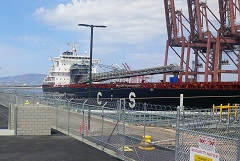
The berthing system developed by the team for Eagle Rock Aggregates includes two stifflegs supported by match-cast, post-tensioned floating concrete platforms. The legs position the self-unloading bulk carrier and provide a load path to bearing walls at the top of the bank. The legs also support a walkway for vessel line handling and pilot access to the buoyancy float.

CSL Tecumseh arrived at the berth on the morning of July 19th. Polaris Materials, President and CEO, Herb Wilson reported the ship’s pilot and crew were impressed by the strength of the stifflegs and how easy line handling was at the new berth. Polaris Materials is the parent company of Eagle Rock Aggregates.

“The stiffleg system utilized at D44 delivered ship berthing and mooring at a fraction of the cost of a conventional pile supported facility,” shared, Mark Mattila, Vice President of Ports and Marine for Seabulk. “For clients where project capital cost is important, this solution may be of interest. Different versions of the stiffleg system have been designed for bulk carriers and barges discharged by front end loaders.”

Additional features and benefits of the system include minimal overwater coverage, pre-fabrication of components for quick and easy marine installation, and the absence of marine pile driving reduces costs and is an ecological benefit.

Mattila added, “Bellingham Marine’s concrete buoyancy floats mesh beautifully with the design and provide requisite buoyancy and deadweight for the system to work.”

As the world’s leading marina design-build construction company, Bellingham Marine specializes in floating dock, floating platform and floating wave attenuation systems for marinas worldwide. The company also produces dry storage systems for the upland storage of boats.

Global provider of innovative solutions in the marine bulk industry for the delivery of cargo from producer to end user, Seabulk specializes in the development of onshore and offshore installations for dry bulk and liquid bulk handling.

First Yemen aid ship under ESCGS protection

0

ESC Global Security (ESCGS), one of the world’s leading independent security consultants, was chosen by shipping agents to protect Han Zhi, which was chartered by the UNHRO to deliver vital supplies to Yemen.

The ship docked in the devastated port city of Aden with ESCGS personnel onboard ensuring the safety of the crew and cargo during the offloading and the UN food agency described the arrival as a “major breakthrough” since the internal war in Yemen began in March. The UN’s World Food Programme (WFP), which chartered the ship, had tried repeatedly in past weeks to deliver aid to the war-torn city but failed because of security concerns.

Early in July a humanitarian ceasefire was declared by the UN but failed to hold and the World Food Programme recently described the truce as the “final hope” to deliver desperately needed aid. With the region just “one step away from famine” according to the UN, ESC Global Security was appointed to protect the ship on the hazardous journey into Aden.

Jaanus Rahumägi, CEO of ESC Global Security, believes the deployment of armed security was vital to ensure the safe delivery of these vital food supplies and medicines.

“The internal conflict in Yemen and the dangerous conditions for shipping arriving in Aden was the driving factor in ESC Global Security being contracted to protect the ship. We understood the risks, defined the parameters for our armed security operations and put into practice highly trained and experienced personnel to accompany the ship into Aden.

“Each operation is significantly different from others but we understand the needs of the maritime industry in protecting not only vessels and crew, but also the cargoes and dockside operations surrounding such ventures. Our prime concerns are safety and operational integrity. In this case it required confidence and experience which we provided for the ultimate benefit of thousands of desperate people in Yemen.”

Maersk welcomes Suez Canal expansion

0

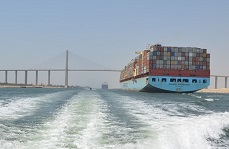
Egypt has all through the 20th and 21st century acted as the bridge between Europe and Asia thereby enabling global trade and growth. From 2004 to 2014 container volumes transported via the Suez Canal has grown around 70% and the expansion confirms the Suez Canal Authority’s continuous commitment to accommodating growth in trade. Maersk Group representative and CEO of Maersk Drilling, Claus V. Hemmingsen will participate in the official opening of the Suez Canal today along with COO of Maersk Line, Søren Toft.

“The Suez Canal is a key corridor on the East/West trade. Maersk has used the corridor for more than 90 years and we welcome the easier transit and reduced transit times that the new expansion will bring,” says Maersk Group representative and CEO of Maersk Drilling Claus V. Hemmingsen.

The Suez Canal accounts for roughly 7.5% of world sea trade and container vessels account for over 50% of the canal’s tonnage passage. Maersk Line contributes with 20% of the container transits, and virtually all Maersk Line’s Asia-Europe cargo goes through the Canal. This includes everything from Chinese textiles and Indian Basmati Rice to German machinery or French wine passing through the Suez Canal.

“The extension will enable larger vessels to transit, benefitting not only the shipping companies, but also our partners and world trade as a whole,” says Claus V. Hemmingsen.

Prior to the extension, the southbound transit took 18 hours and the northbound took 11 hours. After today’s opening of the extension, both ways will only take 11 hours. With the current expansion the next generation of vessels should also be able to transit safely and without delay.

“The development in the number of transits through the canal underscores the need of having a canal that guarantees quick passage both ways and helps relieve bottlenecks, accommodating growth in trade and vessel sizes – an effort we welcome from all our partners and suppliers,” says Claus V. Hemmingsen.