

Wednesday, December 10, 2025
spot_img
Home Blog Page 454

TT Club warns of liability issues due to Calais crisis

0

The problem of illegal immigrants entering Western Europe has been a geopolitical issue for several years. Thus far in 2015 it is widely reported that there have been in excess of 37,000 attempts by immigrants to cross from France to England, the vast majority via Calais.

The commercial reality of the situation is highly damaging both for the local economies and the freight industry, the use of which unfortunately appears to be the preferred means of cross border movement. Substantial delays and property damage have ensued; the FTA (UK’s Freight Transport Association) estimates the cost to the industry to be £750,000 per day.

Are these costs to be augmented by operator’s liability for loss and damage to cargo? The action of breaking a cargo unit’s seal immediately brings into question the integrity of the cargo, but even minor human ingress will physically damage cargo. There have been reports of up to 30 people entering a single freight container. When cargo is intended for human consumption the result frequently is that the receiver will simply reject the entire cargo exposing the freight  operator to significant claims as well as the costs of destruction and disposal. Furthermore, there are fines of £2,000 per immigrant discovered, which, subject to an appeal process, will be imposed on the driver and freight operator.

As far as cargo claims are concerned most shipments by road into the UK are subject to the Convention on the Contract for the International Carriage of Goods by Road 1965 (CMR). The Convention foresees such ‘unpreventable’ cases with the provision that protects the operator ‘in circumstances which the carrier could not avoid and the consequences of which he was unable to prevent’. However, successful defence of a claim is dependent on the circumstances and differing jurisdictional approaches.

So how can operators take preventative steps to help defend such claims and avoid fines?

It is essential not only to have a system in place but also to demonstrate that it is effective.

• Provide written procedures and instructions to all drivers, highlighting the risks.
• Provide robust security measures and devices to secure the vehicle, trailer and cargo.
• Provide all drivers with a security check list
• Provide training to all drivers on the above
• Closely monitor all drivers to ensure compliance.
• Regular checks of the vehicle, trailer and cargo, creating an audit trail.

The UK Border Force has published a document outlying 10 steps to avoiding a fine which can be found in several languages at: https://www.gov.uk/government/publications/guidance-for-hauliers-on-preventing-clandestine-entrants

Applying sound practice, adequate training, use of security devices and regular checking procedures will help reduce exposures. Where an incident has occurred, however decisive early action to involve insurers and experts could result in mitigating the potential cargo claim and saving a portion of the cargo.
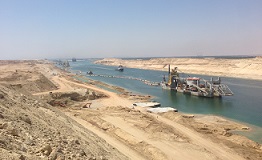
Jan De Nul Group executed a third of all works at the Suez Canal

0

The project was a challenge because of its size but above all because of the very tight deadline. To complete such a project in less than twelve months is unprecedented.

“The only way to realize this project was for us dredgers to join forces,” J.P.J. De Nul continues.” In all, six dredging companies participated in the project, divided over two joint ventures. Still, we had the larger share of the dredging works. This is only logical as thanks to our major investments over the past ten years, we now have the biggest and most powerful cutter fleet in the world. As the soil mainly consists of compacted sand, alternated at some places by rigid clay, this was just the type of vessel that was required for the job.”

Shortest shipping route
The Suez Canal is the shortest shipping route between Europe and Asia and is about 170 km long. In order to increase the capacity of the canal and expand the industrial activity in the region, the canal was doubled over a length of 50 km. Hence, the distance over which vessels can cross each other becomes considerably longer, thus seriously reducing the waiting periods. The work was divided into 5 contract lots and awarded to two joint ventures. The joint venture Jan De Nul Group was part of, carried out lots 2 up to 5 of the contract or 200 out of a total of 250 million m³ of dredging works. The other joint venture did the rest.

For this project, Jan De Nul Group mobilised seven cutter suction dredgers, namely J.F.J. De Nul, Hondius, Kaerius, Fernão de Magalhães, Ibn Battuta, Leonardo da Vinci and Zheng He. The cutter suction dredgers have a total installed diesel power of 134,720 KW.

We employed about 2,000 people, about half of which was local and the other half European.

Port of Saipan update – Typhoon Soudelor

0

As a result of the restrictions, the Port of Saipan will accept vessels during daytime hours from Friday 7 August, with no docking and undocking before sunrise and after sunset. Until further notice, port operations for loading and unloading operations will also occur during daytime hours only. The restrictions apply to all types of vessel.

Typhoon Soudelor hit Saipan on Sunday 2 August – the first time a typhoon has hit the island since 1968. The island still has no water or electricity and a state of Major Disaster and Significant Emergency has been declared for Saipan, Tinian, Rota and the Northern Islands. Saipan is the largest of the Northern Mariana Islands in the western Pacific Ocean, a commonwealth of the United States.

ISS Guam will continue to monitor developments and keep its clients updated.

Unprecedented demand and record delivery times boost Konecranes in the UK

0

Nigel Richardson, Divisional Sales Manager says: “We’re seeing unprecedented demand for machines at the heavier end of the spectrum, particularly from customers in the ports and rail freight sector,” consequently sales of Konecranes lift trucks are enjoying a boost.

So far Impact Handling has soldseveral Konecranes forklifts, and an Empty Container Handler was delivered to Leeds-based freight services specialist Northern Containers in a record 10 days. Patrick Coghlan, Managing Director at Northern Containers, says “We’ve had previous experience with Konecranes, and the quality and reliability of the machines really impressed us. With our fleet in constant use, maximizing uptime is a top priority. This new truck sets the benchmark for build quality, and we have full confidence in Impact Handling’s team to deliver first-class technical support over a long life in service.”

Of Konecranes’ performance in the UK, Lars Fredin, Senior Vice-President and Head of Konecranes Lift Trucks says, “The UK market isimportant, and there is a large number of Konecranes lift trucks in operation there. In Impact Handling we have a stable, energetic and empowered distributor that provides the support and service our customers expect. With Impact Handling as our official UK distributor, we find ourselves very confident of the future”

Impact Handling is a full-service Konecranes Lift Trucks dealer, with depots strategically placed throughout the UK and Ireland. Their aftersales service includes a fleet of mobile engineers with fully stocked service vans, and focus on swift parts supply; their comprehensive rental offering means customers need experience next to no down time.

Lift trucks for delivery to the UK have TRUCONNECT® on-board. The TRUCONNECT® Remote Monitoring service enables the customers to track the real usage of their lift trucks. It provides them with an online view as well as periodic PDF and Excel reports that illustrate the actual use of the lift trucks. The purpose of TRUCONNECT® is to provide the customer with information on which to base confident decisions on.