

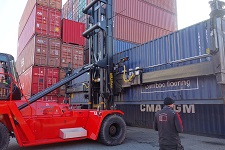
Increasing recurring costs, such as salaries and fuel, add pressure to empty container depot operators, who are constantly looking for new logistics solutions to further optimise operations.
With the Hyster Checker Device, containers can be firmly locked in place at a height of 1.9 metres. This allows the checker to inspect the containers thoroughly for damage from all sides. The advantage of this is that the container no longer needs to be set down for inspection.
“This cuts out a stage from the procedure and saves time, which significantly increases the efficiency of our operation,” says Dr. Roland Karnbach, Managing Director of HCS. “The only way for us to stay competitive is by systematically optimising all costs.”
It was on Dr. Karnbach’s suggestion that Hyster set about designing the new retaining device for containers. The Hyster Special Engineering Department (SPED) in Nijmegen, the Netherlands, developed the innovative solution for empty container handler inspections in under two years.
New Hyster innovation ready for market launch
Hyster first conducted a series of experiments by fitting several machines with the Checker Device for HCS at its big trucks production site in Nijmegen. Hydraulic supports were welded directly onto the mast. These supports can be extended at the touch of a button and then locked to keep both the spreader and the container in place. A traffic light and an acoustic warning signal indicate to the checker that the spreader is fixed and the container stabilised. While in this ‘inspection position’, the driver can no longer move the container handler, which allows the checker to inspect all sides of the containers with ease.
Hyster has since developed this innovative system to market launch stage, and has now delivered the first two H22XM-12EC empty container handlers to HCS. The robust container handlers with Checker Devices have been used in everyday operation since November 2014. The company, which employs a workforce of 60, is planning to fit all its container handlers with the new system in the near future. HCS is receiving technical support from the experienced Hamburg Hyster dealer NORGATEC, which is also providing a full service for each of the specially equipped container handlers.
Taking customer needs seriously
“We are designing our new systems and solutions precisely according to our customers’ wishes,” says Norbert Brünell, Senior Product Strategy Manager Big Trucks EMEA at Hyster in Nijmegen, Netherlands. “Our close relationships with our customers and direct knowledge of container handling equipment manufacturing for the German market enable us to make innovations very quickly and precisely.” Hyster is the only materials handling equipment manufacturer to have developed its own solution -the Checker Device- for the inspection of 20 and 40 ft sea containers. Rather than producing an attachment, Hyster has provided equipment that is fixed directly onto the mast. “The priority for Hyster is always to increase productivity through the use of its materials handling equipment and to reduce overall operating costs,” says Brünell. The two new Hyster empty container handlers fitted with the Checker Device at HCS conform to Stage IIIB emissions regulations. The next generation of container handlers for the Hamburg-based company will be equipped with Cummins engines and exhaust systems in conformity with Stage IV. Their fuel consumption will be up to 20 percent lower than that of older models and their CO2 emissions will be further reduced as a result.
Container handler operating costs further reduced
The fuel savings and optimised productivity are really paying off for HCS. Around 500 containers arrive at the company’s site near the port of Hamburg every day. The containers are delivered directly to HCS on trucks, trains and ships from six o’clock in the morning onwards. The Hyster empty container handlers then take over the handling of the containers within the depot.
The three storage areas at HCS have a total capacity of over 13,000 TEU -almost enough to fill a large container ship. As soon as they arrive, the empty containers are visually inspected by the checkers and examined for damage.
If repairs or cleaning are required, this can be more accurately assessed by the checker directly at the storage site, using the empty container handler fitted with the Checker Device. Minor faults, such as damage to the doors or the interior, are then repaired immediately on site, or the container is transported to one of two repair zones.
For Dr. Karnbach, the new system is ideal: “The solutions that Hyster offers us are perfectly tailored to every requirement, and they will continue to keep us one step ahead of our competitors in the future.”