
Wednesday, December 10, 2025
spot_img
Home Blog Page 460

Abu Dhabi Terminals achieved berth productivity of 206 moves per hour

0

An operational productivity metric and record of 206 Berth Moves per Hour (BMPH) at an average of 46.38 Gross Moves per Hour (GMPH) was achieved during her port stay.

This is the first time ADT has crossed the important benchmark of 200 berth moves per hour; achieving and maintaining these high levels of productivity is one of the key value drivers for both the shipping lines and port operator in order to maximize efficiencies and increase terminal throughput and capacity.

“This productivity record is the result of excellent collaboration and planning by both CMA CGM and ADT operational teams. KPCT ranks among the top five in Europe, Middle East and Africa with regards to port productivity and this record expresses continued confidence in ADT’s ability to perform and maximize value for our customers,” said Simon Brebner, Chief Commercial Officer at ADT.

Claude Lebel, Senior Vice President at CMA CGM Gulf Regional Office in Dubai commented: ”Fast turnaround is essential for our ships and Abu Dhabi Khalifa Port has set their new record moving 206 units per hour allowing our vessel to be completed in 13 hours. This is our third call for this new service and a good cooperation with ADT can only improve the service we render our customers.”

The productivity is evident from the volumes that are increasing year-on-year at KPCT. The total number of TEU handled by ADT during the first 6 months of 2015 increased by 36% compared to same period in 2014.

As a terminal operator that places safety and operational efficiency as its priority, ADT continuously invests in state-of-the-art IT systems and port-centric logistics solutions. By mid-2016 ADT will enhance its terminal handling capabilities to 2.5 million TEUs by adding three new Super Post Panamax cranes.
Extra Irish Sea 'hub' route improves shipping options via Liverpool

0

The new service will improve the options for overseas firms importing from the northern half of the UK, whether directly via the Port of Liverpool or through Rotterdam.

BG Freight currently handles around 650,000 TEU annually. The new Greenock service is expected to add an initial 4,000 TEU per year. The service is also expected to carry around 3,000 empty TEU allowing for more efficient repositioning for shipping lines in Scotland.

Koert Luitwieler, CEO BG Freight Line and Shipping Director PPG said: “The combination of our port network, our existing feeder services and this new route allows us to provide international traders with a way to minimise costs, carbon emissions and congestion. As well as helping to meet increasing demand now, the extra option we can now offer importers and exporters will complement the Liverpool2 container terminal that will open in December this year.”

Peter Samuels, Category Manager Global Freight, Diageo said: “We are very supportive of this new service as it offers an efficient short-sea logistics connection out of the west coast of Scotland into deep sea hubs such as Liverpool.”

Vessels on the route, with a capacity of 1000 TEU, will sail in a ‘butterfly’ schedule.

New inland terminal to open in 2018

0

“This new inland terminal will open the door for economic opportunity and job creation for Northwest Georgia and the region,” said Gov. Deal. “By providing a direct link to the Port of Savannah, the Appalachian Regional Port will create and expand international markets for businesses, and further the economic success of the Southeastern U.S.”

Murray County Commissioner Brittany Pittman said the inland terminal is also a big win for economic development in her area.

“I am excited to see this project come to fruition,” Pittman said. “The inland port will provide important competitive advantages to our existing industries. This development will also bring new jobs to Murray County, not only in logistics, but in support industries and the broader community.”

Operated by the Georgia Ports Authority, the Appalachian Regional Port will deliver goods more efficiently to the GPA’s Garden City Terminal, the second busiest container port on the East Coast behind New York-New Jersey.

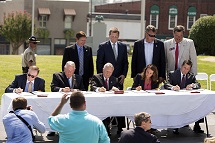
“The public-private partnership established today, which includes direct rail access to the new inland port, will expand access for domestic and international shippers, providing increased options for cost-effective, environmentally friendly transportation services,” said Clarence Gooden, executive vice president and chief commercial officer of CSX.

Port officials estimate the CSX rail route will reduce Atlanta truck traffic by 40,000 moves annually, creating a new intermodal option to and from the deepwater Port of Savannah. Each container moved by rail to the Appalachian Regional Port will offset 355 truck miles on Georgia highways.

“This new inland port is located in an industrial belt, which includes the production and export of carpet and flooring, automobiles and tires,” said GPA Executive Director Curtis Foltz. “The Appalachian Regional Port will make those commodities more competitive in the global market by saving port customers money on inland transit costs. Moving more containers to rail will also reduce carbon emissions.”

The Appalachian Regional Port will be Georgia’s second facility of this kind. In 2013, Gov. Deal, Cordele Intermodal Services and the GPA signed a memorandum of understanding for the Cordele Inland Port. The Cordele facility handles cotton, clay, lumber and other agribusiness exports for customers in Georgia, Alabama and Florida.

“As part of our Network Georgia initiative, we intend to collaborate with communities and transportation partners for the development of future sites,” said GPA Board Chairman James Walters. “Our goal is to create the largest inland intermodal complex in the eastern third of the U.S., expanding our reach with more economical shipping alternatives for new and existing customers.”

The new inland port will sit on 42 acres in Northwest Georgia’s Murray County and feature on-terminal rail. The site is adjacent to U.S. 411 and features easy access to Interstate 75. The facility will handle import, export and domestic cargo.

The Appalachian Regional Port will open by 2018 with an annual capacity of 50,000 containers. A 10-year development plan will then double that capacity.

BTP reaches 1 million containers and ship #1000

0

The facility, a joint venture between APM Terminals and Terminal Investment Limited, has handled container number 1 million, discharged on its quay from vessel no. 1000 to berth at its facility on Friday, 24 July.

This was achieved only one year and eight months after operations officially began at this terminal. Authorities and executives of BTP together watched the offloading of the container from MSC Agrigento, a vessel on the Ipanema service, arriving from Durban, South Africa.

This milestone follows a number of other impressive achievements in terms of operational performance.

BTP’s highest monthly average productivity per crane was achieved in May, with 34.11 moves per hour on the ship-to-shore cranes.

In addition to BTP’s increasing productivity rate, the terminal has also achieved to get the truck cycle – a critical measure for the performance of every container facility – down to only 40 minutes from pre-gate to gate out.

“Our employees have worked increasingly closely with our customers, seeking integrated solutions to improve our processes and increase the quality level of services provided” explains Cláudio Oliveira, CCO of BTP. “These efficiency milestones can, above all, be attributed to the BTP team’s dedicated work”.

In the first half of this year BTP handled 363,921 TEUs, a 167% increase over the number of containers handled in the same period in 2014 thanks to the dredging of the navigation channel which has increased the depth in the access channel to the same level all over, removing obstacles for larger ships to call.

“The Brazilian Ministry of Ports, the Santos Port Authority and other bodies involved in dredging also all played an essential role in the achievement of the two milestones we are celebrating today,” said CEO of BTP, Antonio Passaro.

BTP welcomed its first commercial vessel call in August 2013 and was officially opened in November 2013 after the planned berthing access and basin dredging was completed.

In 2010, APM Terminals finalized a joint venture agreement with Terminal Investment Limited, assuming a 50% share of ownership and jointly managing the facility. The 121 acre terminal offers a 15 meter depth, and 1,108 meters of quay which can accommodate up to three vessels of 9,200 TEU capacity simultaneously.

The terminal is equipped with eight Ship-to-Shore cranes, 26 RTGs, 40 terminal trucks and a semi-automated 16 lane gate. Container volume at the Port of Santos, which represents approximately 27% of Brazilian foreign trade, was 3.7 million TEUs in 2014. BTP handled 736,711 TEUs in its first full year of operations in 2014.