
Monday, December 8, 2025
spot_img
Home Blog Page 461

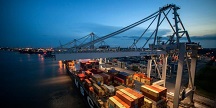
GPA achieves record TEU, tonnage, rail and Ro/Ro in FY15

0

“The deepwater ports of Savannah and Brunswick are cornerstones of Georgia’s success, and major factors in creating new jobs and prosperity across the state,” said Georgia Governor Nathan Deal. “The wave of economic impact created by our logistics network supports virtually every industry, from manufacturing and agriculture to mining, distribution, technology and transportation.”

Strong performances across business sectors also led to records in total tonnage and roll-on/roll-off cargo in the year ending June 30.

“Georgia’s ports have seen phenomenal growth over the past fiscal year, due to a combination of West Coast cargo diversions, U.S. economic recovery and regional gateway shifts placing more demands on Georgia’s terminals,” said GPA Executive Director Curtis Foltz. “Our people and our infrastructure rose to meet that demand flawlessly, handling record volumes while maintaining world-class customer service.”

The 3.66 million TEUs crossing Savannah’s docks in FY2015 constitutes a 17 percent increase compared to the previous fiscal year. FY2014 was the first year in which GPA moved more than 3 million TEUs.

“Part of ensuring reliability is investing in port infrastructure,” GPA Board Chairman James Walters said. “Our development plans will follow our current practice of maintaining capacity at least 20 percent above demand – not only in Brunswick, but in Savannah, where we are buying four new ship-to-shore cranes and 30 more gantry cranes. Investments such as these will enable GPA to handle expanding cargo volumes both now and in the future.”

Total tonnage in FY2015, reached a record 31.69 million tons, up 7.8 percent or 2.29 million tons. Of that amount, containerized cargo accounted for 25.89 million tons, also up 7.8 percent or 1.86 million tons more than in FY2014.

Fiscal 2015 also saw the highest-ever volume of intermodal rail moves. The Port of Savannah moved 369,347 containers by rail in FY2015, up from the previous record of 332,996 containers set in FY2014. The growing volumes moved by rail resulted in an increase of 10.9 percent or 36,351 containers for the year.

In other cargo sectors, the GPA achieved an 8.1 percent improvement in bulk cargo tonnage for a total of 2.95 million tons, an increase of 221,601 tons. GPA terminals moved 7.6 percent (200,875 tons) more breakbulk cargo in FY2015 than in the previous year. Total breakbulk, which includes commodities such as paper, rubber and steel, reached 2.83 million tons.

The GPA moved more autos and machinery than ever in the year just ended. Combined, Brunswick and Savannah moved 714,021 units of roll-on/roll-off cargo, an improvement of 13,313 units or 1.9 percent. Of the total, Brunswick handled 680,427 units.
Korea unveils plans to create major trans-shipment port at Busan

0

In recent years trans-shipment cargo at Busan has grown by 10% (average) year-on-year while local cargo has increased by 4.2%. In 2014, trans-shipment activities overtook local cargo operations for the first time in the port’s history with trans-shipment accounting for 50.5% (9.43 million TEU) up from 31.7% in 2000.

Taking a lead from this success, the Korean government and BPA are implementing concrete plans to consolidate and strengthen Busan’s position as a global trans-shipment hub.

The first step is to integrate container handling activities currently undertaken at North Port and New Port into a single New Port location. This will also include the creation of eight new berths at New Port by 2020 – these will add a further 6.21 million TEU capacity. Added to this, a feasibility study will investigate further expansion to the western container terminal at New Port.

In addition, a feeder terminal for intra-Asian carriers will be created to serve the feeder network within the port.

Meeting the demands for ever-growing container ships, the current program of dredging to a depth of 17m will be completed ahead of  schedule in March 2017. Todo Island, currently situated in the port entrance, will be removed by 2019 and the entrance itself will be expanded by the end of 2018.

State-of-the-art, power-efficient container cranes and transfer cranes will be installed in the new facilities and the existing yard tractors will switch from oil power to electricity. This is expected to reduce CO2 emissions by 42%.

For the efficient transfer of trans-shipment containers, the current multi-purpose terminal sited between the north and south container terminals will be replaced by a yard tractor shuttle road and storage area. The multi-purpose terminal will be relocated elsewhere. A new port-wide ITT platform will control all container movements.

To generate economies of scale and to facilitate these new arrangements, the four existing terminal operators at North Terminal will form a new unified joint venture company with BPA taking a shareholding.

By integrating all container handling at New Port, it gives North Port the opportunity to develop into a new maritime cluster accommodating maritime manufacturing, marinas, cruise terminals and other facilities – this is being progressed.

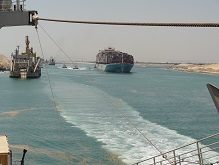
First vessels sailing through new Suez Canal

0

On Saturday, the very first three vessels sailed through the new Suez Canal. In the first week of August the new canal will be officially inaugurated. A total of 200 million m³ was dredged in less than one year, which makes this iconic work the largest cutter project ever.

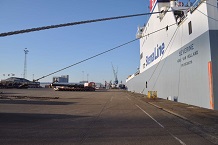
Second berth for Stena Line at Europoort

0

Freight volumes between Rotterdam and the UK have continued to grow in recent years as the economy recovers from the crash in 2008 and predictions for sustained future growth are positive.

“We are pleased with the development of the second berth in Rotterdam and of our routes to Harwich and Killingholme. We believe in the future of Europoort as a strong freight hub on the North Sea and are committed to the development of the terminal as part of a long term investment plan. The second berth allows us to fully facilitate business development long-term and to meet future customer demand,” said Annika Hult, Route Manager, Stena Line North Sea.

“This is a big investment and demonstrates the confidence in the RoRo-market’s long-term development and the growing freight volumes to and from Rotterdam. The Port of Rotterdam is committed to enable a further growth; amongst others via developing additional rail capacity to strengthen the RoRo rail infrastructure,” said Joyce Bliek, Director Containers at Port of Rotterdam.

The work to develop the new berth, with a length of 212m and 6.30m draft, will start shortly and is expected to be completed in Q1 2017. The current berth will then be renewed and both berths are planned to be operational by January 1, 2018 offering Stena Line much greater flexibility to service the growing freight market.