
The number of cruise passengers grew by one percent to 3.89 million during FY19 and petroleum volumes increased by 2 percent to 125.9 million barrels (42 gallons in a barrel). Overall revenue increased 2 percent from $168 million in FY18 to $170.7 in FY19. “These numbers are strong, especially considering the high amount of construction underway at the Port,” said Acting Chief Executive & Port Director Glenn Wiltshire. “We anticipate similar stable numbers over the next two years as we continue with the Southport Turning Notch Extension to add new cargo berths and Super Post-Panamax gantry cranes.” New automobiles highlighted the year as Horizon Terminal Services, which opened a new terminal in January 2018, increased the number of new vehicles moving through Port Everglades by 76 percent year-over-year to nearly 51,000. “New vehicles are a new business line for the Port, and further diversifies our revenue stream,” said Jim Pyburn, Port Everglades Director of Business Development. Port Everglades is one of the leading containerised cargo ports in Florida, the third largest cruise port in the world and South Florida’s main seaport for receiving petroleum products including gasoline, jet fuel and alternative fuels.
Seven percent rise in container volumes at Ports of Stockholm
During the period January to October, container volumes have risen by seven percent compared to the same period last year. “The Stockholm region is growing and around 50 percent of Sweden’s consumption happens in the greater Stockholm region. The continuing rise in container volumes is a message of strength before the opening of the Stockholm Norvik Port in 2020,” says Nicklas Ebersson, Marketing Manager Cargo at Ports of Stockholm. The Stockholm Norvik Port has a natural depth of 16.5 metres and the size capacity needed to be able to handle the largest vessels operating in the Baltic Sea. Its location, with short approach lanes from the fairways and good connections to major roads and railway routes, makes the Stockholm Norvik Port a new, efficient and sustainable transport hub in Sweden. When the Stockholm Norvik Ports opens in 2020 it will replace the container terminal at Stockholm’s Frihamnen Port. The new container terminal will be run by Hutchison Ports, one of the world’s leading container terminal operators. During 2020 the RoRo (rolling goods) section of the Stockholm Norvik Port will also open. This will be run as part of Ports of Stockholm’s own business operations.
September proves to be another strong showing for the Port of NY & NJ
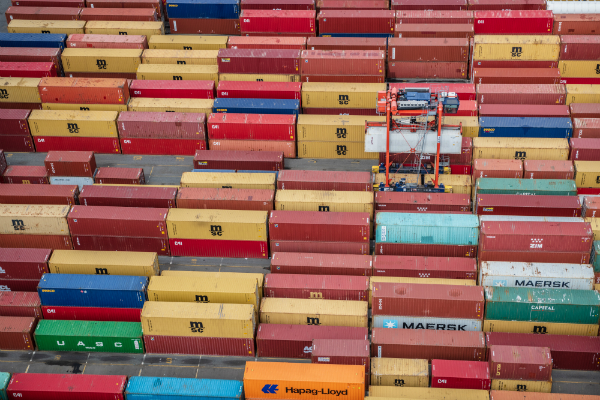
Total volume for September 2019 was 624,961 TEUs (352,098 lifts) versus 603,034 TEUs (341,676 lifts) in September 2018, a 3.6 percent increase. Bringing our year through September total to 5,620,381 TEUs. Import loads (TEUs) were up 3.9 percent in September 2019 vs. September 2018, export loads (TEUs) decreased 0.4 percent in September 2019 vs. September 2018. Export empties increased 5.7 percent totalling 191,143 TEUs in September 2019 versus 180,880 TEUs in September 2018. Import loads for the month of September totalled 315,866 TEUs (178,177 lifts) versus 304,125 TEUs (172,737 lifts) in September 2018, a 3.9 percent increase. For the period January through September 2019, the Port of New York and New Jersey imported loads reached 2,841,441 TEUs (1,612,709 lifts) versus 2,717,353 TEUs (1,550,944 lifts) in the same period of 2018, a 4.6 percent increase. Import empties are up 6.2 percent in January through September 2019 versus the same period in 2018. Export loads for the month of September totalled 116,231 TEUs (64,244 lifts) versus 116,711 TEUs (64,746 lifts) in September 2018, a 0.4 percent decrease in TEU volume. For the period January through September 2019, the Port of NY and NJ exports loads reached 1,103,001 TEUs (610,463 lifts) versus 1,114,656 TEUs (618,399 lifts) in the same period of 2018, a 1.0 percent decrease. Export empties totalled 1,662,821 TEUs for January through September 2019 versus 1,483,452 TEUs in the same period of 2018, an increase of 12.1 percent. Rail volume decreased 4.9 percent from the previous year’s September figure, totalling 53,247 containers for September 2019. Rail volume, January through September 2019, is 3.2 percent greater than in the same period of 2018. Autos moved through the Port of NY and NJ totalled 32,286 in September, a decrease of 16.7 percent when compared against September 2018. Auto volume for January through September 2019 is 1.8 percent greater than in the same period of 2018.
Hyster promises global big truck productivity
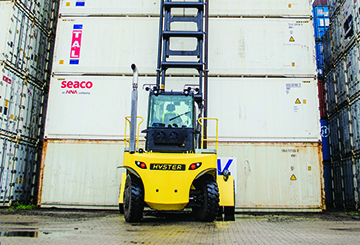
“Hyster® Lift Trucks over 8 tonnes, container handlers and reachstackers can all be purchased to comply with either Stage III / Tier 3, Stage IV / Tier 4 or Stage V emissions regulations, depending on local rules and requirements,” confirms Jan Willem van den Brand, Director Big Truck Product Strategy & Solutions at Hyster Europe. For our US customers, and those in regions requiring Stage IV / Tier 4 compliant trucks, we provide highly efficient Cummins engines delivering fast cycle times,” he says. “For European countries, we have maintained these exceptional productivity levels whilst meeting Stage V emissions regulations. In fact, our new Stage V models also offer low DEF (Diesel Engine Fluid) consumption,” he says, explaining that the addition of DEF is necessary to meet the Stage V regulations. High performing engines with high torque values at low RPM ranges are used for all global applications. Across the Big Truck range, this has enabled Hyster to tune each truck, and the hydraulics, to run at a lower engine speed, further optimising the balance between fuel consumption and productivity. For those requiring Stage V-compliant equipment, new Hyster® lift trucks over 8 tonnes, container handlers and reachstackers will be equipped accordingly with the Stage V-compliant Mercedes-Benz Series 1000 and 1100 engines. The exact availability varies per series. For European customers, Stage V engines are a requirement for new 20-52T Hyster® trucks, purchased after 1st January 2019 and new 8-18T trucks bought after 1st January 2020. Stage IV engines may be supplied with trucks ordered before these deadlines in line with the exception rule. For the Chinese market, Hyster continues to offer China Stage III compliant engines but will look to supply equipment to comply with the forthcoming China Stage IV regulations in future. “Wherever our customers are located in the world, Hyster® Big Trucks will provide exceptional productivity levels and help reduce the total cost of operation,” Jan Willem says. “Whether it’s handling containers in a Swiss rail terminal, hot metal slabs in a Turkish steel works or paper rolls in California, we deliver.”