
Monday, December 8, 2025
spot_img
Home Blog Page 472

Charleston Harbor Deepening Project earns key Federal funding

0

The announcement follows last week’s US Army Corps of Engineers Civil Works Review Board (CWRB) approval to release the project’s Final Integrated Feasibility Report and Environmental Impact Statement for final review, another critical step of federal approval for the SC Port Authority to provide the deepest harbor on the East Coast.

“The allocation of federal funding for the PED phase of our deepening project is tremendous,” said SCPA Board Chairman Bill Stern. “We are grateful to the leadership of state and federal elected officials and the Obama Administration for their united support of Charleston’s harbor deepening. The merit of our project and the significant benefits it will deliver for our state and nation are signified by the efforts of elected officials on all levels to ensure it progresses without delay.”

Total PED costs for Charleston’s deepening project are estimated at USD4.5 million, divided equally between federal and state government. With the full estimated state share of the design and construction costs set aside by the South Carolina General Assembly in 2012, the PED phase is 80 percent funded even before issuance of the project’s Chief’s Report.

The PED funding provides for the execution of a design agreement with the Corps of Engineers, allowing work to proceed in order to finalize the project design and produce contract documents. PED is the final major step in the deepening process before construction begins. Additional work completed during this phase includes ship simulation studies, refinement of cost estimates, coastal monitoring and analysis of beneficial use of dredged material.

Concurrent with preparations for the design agreement is a 30-day review period of the final report for state and resource agencies that begins July 10. The Chief’s Report, issued by the US Army Corps of Engineers, is expected to be finalized by September and transmitted to Congress for authorization later this year.

“The container shipping industry’s deployment of big ships is evident, and there is no question that the Southeast needs a harbor deeper than 50 feet to accommodate fully-loaded post-Panamax container ships,” said SCPA president and CEO Jim Newsome. “SCPA will soon be able to handle these vessels without tidal restriction, ensuring we can support growing volume needs. The US Army Corps of Engineers’ timely response to this dominant industry need is admirable, and we look forward to the completion of PED followed by significant progress on construction by the end of the decade.”

The Post-45 Deepening Project began in 2011 and has moved expeditiously through the US Army Corps of Engineers’ accelerated planning process. Upon completion of the 52 foot deepening, Charleston will offer the deepest harbor on the East Coast with unrestricted capability to handle post-Panamax vessel calls.
Pilbara Ports Authority delivers record annual throughput

0

In June 2015, PPA achieved a total monthly throughput of 54 Mt, an increase of 5 Mt or 10% from the same month in 2014.

Port of Port Hedland
The Port of Port Hedland achieved a record annual throughput of 446.9 Mt, an increase of 74.6 Mt or 20% from the previous year. Iron ore exports for the year totalled 439.6 Mt, an increase of 75.2 Mt or 21% from the previous year. The port also achieved a record monthly throughput of 38.8 Mt in June, an increase of 4.5 Mt or 13% from the same month last year. Iron ore exports in June totalled 38.3 Mt, an increase of 4.7 Mt or 14% from the same time last year. Imports for the year totalled 2.1 Mt, a slight decrease of 105,000 tonnes or 5% from last year. June imports totalled 112,000 tonnes, a decrease of 57,000 tonnes or 34% from the same month in 2014.

Port of Dampier
The Port of Dampier delivered an annual throughput of 172.9 Mt, a decrease of 4.6 Mt or 3% from the previous year. In June, the port achieved a monthly throughput of 15.2 Mt, an increase of 300,000 tonnes or 2% from the same month last year. Imports for the year totalled 1.1 Mt, an increase of 265,000 tonnes or 32% from the previous year. June imports totalled 96,000 tonnes, an increase of 26,000 tonnes or 36% from the same month in 2014.

BMT awarded port geographe coastal engineering management contract

0

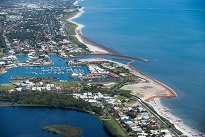
Port Geographe harbour is a coastal marina and residential canal estate developed in 1996 near the town of Busselton, Western Australia. The development has experienced ongoing problems due to large accumulations of seagrass wrack in the harbour and on adjacent beaches during winter months. Extensive coastal studies have led to the recent reconfiguration of the harbour entrance for which BMT has managed the capital and maintenance dredging components.

In order to successfully deliver its broad scope of works, BMT has put together a team comprising extensive knowledge of the facility and its coastal setting to develop operational plans and provide coastal management and engineering services. To ensure compliance with DoT commitments to State Government regarding water quality and amenity of beaches and waterways, BMT will also undertake regular monitoring and management of site works including wrack removal, maintenance dredging and sand bypassing for beach re-nourishment.

Tim Green, Managing Director of BMT JFA Consultants comments: “We’re delighted to have secured this contract which is part of the much larger Port Geographe reconfiguration project.

Working closely with Western Australian Department of Transport we look forward to delivering our element of the scheme and in so doing, help improve the environmental and health issues caused by seagrass wrack and sedimentation.”

Terrorist will take advantage of EU migrant crisis

0

“There is a reasonable doubt that some refugees from these areas will be a threat to European security. Terrorists and fundamentalists will take advantage of the crisis if they haven’t already,” said Jaanus Rahumägi, President & CEO, ESC Global Security.

He said: “With thousands crossing the Mediterranean from Africa and the Middle East each month, the abolition of Europe’s internal frontiers will make it easier for terrorists to move across Europe undetected. But the identities of migrants can be verified before they reach land by security personnel.”

However, Rahumägi dismissed calls to shift EUNAVFOR Atlanta, the European naval patrol operating in the Red Sea, to the Mediterranean in order to capture or destroy migrant ships.

“This is not the answer. Moving Atlanta simply because the risk of Somali piracy has been reduced does not mean it has been eradicated. A separate EUNAVFOR patrol is required and the Mediterranean should be given High Risk Area status until the migrant situation has been resolved,” he said.

“According to newspaper reports, there are thought to be about a million migrants looking to enter Europe across the Mediterranean from North Africa. But if merchant ships continue to go to their aide without adequate protection, then there is a significant risk to maritime security. Mediterranean shipping lanes must be protected in the same way that the merchant fleet is protected when it transits the Gulf of Aden and the southern Red Sea,” Rahumägi said.

“If we are to mitigate the security risks associated with this humanitarian crisis, Brussels, the maritime administrations and the security services must work in concert.”

Rahumägi’s comments coincided with a joint statement issued last week by the International Maritime Organization (IMO) and the International Organization for Migration (IOM). IMO Secretary-General Koji Sekimizu and IOM Director-General William L. Swing agreed to establish an inter-agency platform to disseminate information, highlight the dangers of and find a solution to the unsafe and irregular migration by sea.

The IMO and IOM urged the international community to take robust measures against people smugglers “who operate without fear or remorse and who deliberately and knowingly endanger the lives of thousands of migrants at sea.”