

Monday, December 8, 2025
spot_img
Home Blog Page 475

Port of Immingham expands fleet with continued investment in new technology

0

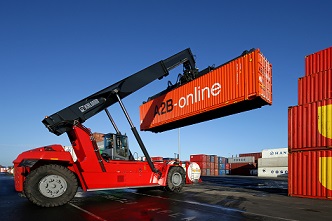
The reachstacker, a Kalmar Type DRG450-70S5X, was shipped over to Immingham direct from the Kalmar Factory in Poland to be used for a wide variety of cargoes at the Immingham Container Terminal (ICT). Steve Williams,
Head of Operations for Grimsby and Immingham explained the significance of this investment:

“This new addition to our reachstacker fleet will be used to further enhance the reliability of our customer offer here in Immingham.” said Steve. “We’ve continued to attract new business, and our plan for growth and improved efficiency requires us to invest in the highest standards in modern technology at ICT.”

“Our planned programme of ongoing investment in this area of ABP operations means the port will continue to thrive and support local jobs. We aim to invest up to £10 million over the next two years in areas such as the Gate House and Terminal entrance, as well as in new equipment from Gantry cranes to improved CCTV. We are currently setting out objectives for the next two years that will ensure that we continue to deliver our customers a first-class service.”

The new machine has a 7m wheelbase and weighs approximately 90 tonnes. It joins an existing fleet of four reachstackers, each capable of lifting 45t containers, stacking them to five high. The terminal’s fleet of machines continues to grow, and is currently worth around £20 million.

Immingham is the UK’s busiest port by tonnage which, along with the three other Humber ports, contributes around £1.5 billion to the regional economy and supports 14,000 jobs in the area.

Photo:
New Kalmar Reachstacker- TYPE DRG450-70S5X (image courtesy of ABP/David Lee
Photography – see link below to download high resolution image)
Port of Calais closed due to industrial action

0

The duration of this industrial action is currently unknown.

Operation Stack has been implemented (holding freight traffic on the coast-bound carriageway of the M20). The Port of Dover is liaising closely with Kent Police and Highways England. Tourist traffic heading for the Port of Dover is advised to use the A2/M2 route. Local traffic is free flowing. Customers are advised to contact their chosen ferry operator before travelling and consult the Port of Dover website (www.doverport.co.uk) or Twitter account (@PoD_travelnews) for the latest travel information.

The Port of Dover will continue to monitor the situation closely in liaison with their ferry partners and the Port of Calais in order to resume normal operations as soon as possible. Please note that there may be delays to services when the Port of Calais re-opens.

Next generation CCS soon to be unveiled

0

For the past year, MGI has had an internal team dedicated to replacing AP+: the ARROW (Air, Rail, Road, Ocean, Waterways) team. Fabrine Frestel, Project Director at MGI, heads up the team, and particularly relies on the innovation division, under the responsibility of Christophe Reynaud.

MGI and SOGET, joint owner of the AP+ solution, are also working together to create a national CCS, to make French ports and airports more competitive.

The client at the heart of MGI

The ARROW team organised a survey to identify the needs of users of AP+ and its various modules. An on-line questionnaire was first distributed to collect expectations and possibilities for enhancing functionalities in the new CCS. Additional feedback was obtained during trade-specific user workshops with forwarding agents, shipping agents, airlines, pre and post shipping transport providers, terminal operators, consolidators and container depots. These workshops provided an opportunity to discuss the strong points of the current solution, possible improvements, potential changes in each trade and industry innovations that would have an impact on operational processes. Future users have already demonstrated their enthusiasm for the future solution.

MGI also consulted with outside experts, and in particular, representatives of the United Nations Centre for Trade Facilitation and Electronic Business (UN/CEFACT), the French Ministry of Transport and competitiveness clusters, to obtain a broad vision of new technologies and a long-term outlook for future transport systems.

The next generation CCS will meet the new requirements of the forthcoming EU customs law, and Directive 2010/65/EU on electronic reporting formalities for ships.

Supply the most advanced CCS on the market

The next generation CCS is based on four main principles:
– The Fast Lane concept: speed the flow of goods via automated processes that give priority to professionals who have planned their operations in advance
– Door-to-door traceability of goods: inter-port communication between the CCS and Port Community Systems nationally and internationally
– The latest innovations from R&D work, in particular the intelligent container
– Future trends and uses

MGI’s objective: offer the most advanced community communication system on the market. A Proof of Concept of the new CCS will be revealed in December, during MGI’s anniversary evening reception.

APM Terminals' productivity performance tops global rankings

0

A total of 12 port facilities within the APM Terminals Global Terminal Network scored positions within the JOC Group’s 2014 annual global port and terminal productivity rankings, including APM Terminals Yokohama, which again led all container facilities with 186 crane moves per hour (MPH) with a vessel alongside. Nine facilities either operated by APM Terminals, or in which APM Terminals holds a significant financial interest, were included among the world’s 25 most productive terminals, with three more members of the APM Terminals portfolio listed as among regional top performers.

“Productivity will become the crucial determining factor in port call selection, as larger vessels and shipping alliances increase port call container volume concentrations, and we are proud of the efforts of our staff and our partners, in meeting this challenge so convincingly this past year” said APM Terminals Chief Operating Officer Jeff De Best.

Six terminals, in which APM Terminals is an investor or joint venture partner, among the Top 25 global leaders, are located at Chinese ports: Qingdao Qianwan Container Terminal, and Tianjin Port Alliance International Container Terminal tied for third place with 136 MPH; Xiamen Songyu Container Terminal, tied for sixth place with 124 MPH; Tianjin Port Euroasia International Container Terminal, is in seventh place with 121 MPH; Guangzhou South China Oceangate Container Terminal, ranked 10th with 117 MPH; and Dalian Port Container Terminal, ranked 12th, with 108 MPH. South Asia Gateway Terminal, in Colombo, Sri Lanka, is tied for 11th place with 111 MPH.

APM Terminals Rotterdam tied for first place among European terminal operations with 101 MPH, a performance which also merited a three-way tie for 16th place among the global terminal productivity leaders. APM Terminals Los Angeles was the highest ranking port for productivity in North America, with 92 MPH. Within the JOC Group’s “Europe, Middle East and Africa” grouping, The Port of Salalah, Oman; and NTB North Sea Terminal Bremerhaven, in both of which APM Terminals is a shareholder, tied for fifth place with 96 MPH. In productivity while working vessels of over 8,000 TEU capacity, Qingdao Qianwan Container Terminal (QQCT) tied for first place globally, with 157 MPH.