
Monday, December 8, 2025
spot_img
Home Blog Page 476

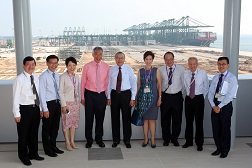
Singapore Prime Minister opens PSA'S Pasir Panjang Terminal – Phase 3 and 4

0

When the expansion is fully operational by the end of 2017, Singapore would be able to handle a total of 50 million Twenty-foot Equivalent Units (TEU) of containers annually.

PPT Phases 3 and 4 feature class-leading infrastructure and the latest port innovations, such as a zero-emission, fully-automated electric yard crane system. Such technologies will help to raise port productivity, enhance PSA’s ability to manage greater business complexity and create more higher skill-based career opportunities.

At the opening ceremony today, PSA also took the opportunity to pay tribute to its people, including pioneer employees who had worked on the first container ship to call at Singapore exactly 43 years ago.

Mr Fock Siew Wah, Group Chairman, PSA International said, “It is significant that today’s opening falls on the same day and month as the arrival of the first container vessel, the M.V. Nihon, in Singapore back in 1972. We are proud to be always alongside Singapore, playing a leading role in an industry which underpins our nation’s economic success. I would like to thank the government, our customers and business partners for their unstinting support over the years. Our dedicated and closely-knit team of management, unions and staff, have been instrumental in making PSA what it is today. Now and into the future, we will continue to count on the trust and support of these vital partnerships, as we write the next chapters of the PSA Story together.”

Beyond PPT, PSA is working closely with the Singapore government on the development of the future Tuas Port, which will incorporate more innovative automation systems, intelligent planning and control systems, and environmentally-sustainable solutions. With a designed capacity of 65 million TEUs, the Tuas mega 2 container port will ensure that Singapore is even more competitive and relevant as an International Maritime Centre for decades to come.
Long-term dredging contract for DEME in Papua New Guinea

0

OK Tedi Mining Ltd. (OTML) is a major producer of copper concentrate and operates an open-pit copper, gold and silver mine at Mount Fubilan, in the Star Mountains of Papua New Guinea’s Western Province, approximately 24 km from the border of West Papua, Indonesia.

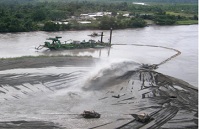
The main objectives of the Lower Ok Tedi Dredging Project are to minimize over-bank flooding by reducing riverbed levels and alleviating floodplain dieback downstream of Bige along the Ok Tedi and Fly River through dredging a section of the river at Bige, approximately 100 km downstream from the mine. This remediation-dredging program has been incorporated into OTML’s operations since 1998 and led to successful environmental results.

OTML has continuously engaged the CSD ‘Cap Martin’ through Dredging International’s local entity Dredeco PNG since the start of the program in 1998, to operate and capture the possibly polluted sand-sized sediments flowing down the river, and thereafter store them in engineered stockpiles on the East and West riverbanks of the OK TEDI river at Bige. To date, over 170 million m3 of sediments have been removed and pumped in stockpiles up to 30 m high, situated up to 6 km from the dredging area.

From the time dredging operations commenced, there has been a remarkable improvement in the environmentally sensitive river system downstream of Bige, with reduced die-back and establishment of secondary growth along the river banks.

OTML has recently received approval to continue mining operations. The continuation of the mine’s operations was agreed to and supported by all stakeholders and local communities.

As a result of OTML’s decision to extend the mine life, and due to the successful implementation of the joint remediation dredging program since 1998, OTML has awarded Dredging International this continuation dredging contract to remove sediment from the river system for another five and a half years.

In parallel, the environmental team has commenced re-vegetation on completed sections of the stockpiles. The aim is to stabilize the outer slopes and crown through sustainable vegetation cover, and to establish a primary vegetation cover through which final canopy tree species can be planted.

All operations are governed by the ‘Mining Act’, and are in compliance with all conditions set out by the ‘Environmental Regime’, which contains the environmental management and reporting obligations against a set of environmental values. Specific monitoring activities are undertaken on an annual basis, and an Annual Environmental Report is submitted to the Authorities, giving a solid regulatory basis to this long-term environmental remediation effort by the DEME Group.

The contract represents a value of USD 220 million (approximately EUR 194 million).

APM Terminals Mobile helps commemorate first jetliner component delivery

0

Airbus projects output at the Brookley facility at between 40-50 aircraft per year within three years. The fuselage and wing components arrived at APM Terminals Mobile on June 17th aboard the chartered German-flagged BBC Fuji, which transported the Spanish, German and British-manufactured sections from the Port of Hamburg, Germany.

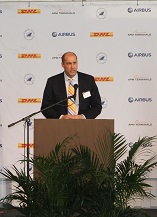
“We are very proud of the role that APM Terminals Mobile will be playing in this major new aerospace industry expansion in Alabama and the Port of Mobile” said APM Terminals Chief Operating Officer Jeff De Best, who had travelled from APM Terminals’ headquarters in The Hague, Netherlands, joining over 100 local dignitaries and government representatives for the celebration.

Airbus has sold more than 11,500 passenger aircraft to more than 470 customers and airline operators around the world, including over 9,400 of this single-aisle model family, with another 3,900 orders awaiting delivery from the four Airbus A320 assembly centers in Germany, China, France, and now the USA.

APM Terminals has been expanding and upgrading the Mobile terminal, which opened in 2008, and will add two new super-Post Panamax STS cranes – along with a yard expansion as part of a $40 million infrastructure investment to expand the terminal’s capacity in response to growing demand and opportunity in the US Southeast served by Alabama’s primary port. APM Terminals Mobile has a current annual throughput capacity of 350,000 TEUs with two cranes currently in service. Regular shipments of the Airbus A320 components through APM Terminals Mobile are set to begin within the next few weeks.

The Alabama State Port Authority has begun construction of an Intermodal Container Transfer Facility (ICTF) in the Port of Mobile which will be located adjacent to the APM Terminals facility. The ICTF will connect Mobile, via national intermodal rail service, to major markets in the US Southeast and Midwest, including direct access to Atlanta, Memphis, Nashville, and Chicago. The ICTF is scheduled to be operational by early 2016.

Colombia upgrades AtoN in the Gulf of Urabá

0

With this move, DIMAR, the Colombian Maritime Authority, is keeping to its plan and continues to improve aids to navigation around the Colombian coast. This time it’s been in the Gulf of Urabá, in the Northwest Caribbean coast.

The plan to improve the Colombia’s aids to navigation system was initiated in 2013 at the major Pacific and Caribbean ports of Buenaventura and Cartagena. Now DIMAR is focused on the safety navigation in smaller ports and harbours used mostly by local vessels.

Nine lateral buoys, one safe water mark, one special and one cardinal marks were deployed recently, all equipped with 5NM LED lights. G2200TW Guia buoys were manufactured with a 2,2m diameter hull in closed cell polyethylene foam core with a polyurethane elastomer skin and a highly visible 2m stainless steel tower. These buoys are designed for areas of intense marine traffic that require maximum robustness and durability. The design of Urabá buoys is the same as the buoys supplied last year in San Andrés and Providencia islands.