

Thursday, December 11, 2025
spot_img
Home Blog Page 480

Port of London Authority recycling helps cats and critters at Wildlife Heritage Foundation

0

The recycling idea was launched as part of the PLA’s drive to make use of materials that would otherwise be thrown away and at the same time, it helps with wildlife conservation. 

Wildlife Heritage Foundation (WHF) collected the first two pallets of rope and lifting strops last month and they are now being used at the Kent-based sanctuary’s ‘Enrichment’ enclosure as scratch posts, to keep cat claws sharp and their feline minds stimulated.

A 10-metre plastic pipe dumped in the Thames and salvaged by PLA staff will also be fashioned into play tunnels for meerkats at the WHF’s sister site in Hertfordshire.

PLA environment manager Tanya Ferry said: “It’s really rewarding to know that something we’ve finished with has been given another lease of life. It helps reduce the waste we are producing, and cuts the Foundation’s spending on ropes, which can be expensive.”

The PLA team had previously visited WHF to see how the authority’s born-again rope was being put to use.

“It’s brilliant that our old rope, which was used for towing and mooring lines has struck a chord with staff and cats at the sanctuary,” said PLA marine manager ashore, Danny Marsh. “The plastic pipe was found in the Thames near central London and had been with us for a while.  As we can’t use it ourselves, what better way to reuse it, than to let meerkats have some fun?” 

The 38-acre WHF site in Smarden, near Ashford, Kent, is home to a huge range of cats, including pumas, cheetahs, leopards and lions. They are encouraged to breed as part of a painstaking programme that let cats at the park thrive.   

WHF spokesperson Tanith Brown thanked the PLA for its donation on behalf the Sanctuary’s 56 feline residents that will love getting to grips with the rope and strops.

She said: “These kinds of donation are really good for us, especially as we’re not open to the public in the normal sense. All help is appreciated, and anything that can help raise awareness of what we do is also welcome.”
ICTSI Oregon leads Congressional effort to end West Coast labour slowdowns

0

The PLUS Act, which was introduced by Idaho Senator James Risch, was the result of efforts by ICTSI Oregon, Inc., the terminal operating company for the Port of Portland’s Terminal 6, to focus congressional attention on the ongoing problem of maritime labor slowdowns.

The measure would amend the National Labor Relations Act (NLRA) to make intentional slowdowns by maritime unions an unfair labor practice. Offending labor organizations would be subjected to federal court injunctions against slowdowns as well as damage claims to injured parties. Intentional slowdowns are orchestrated campaigns by labor unions such as the International Warehouse and Longshore Union (ILWU) to essentially engage in a strike with little or no cost to their members. In contrast to a formal strike, however, union workers continue receiving full pay and benefits, even as they inflict significant damage on thelocal, regional and national economies.

“As a port operator, ICTSI Oregon has deep relationships with local small businesses, farmers, and the import and export community throughout the Columbia River region and Western states. We identify with the significant pain they continue to experience as a result of the ILWU’s actions during the most recent contract negotiations,” said ICTSI Oregon CEO Elvis Ganda. “If enacted, the PLUS Act will help ensure that a small number of workers cannot engage in unfair labor practices that threaten our nation’s economic prosperity and hold our economy hostage.”

While intentional slowdowns are not a significant problem in most segments of the U.S. economy, they are a major and growing problem in the maritime industry, particularly the West Coast. Currently, a loophole in the NLRA has allowed the ILWU to use slowdowns as leverage against ports and port operators—particularly during contract negotiations. As a result, the last three contract negotiation years have seen major disruption to the West Coast and U.S. economy. In 2002, a 10-day shutdown as a result of labor slowdowns cost the U.S. economy an estimated $15.6 billion. This past year, economists report that slowdowns subtracted a full percentage point off the entire U.S. GDP during Q4 2014.

ICTSI Oregon representatives recently made trips to Washington, D.C. to propose and build support among congressional lawmakers and trade associations for reasonable maritime labor law reform. According to Ganda, there is growing support among a diverse range of stakeholders to find a solution to West Coast labor issues and significant interest in the proposed legislation. ICTSI Oregon has worked closely with Senator Risch and his staff to finalize the PLUS Act for Senate consideration.

“We applaud Senator Risch’s leadership in proposing the PLUS Act and are hopeful that other West Coast representatives and senators will champion the measure,” said Ganda. “This legislation represents an important change to maritime labor law that will go a long way toward ensuring a more stable work environment at West Coast ports, one in which innocent parties are not subjected to severe economic damage by unfair union slowdown tactics.”

The PLUS Act has been referred to the Senate Committee on Health, Education, Labor, and Pensions.

Amsterdam reports 2014 was a positive year

0

The net result for 2014 came to EUR 52.5 million. These and other key figures are stated in the recently published annual report. The most important source of income for the Port of Amsterdam comes from port dues that ships pay when calling in the port and the leasing of sites. The income from port dues amounted to EUR 50.4 million in 2014 (2013: EUR 50.6 million), while income from inland port dues came to EUR 6.4 million (2013: EUR 5.6 million). The income from rents, ground lease and quayage in 2014 came to EUR 74.2 million (2013: EUR 70.8 million).

The number of ship calls in the port region (Velsen, Beverwijk, Zaandam andAmsterdam) was 7,486 in 2014, compared to 7,596 in 2013. The lower number was due to the increase in the average size of the ships. A total of 126 sea cruises called in Amsterdam, compared to 137 in 2013. The river cruise market increased again, with 1,685 calls in Amsterdam compared to 1,483 in the previous year.

Port of Amsterdam CEO Dertje Meijer: ‘2014 was an iconic year for us and our customers. The positive decision for a new sea lock is a choice for growth and a future for the region and the Port of Amsterdam. If we can grow further, we can also add more value to the city, the port region and the Amsterdam Metropolitan Area. From a financial point of view, it was also a good year. Once again, together with our customers, we have succeeded in posting a very satisfactory result.’

We expect growth to continue and that the result for the whole of 2015 will be positive. Port of Amsterdam has had a good first quarter in 2015. Operating income has risen compared to the previous year, mainly due to higher contract income from land allocation in 2014 and the first three months of 2015. Transhipments amounted to 21.3 million tonnes in the first quarter, virtually the same amount as in the first quarter of 2014.

Panama locks filled with water

0

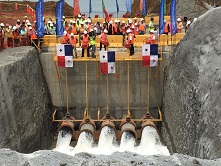
During the first phase, which will take 7 days, no less than 6 million m³ is needed for the filling of the locks, with a flow of 50,000 m³ per hour.

Since 2010, a consortium including Jan De Nul Group has been constructing the new lock complexes at the Panama Canal, one of the most prestigious infrastructure works in the world. The works comprise the construction of two lock complexes, each having three lock chambers, of which each chamber has approximately the same size of Antwerp’s Berendrecht Lock. Thanks to this project, the capacity of the Panama Canal will increase by 80%.

In less than a year the passage through the renewed Panama locks will be possible for maritime traffic and the country will benefit of the added value of this project.