

Friday, December 19, 2025
spot_img
Home Blog Page 484

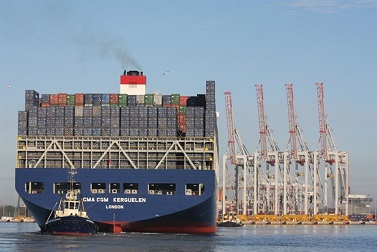
UK flag's biggest ship in the world calls at Southampton

0

She arrived at DP World Southampton’s container terminal on her maiden voyage which began when she left Shanghai, Hong Kong, last month. CMA CGM Kerguelen rivals some of the world’s biggest ships at 398 m long and 54m wide. She is the first of a series of six vessels of the same size set for delivery this year. Deployed on the FAL route linking Europe to Asia, CMA CGM Kerguelen calls in 11 countries and has the capacity to transport almost 200,000 tons of goods from clothes and televisions to sofas and washing machines. CMA CGM Kerguelen berthed at Southampton’s new deep water berth, SCT 5, which was specifically built and commissioned with four brand new super-post panamax cranes, to accommodate these ultra large container ships.

Over £100 million has been invested by Associated British Ports, as the harbour authority, to ensure that Southampton can continue to stay at the forefront of the UK container market. Rob Waterman, CMA CGM (UK) Chief Executive, watched Kerguelen arrive in
Southampton, and commented: “Clearly I am biased, but she really is a very impressive sight. She will not be in port for more than 24 hours thanks to the great service we get here in Southampton.”

Chris Lewis, Managing Director, DP World Southampton, added: “UK PLC and the global economy rely on vessels such as these to transport goods all over the world to our shop shelves. The trend for larger and larger vessels means ports and terminals, like ours, need to keep pace. Shipping lines and cargo owners need the fast and efficient service that has become Southampton’s trademark.”

Visitors, including the Chairman of CMA CGM (UK), Michael Parker and the Sir Alan Massey Chief Executive of the Maritime Coastguard Agency, joined management from DP World Southampton and Associated British Ports to present the Captain of the CMA CGM Kerguelen with a traditional plaque to commemorate her maiden call.

CMA CGM Kerguelen, is not the first vessel in the CMA CGM fleet to be registered under the UK flag. The company has 40 vessels on the UK register.
Kuenz awarded by HHLA for stack extension at CTB

0

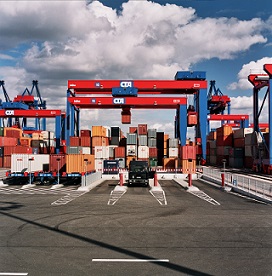
The innovative Kuenz/ABB automated stacking crane concept has been significantly improved with regard to the components’ lifetime and easy and efficient maintenance solutions. The proven patented travel gear, the patented innovative hoist system (stiff rope tower, no sheaves) increase life time of wheels and ropes significantly.
The design of the E-house (compact design, low energy consumption) allows significant reduction of energy needed for cooling. Sustainability and efficiency are focal points of the Kuenz-ABB design.

Installation and commissioning on site will be facilitated by preassembled assembly groups. Crane’s travel gear, trolley and E-house will be manufactured in house and tested prior to delivery in order to ensure fast and efficient assembly and commission on site. The software interface between crane control and TOS/ZKA will also be lab tested prior to delivery. Partnership between all parties involved is essential to achieve not only the required success during the project execution, but also thereafter. Professional project
management with well-known and experienced staff ensures on time delivery.

Kuenz was founded in 1932 by Hans Kuenz who succeeded in creating a recognized and successful mechanical engineering company in a very short period of time. The company started out manufacturing tower construction cranes, the focus later shifted towards manufacturing container cranes, followed by hydro power equipment. Kuenz is one of the oldest and most prestigious mechanical engineering companies in the western region of Austria.


May's TEU volume surpasses 230,000 at Port of Virginia

0

In May, the port handled 230,511 twenty-foot equivalent units (TEUs), an increase of 13 percent increase when compared with the same month last year. The port set its previous mark for monthly TEU volume in March, having handled 229,000 units.

“We are on pace to show significant growth – set records — for both the calendar and fiscal year,” said John F. Reinhart, CEO and executive director of the Virginia Port Authority. “So our effort is to continue to reinvest in facilities, equipment and people to be able to deliver consistency to all port users and improve service for motor carriers.”

Some of the reinvestments include:

• A temporary yard / stack for rail containers at Virginia International Gateway (VIG) (set for completion at the end of June) that will create more velocity in the main stack for motor carriers.

• The addition of 1,000 new chassis to Hampton Roads Chassis Pool by summer’s end (500 lease and 500 purchased).

• Implementation of an automated gate at Norfolk International Terminals (NIT).

• Continuing the Saturday gate hours at VIG, NIT and the Pinners Point Container Yard (PPCY).

• The addition of several new members to the port’s operations team.

• At Portsmouth Marine Terminal, improvements and repairs to the berth along with maintenance dredging to ensure 43 feet of
alongside depth.

• An investment of $40 million-plus on container handling equipment.

In May, the port processed 87,455 truck moves, up 21.5 percent; vessel calls, up 0.6 percent; rail containers, up 3 percent; Virginia Inland Port volume, down 0.3 percent; and barge containers, down 4.5 percent. Vehicle units soared in May as the port handled 8,675 import vehicles from Nissan and Chrysler at Newport News Marine Terminal (NNMT). The month’s total was driven, in part, by Chrysler automobiles that were diverted to Virginia from another US East Coast port. May’s total for vehicles processed at NNMT is the highest monthly result since January 1988.

“With the service that we have delivered to the customer in this area of operation, we are well-positioned to build this segment of business,” Reinhart said.

Thus far into the calendar year, the port’s TEU volume is up 9.5 percent compared with the same period last year; truck moves, up 12 percent; vessel calls, up 2 percent; rail containers, up 8 percent; Virginia Inland Port volume, down 3.8 percent; barge containers, down 5 percent; and vehicle units, up 48 percent. “We continue to be tested with these mounting monthly volumes; our busy peak season is not far off and we anticipate that we will see cargo volume that exceeds May’s result,” Reinhart said. “We continue to prepare and are in a better position to strategically act to handle volume and build velocity with consistent service.”

RTG cranes from Konecranes for the new Baltic port of Bronka

0

The firm is among the world’s leading manufacturers of cranes and lifting gear. Arriving from Hanko in Finland, the “Meri” was the first merchant ship to transit the new, recently constructed canal providing access to Bronka, then making fast at the already operational Berth 3. Discharge of the three RTG cranes constituted a dress rehearsal for clearance of a vessel at the new terminal in Bronka, in advance of the official start of operations in Bronka in September. Delivered in a state of operational readiness, the RTG cranes rolled ashore from the “Meri” on their own wheels and will in future be deployed at the Port of Bronka container terminal. A second batch of three RTG cranes will be delivered by Konecranes in mid-August.

“We are extremely satisfied with the mutually agreed fitting-out of the RTG cranes ordered from Konecranes, and their punctual delivery. At our new Port of Bronka, we are installing highly efficient, state-of-the-art equipment. We are convinced that with these RTG cranes from Konecranes, we shall achieve high operating reliability and productivity in container handling at our new multi-purpose port,” says Alexei Shukletsov, CEO of the Port of Bronka.

Konecranes possesses immense knowhow in designing port solutions. The rubber-tyred gantry cranes (RTG) supplied for container handling at the Port of Bronka not only fulfil normal performance specifications but also feature numerous standard innovative functions. While cutting maintenance costs, these also boost performance and reliability. This both enhances operational  dependability and minimizes costs for maintenance and spares. In the tough operating conditions in the Russian Baltic port of Bronka, that will be a distinct advantage.

The deepwater Port of Bronka is being built on the Southern bank of the Gulf of Finland, on the outskirts of St. Petersburg and near the municipality of Lomonossov. The multi-functional cargo handling facility comprises two terminals plus a logistics centre. Covering 107 hectares, the container terminal offers five berths along quays extending 1,176 metres. The Ro-Ro terminal covers 57 hectares, and with a quay length of 630 metres permits simultaneous handling of three ships. At the first stage of construction, handling capacity of the container terminal totals 1.45 million TEU per year, plus 260,000 units at the Ro-Ro terminal. A first-stage water depth of 14.4 metres enables the Port of Bronka to handle post-Panamax vessels. The multifunctional Bronka handling facility is scheduled to enter service in September 2015.