

Tuesday, December 16, 2025
spot_img
Home Blog Page 492

Next generation of automated container handling has been inaugurated in Surabaya, Indonesia

0

Lamong Bay Terminal’s automated container handling system was provided by Konecranes.

The newly inaugurated Lamong Bay Terminal is the jewel in the crown of Indonesian state-owned terminal operator PT Pelabuhan Indonesia III (Persero), “Pelindo III”. Its automated container handling system, provided by Konecranes, consists of 20 Automated Stacking Cranes (ASCs), Remote Operating Stations (ROSs), and associated container yard infrastructure. Konecranes also provided 10 Ship-to-Shore (STS) cranes and 5 straddle carriers. Hand-over of the automated container blocks is proceeding smoothly. Konecranes is providing expert engineering support on-site.

“Lamong Bay Terminal is the next generation container terminal. Thanks to the reliability, productivity, predictability and safety provided by our Konecranes automated container handling system, we will provide our shipping line customers with uninterrupted, reliable container flow. This will be the key to build up business success in Indonesia and South-East Asia,” says Mr. Prasetyadi, President Director, Terminal Teluk Lamong.

It’s the next generation
Lamong Bay Terminal’s automated container handling system incorporates a host of technological improvements including stronger redundancy throughout the design, and an improved Remote Operating Station (ROS) and Graphical User Interface (GUI).

Most importantly, Konecranes’ unique Active Load Control technology is now extended with an advanced machine vision system which detects containers and container profiles with great precision. As the container approaches the target, the container profile becomes more accurate. The effects of dust, fog etc. are minimized. The system senses neighboring container stacks from the point of view of the load, and performs canyon driving. The automated container handling process becomes more precise and predictable.

Mastering the building blocks
Lamong Bay Terminal’s automated container handling system is designed and built by Konecranes across all of its constituent parts: from the Active Load Control system of the ASCs that eliminates container sway, to the automation technology and software, and up to the GUI of the Remote

Operating Stations
Konecranes masters all of the building blocks of an automated container terminal, and consolidates all of the automation interfaces. At the core of the system, Konecranes provides its own automation technology, designed and built in-house to work flawlessly across the system.

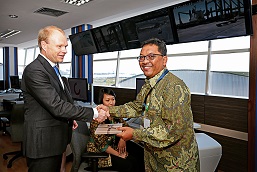
Pekka Lundmark, CEO and President of Konecranes, attended the inauguration ceremony. “This is an important day for Konecranes and Indonesia. The future is very bright for Lamong Bay Terminal. I’m confident that it will achieve lasting business success,” he said.

Kalmar awarded contract to deliver rough terrain container handlers

0

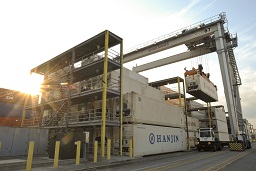
Destined to replace older equipment, the Kalmar RT240s will be delivered to multiple locations across the United States by the end of the year 2015. The total value of the order is approximately EUR 16 million (USD 18 million).

The Kalmar RT240 provides exceptional performance, able to handle containerised loads of up to 53,000lbs (24 tonnes) across all types of terrain.

Commenting on the order, Stephen Speakes, President and CEO at Kalmar RT Center (KRTC) in Cibolo, Texas, said, “This is yet another endorsement of the great quality of Kalmar’s solutions for rough terrain applications. The RT240 provides a reliable materials handling solution, it is simple to service, maintain and fix in the field.”

KRTC has been producing rough terrain handlers since 2009 and currently has three assembly lines focusing on container handlers and forklift trucks. The centre employs approximately 170 people.

Port of Savannah ramps up frozen cargo capacity

0

“Increased on- and off-terminal capacity gives customers more options for moving refrigerated commodities to and from international markets,” said GPA Executive Director Curtis Foltz. “This additional infrastructure will strengthen Savannah’s position as the premier East Coast facility for refrigerated exports.”

By adding 20 more racks, GPA will increase its refrigerated container rack slots by 480, for a total of 2,496 – a 28% increase in refrigerated container rack capacity. Counting 600 chassis plug-ins, Savannah’s total capacity will grow to 3,096 refrigerated boxes.

The Port of Savannah handles nearly 40 percent of the nation’s containerized poultry exports, and much of that cargo is supplied by Georgia growers. Supporting agribusiness is an important part of GPA’s mission. Farming accounts for more than $75 billion in total economic impact and employs more than 375,000 in Georgia. The Port of Savannah links our poultry, pecans, peanuts and blueberries to global buyers.

Refrigerated container racks have greatly increased the efficiency of frozen cargo handling at the Port of Savannah, making the operation much cleaner for the environment. Previously, diesel generators were used to power refrigerated containers in tandem with wheeled parking spots with electrical hookups. Today, for every 10 racks placed into service, the GPA avoids the use of about 540,000 gallons of diesel fuel annually, which would have been used to power diesel generators.

The additional racks approved by the GPA board will also allow the Port of Savannah to make room for the anticipated 4.5% growth rate for refrigerated cargo.

“We continue to experience high demand from existing customers wanting to move their distribution closer to the port,” said Ross Maple, Director of Business Strategy for Nordic Cold Storage. “Savannah’s additional racks will allow us to meet customer demands, as increases in exports are expected as poultry consumption worldwide continues to grow, while an increase in frozen imports is anticipated with the expansion of the Panama Canal.”

Kalmar to heightening three ship-to-shore cranes for DP World Antwerp

0

The order was signed into Cargotec’s first quarter of 2015 order intake, with the completion of the project scheduled to take place in the first quarter of 2016.

Kalmar will be responsible for the turnkey project, including planning and engineering, the execution of the heightening, and commissioning. The cranes, which have been operational since 2005, are to be heightened by six metres to accommodate larger vessels entering the port. This is in anticipation of significant growth in container movements.

Rob Harrison, CEO of DP World Antwerp Gateway: “‘Today’s challenges in the port industry evolve around capacity and more and more upon capability. We at DP World Antwerp Gateway are confident in Kalmar being able to deliver this project and allowing us to meet these needs in a practical and effective manner. Ultimately collectively serving the demands of our shipping line customers.”

Jelle van der Waal, Director Crane Upgrades in Kalmar EMEA North said, “Quality and operational efficiency are high on our agenda. With professional planning and execution of an upgrade project, disruption on the terminal’s operational efficiency during the project can be minimised.” He continues: “DP World is naturally a very important and long-standing customer to Kalmar. They are a progressive, forward-thinking organisation and totally focused on improving the efficiency of their container handling operations. I am delighted to work with them again.”

The highly specialist operation will be achieved by inserting leg extensions underneath the portal beams in the existing flange junctions. The project will also include the installation of consequential structural reinforcements in crane travel and trolley travel direction. The heightening of the crane structure is achieved by means of jacking towers and hydraulic jacks, including all bracings for horizontal forces to ensure optimum safety during the process.