Monday, December 15, 2025
spot_img
Home Blog Page 505

Saudi Global Ports (SGP) starts operations in Dammam

0

The new terminal is the second container terminal operating within King Abdul Aziz Port, a key gateway port on the Gulf.

In its first phase, the SGP terminal features a 700m quay with a depth of 16m alongside – the deepest in the region – and is equipped with 6 quay container cranes capable of handling vessels with 23 container rows. Once the terminal is fully developed it will have a design capacity of 1.8 million TEU per annum supported by quay a length of 1.2km and 12 quay container cranes.

On 23 April, the SGP terminal handled 1,011 TEU on the 2,000 TEU capacity vessel, Niara, owned by Dubai-headquartered Orient Express Line.

According to Abdul Rahman Mohammed Al Mufadhi, secretary general of the PIF, the opening of the second container terminal in Damman is “strategically significant” for the development of the country’s economy.

“The completion and start-up of PSA’s first container terminal in Dammam testifies to PSA’s commitment to the Kingdom of Saudi Arabia,” said Tan Chong Meng, group CEO of PSA, highlighting the importance of the gateway port that helps to grow regional trade and business activities.

Port of Philadelphia's Q1 cargo figures indicate continued growth

0

Further, in addition to overall cargo increases in broad categories such as containers, breakbulk, liquid bulk, etc., for the first time in recent history every major cargo category that the statistical process counts, which includes containers, steel, forest products, cocoa beans, project cargo, ro/ro, liquid bulk, and other/miscellaneous cargoes, all showed increases, with no exceptions.

“Our latest cargo figures are gratifying to see,” said PRPA Chairman Jerry Sweeney, who was appointed Chairman of thePRPA Board by Pennsylvania Governor Tom Wolf earlier this year. “Not only do they once again show healthy gains when comparing the same periods of this year and last year, but they also show, for the first time in a long while, that all cargo sectors showed growth, not just some or even most. This is truly a testament to our terminal operators, the= logistics industry that surrounds them, our dedicated labor force, and our staff at PRPA, all of whom work together to make this port as efficient and successful as it can be.”

Containers showed healthy gains in the first quarter when counted either as TEU’s or tonnage. 100,203 TEU’s were handled during the first quarter of 2015 compared to the 97,922 TEU’s handled during the same period of 2014, a 2.33 percent gain. Counted as tonnage, 684,360 metric tons of containerized cargo was moved during January-March 2015 compared to the 646,621 metric tons moved during that same period of 2014, resulting in a 5.84 percent gain.

The across-the-board increases in all breakbulk cargo categories are as follows: steel was up 1.22 percent, with 105,398 metric tons handled; fruit was up 16.68 percent, with 66,390 tons handled; forest products were up 34.98 percent, with 162,879 tons handled; cocoa beans were up 18.98 percent, with 45,859 tons handled; project cargo was up 21.69 percent, with 11,380 tons handled, and other/miscellaneous cargoes were up 975.65 percent, with 2,076 metric tons handled.

In the ro/ro category, which is primarily made up of the Port’s automobile cargoes (principally Hyundai and Kia automobiles that arrive in South Philadelphia for ultimate distribution to dealerships throughout the U.S.), cargoes were up when counted either as individual units or tonnage. 36,683 automobiles were moved during the first quarter of this year, a 2.31 percent increase over the same period last year. Counted as tonnage, 54,923 metric tons of automobiles were moved, a 10.58 percent increase.

In the liquid bulk category, the 338,748 metric tons of liquid bulk cargoes handled during the first quarter represented a 1.54 percent increase compared to the same period last year.

These current cargo increases, which continue a trend of growth that began over five years ago, are occurring during an exciting time for the Port of Philadelphia, as the Port’s 45-foot Main Channel Deepening project nears completion, and the PRPA Board of Directors is overseeing the advancement of the Port’s Southport Project, which will result in one or more major new maritime operations in South Philadelphia, the first entirely new operations added to the Port in more than a generation.

The Philadelphia  Regional Port Authority is an independent agency of the Commonwealth of Pennsylvania charged with the management, maintenance, marketing, and promotion of publicly owned port facilities along the Delaware River in Philadelphia, as well as strategic planning in the port district. PRPA works with its terminal operators to modernize, expand, and improve its facilities, and to market those facilities to prospective port users. Port cargoes and the activities they generate are responsible for thousands of direct and indirect jobs in the Philadelphia area and throughout Pennsylvania, as well as numerous other economic benefits.

JAXPORT sets new record with largest container ship

0

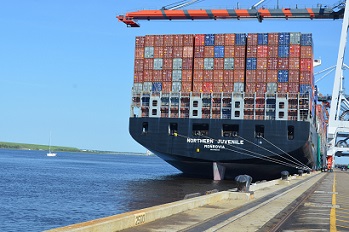
The ship, which transited the Suez Canal from Asia before reaching the U.S. East Coast, loaded and offloaded cargo at JAXPORT’s TraPac Container Terminal at Dames Point.

More than 1 million containers move through Jacksonville’s public and private marine terminals annually. Jacksonville boasts the widest shipping channel in the Southeast U.S., wide enough for two ships to pass at the same time and offers worldwide cargo service from more than 40 ocean carriers, including direct service with Europe, Africa, South America, the Caribbean and other key markets.

Florida is now the nation’s third most populous state – and more than 60 million U.S. consumers live within a one-day truck drive of Jacksonville’s port. JAXPORT terminals are serviced by three U.S. interstates (I-10, I-95 and I-75), and the city has 36 daily train departures via three railroads: CSX, Norfolk Southern, and Florida East Coast. The port’s equal balance of imports and exports provides backhaul opportunities, saving money and maximizing transportation costs.

JAXPORT has invested $600 million in recent infrastructure investments in everything from cranes to docks to rail and a newly authorized project to deepen the federal shipping channel.

Containers and crude drive Q1 increase at Marseille Fos

0

Box traffic rose 8% to 312,820 teu after growth of 9% at the deepsea Fos terminals and 5% at the largely intra-Mediterranean Marseille facility. The performance was marked by a 15% increase in March, when the port handled an all-time high of almost 116,000 teu. The container volumes drove general cargo to a three-point improvement on 4.4MT, which included 0.87MT from ro-ro (+5%) and 0.61MT in conventional trades (-11%).

The oil-led liquid bulks sector jumped 12% to 12.27MT. Crude oil and petroleum products saw a 13% increase on 11.42MT, notably because crude imports soared 28% to 7.22MT as refineries took advantage of falling prices. LPG gained 21% for 0.73MT, although LNG fell 24% to 0.75MT and refined products were 5% down on 2.72MT. Elsewhere in the sector, liquid chemicals and agro-products slipped 3% to some 0.86MT due to lower imports of biofuels and MTBE.

Dry bulks totalled 3.43MT, down 4% compared with a particularly strong first quarter in 2014. The fall stemmed from a 4% drop to 2.4MT in imports of raw materials for the steel industry, but this trade recovered from a slow start to the year with a 41% month-on-month increase in March to 0.98MT.

Passenger throughput was down 4% to 308,000 due to an unaccustomed blip in cruise numbers, which fell 11% to 178,000. However, this reflected a market-driven change in the schedule of port calls, which now focuses on the summer season, and the deficit is set to be wiped out over the full year. Meanwhile Corsica and North Africa ferry carryings rose 8% to 130,000, although the market remains difficult.