

Monday, December 8, 2025
spot_img
Home Blog Page 510

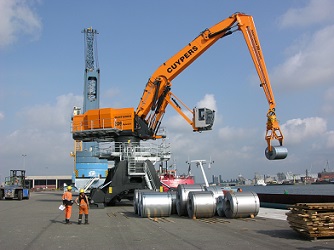
Mantsinen 200M HybriLift promises greater handling productivity

0

The Mantsinen 200M HybriLift has the longest reach of any piece of wheel-mounted hydraulic materials handling equipment and is now available exclusively through materials handling specialists, Cooper Handling Group and offers a range of productivity benefits over traditional rope-based systems.

With a maximum reach of 40m and a maximum lift capacity of 50 tonnes, the Mansinen 200M HybriLift will productively load and discharge 36 tonnes at 20 metres outreach and isarguably the most versatile port or industrial crane on the market and
represents the latest evolution of a concept that’s already well established in continental Europe.

In modern day ports overseas, material handlers are the default choice for operators looking for the most cost effective and efficient discharge and loading of vessels.

David Cooper, Managing Director of Cooper Handling, explained: “The origins of material handlers can be found in re-arranged construction-based excavators and this concept remains the norm today in smaller industrial applications. For ports however, materials handlers are still evolving with demands for yet greater capacities and longer reaches.

“Mantsinen, identifying the restrictions with proprietary excavators have led the way with purpose-built materials handlersare reaping the rewards with a design programme that yields larger machines on the widest range of differing undercarriages.

“None is more representative of this than the 200M just launched in the UK. Whilst these large machines represent a norm based on tracks, the 200M is believed to be the first of such size based on wheels.

This massive machine, weighing in at over 240 tonnes can be supplied with a boom and stick configuration with a maximum horizontal reachof 40 metres. However, typical applications will see it lifting 36 tonnes at 20m outreach.

Cycle times remain much the same, resulting in charging and discharge rates of circa 1200 tonnes per hour on solids and 1500 tonnes per hour on bulk.

Designed with five twin steering axles, three of which provide motive power, the front and rear axles work in opposite directions to provide maximum manoeuvrability. A travel speed at 5kph is also favourablecompared to track-based alternatives whilst the 200M has sufficient capacity and reach to bring laden container handling into the scope of material handlers. Cycles of 50 to 60 containers per hour compare favourably with reachstackers, which will operate at circa 25 containers per hour maximum. The 200M is also available in electric variant and is supplied, as standard, with the patented Mantsinen HybriLift® energy recovery system which will save 35% in fuel.

Mr Cooper added: “In August 2014, two of these machines were delivered to Belgium with a third currently on order. In operation it has delivered exceptional productivity andwe are delighted to be able to bring this level of performance to the UK and Ireland.”

New Chief Executive for Port of Brisbane

0

PBPL Chairman Jerry Maycock said Mr Cummins brings substantial port management and maritime experience, having worked in the ports industry for more than 25 years.

“Roy’s expertise lies in his extensive port development, strategy and leadership experience, which he has gained in both Australia and internationally.

“He has held a variety of port management roles including seven years working for P&O on the Australian waterfront from 1999 to 2006, and the last five years managing a significant ports portfolio as Chief Commercial Officer of Global Ports Investments Ltd, one of
Europe’s larger amalgamated port companies,” Maycock said.

Mr Cummins will replace outgoing CEO, Russell Smith, who announced his resignation from the role in late-2014.

“I would like to thank Russell for his outstanding leadership, passion and dedication to PBPL since his commencement as CEO in 2011,” Mr Maycock said.

“During his time at the Port, Russell has successfully overseen the transition of PBPL from a government owned
corporation to a dynamic private sector port company.

“We wish Russell all the success in his future career,” he said.

Having been based internationally for the past nine years, Roy returns to Australia to take up the position in Brisbane in June.

Transas integrates Shipping Guides Port Data in its Navi-Planner 4000

0

Having detailed information on ports is essential to fully plan a port call, and adding port data became a logical step in development of
this market-leading voyage planning software. The Navi-Planner Port overlay displays port information for viewing on a chart panel or in tabular format. Port data can be ordered and updated directly through Navi-Planner to assist passage planning to all ports on your route.

The port database locates over 9,000 ports, harbours, terminals and marine facilities around the world. Through incorporating the information within the Navi-Planner Transas customers have vital access to over 70 port information categories tailored to assist in the
planning of a port call, as well as a variety of port entry requirements.

The in-depth port data provides pre-arrival details, berth and cargo specific port facilities, port security information, contact details for over 24,000 port service providers, as well as general details including local information and shore basedfacilities.

There are two levels of access to the database, with basic port data available for free and detailed information provided at a fixed annual rate.

All featured data is the result of constant research carried out by Shipping Guides, with worldwide authentication through the key port authorities and agents.

GPA container traffic leaps nearly 28%

0

The Georgia Ports Authority increased containerized cargo in March by 27.8 percent compared to the same month a year ago, for an additional 72,499 twenty-foot equivalent container units (TEUs).

For the first time ever, the Port of Savannah moved 333,058 TEUs in a single month, surpassing its previous monthly record set in October 2014 by more than 21,000 TEUs.

“We are moving record volumes while maintaining excellent service levels for our customers,” said GPA Executive Director Curtis Foltz. “Our March numbers have once again demonstrated the scale, flexibility and efficiency of the Garden City Terminal. Freight handling remained fluid, even with demand well above forecasts.”

“A 28 percent increase in container volume shows the level of trust cargo owners have in our efficient ports, and translates into jobs for Georgia and the U.S. Southeast,” said GPA Board Chairman James Walters. “The ability to quickly move cargo to and from important inland markets via superior road and rail connections is a key reason Georgia is ranked the Number 1 state for business.”

Foltz added that the GPA is taking steps to increase capacity at Garden City Terminal, including construction of a new truck gate and the purchase of 30 rubber-tired gantry cranes, which will bring the total number to 146 RTGs.

March also capped an active third quarter, which helped to deliver a 15.3 percent increase in TEU volumes for the fiscal year to date. For the nine-month period, GPA moved 2.66 million TEUs, an increase of 352,381 compared to the same period last year.

In other commodity groups, breakbulk cargo – a category including goods such as steel, paper and rubber – has improved by 7.6 percent (144,968 tons) compared to FY2014, to reach 2.04 million tons. Bulk cargo, ranging from wood pellets to vegetable oil and other agricultural products, increased by 4.1 percent (87,429 tons) through March for a total of 2.21 million tons.