Tuesday, December 16, 2025
spot_img
Home Blog Page 539

Moody's and S&P affirm strength of Port facilities revenue bonds

0

“These ratings confirm the path we are on to create a sustainable business model that addresses our short- and long-term needs to continue to grow The Port of Virginia,” said John F Reinhart, CEO and executive director of the Virginia Port Authority.

“As we continue to improve upon controlling our day-to-day operational costs, there is a growing, positive reflection on several important issues such as bond health, the ability to strategically invest in the operation and long-term sustainability.”

“This sends out a larger, positive message to our customers and stakeholders about the fiscal health and well-being of the port. The end result is an improved ability to invest in the future of this port.”

Following its review of VPA’s overall financial plans, Moody’s this week issued its report and concurrently affirmed the Aa3 ratings on outstanding senior lien bonds. The agency assigned the bonds an Aa3 “stable” rating, which is the fourth highest rating out of 21.

With labour dispute resolved Long Angeles and Long Beach Mayors pledge new levels of cooperation

0

The two ports recently submitted to the Federal Maritime Commission an updated cooperative working agreement that clarifies and expands on their existing pact. The proposed update, now in a public comment period which ends this Wednesday, will enable the ports to work together on strategies that will benefit both ports in the areas of supply chain logistics and gateway marketing, as well as environment, security and legislative advocacy.

“With a tentative labor contract announced late last week, the Ports of Los Angeles and Long Beach must collaborate and invest in the future to reach new levels of cargo efficiency and re-enforce our position as the Western Hemisphere’s trade gateway to the world,” said Mayor Garcetti. “With second-to-none infrastructure, a highly skilled labor force and unparalleled industry assets, our two ports need to work with stakeholders to promote ourstrengths and ensure that jobs and cargo continue to flow into Southern
California.”

“Now that our ports are moving again we plan to redouble our efforts to invest in port infrastructure, increase trade and ensure that we remain the best place to do business on the West Coast,” said Long Beach Mayor Robert Garcia. “We are still the largest and most efficient port complex in the country.”

The Port of Los Angeles and Port of Long Beach are the largest ports in the nation, ranked first and second respectively, and combined are the ninth largest port complex in the world. The two ports handle approximately 43 percent of the nation’s total import traffic and 27 percent of its total exports. More than 3 million direct, indirect and induced jobs are related to cargo movement at the port complex. More than $30 billion in national, state and local taxes are generated from port-related trade each year.

In recent months, the harbor commissions of both ports have requested from the FMC approval of an updated cooperative working agreement to work together on supply chain issues that include greater collaboration in the development of chassis supply and storage solutions, greater vessel call coordination, reduced truck turn-times, and solutions to help address congestion related to marine terminal operations.

“With an agreement in place, the ports of Long Beach and Los Angeles can focus on velocity, efficiency and environmental sustainability,” said Port of Long Beach Chief Executive Jon Slangerup. “Together, we will quickly re-establish our gateway as the most efficient route between Asia and North America. We thank Mayors Garcia and Garcetti for their leadership and we will all work to clear the current backlog as quickly as possible and put in place new measures to move cargo quickly even during our busiest times.”

“The changing face of seaborne trade is impacting major ports around the world,” said Port of Los Angeles Executive Director Gene Seroka. “In order to keep our competitive edge, it makes good sense for our ports to strategize and help facilitate changes in the supply chain that will enhance Southern California’s competitive advantage.”

The ports have already been working with the three primary chassis pool providers as they finalize plans to open a “gray chassis pool” or “pool of pools” March 1 that will help ensure more availability and efficient positioning of the truck-trailer chassis used to haul containers to and from the port. The ports also plan to hold a supply chain stakeholder summit once the labor contract is ratified, in order to look at solutions to the cargo flow challenges specific to San Pedro Bay. Shortly, the ports will also re-convene to discuss a new generation of Clean Air Action Plan strategies following recent years of success in reducing air emissions from port-related goodsmovement in San Pedro Bay and across the region.

Cargo tonnage continues strong upward trend at Port of Houston

0

“We continue to receive many inquiries about moving freight from East Asia via the Panama Canal and through our port,” Guenther reported tothe Port Commission during the regular monthly meeting. Emphasizing the Port Authority’s readiness to capture increased container cargo demand through the region, Guenther cited four new wharf cranes destined for the Barbours Cut Container Terminal, which departed this week from Korea and are expected to arrive at the terminal in early May. At the meeting, the Port Commission also approved the purchase of nine new rubber tyred gantry cranes for the Bayport terminal.

Guenther reported that dredging is progressing well at the Bayport and Barbours Cut channels. With much of the disposal site and preparatory work complete, plans call for adding two dredges to the project so that in the coming months, one dredge will work at Barbours Cut and two dredges will operate at Bayport.

“Dredging continues to be closely coordinated with the (Houston) Pilots, the maritime industry, and the communities around our terminals,” he said. “When the new Barbours Cut cranes are commissioned, our deepened channel will be complete and ready – and the Bayport channel will also be completed this year, well in advance of the completion of the new Panama Canal locks.”

Faith Beaty, president, and Todd Welda, marketing director, of DNV-GL Business Assurance USA, Inc. announced the results of PHA’s recertification to ISO 14001 Environmental Management System (EMS) standards. The ISO 14001 certification standard is one of the most stringent and challenging in the environmental industry. The speakers recognized the Port Authority and its Environmental Affairs Department for their fifth successful EMS certification,after an evaluation process that occurs every three years. The Port
Authority is entering its 13th year of using the EMS tool to enhance environmental compliance, resources protection and conservation. Beaty said the results of the audit revealed no major or minor nonconformances, which, she stated, should give the community, regulators, and stakeholders great confidence in the Port Authority’s commitment to environmental stewardship.

Chairman Longoria recognized the Port of Houston Partners in Maritime Education Program. First established in Houston Independent School District’s Jack Yates and Stephen F. Austin high schools in 2009, and soon after expanded to include Galena Park, La Porte, and Pasadena ISDs, the program continues to flourish. Approximately 1,100 students are currently taking maritime classes. The program was recently recognized as a “Bright Idea” by the Innovations in American Government Awards as “part of an exemplary group
of programs that represent the cutting edge in government policies, initiatives and best practices.”

In his financial report to the Port Commission, Guenther said tonnage continues to be strong. In January, import steel was up by 35 percent over the same month in 2014, but Guenther noted high steel volumes are expected to taper off. Container cargo volume has continued to strengthen as well, with a constant upward trend in full import boxes. PHA attained a healthy overall 2.9 million tons for the first month of the year.

All of this activity in January returned operating revenue of $24 million, up 18 percent from the prior year. The Port Authority generated $7 million in net operating income and $12 million in cash flow, critical elements to funding its aggressive capital investment plan for the next fiveyears.


Konecranes to deliver 10 more RTGs to GPA

0

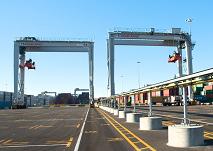
The RTGs will go into service at Garden City Terminal, Port of Savannah. With this delivery, scheduled for the summer of 2016, the Port of Savannah will operate a total of 146 Konecranes RTGs.

“This order moves us another step closer to achieving an all-electric RTG fleet at the Port of Savannah,” said GPA Executive Director Curtis Foltz. “It’s an important part of our long-term mission to reduce emissions and protect the environment around the port, while increasing the port’s efficiency and growing our business. Konecranes is our long-term partner in this endeavor.”

“It’s a pleasure to play this key role in GPA’s continuing story,” says Tuomas Saastamoinen, Konecranes’ Sales and Marketing Director, Port Cranes. “We provide GPA with reliable, eco-efficient container handling equipment that keeps their productivity high.”

The Konecranes RTGs on order are high-performance, 16-wheel RTGs with a lifting capacity of 41 tons, a stacking height of 1-over-5, and a stacking width of 6 plus truck lane wide. They will be all-electric cranes powered by a busbar system. They will also be equipped with Konecranes’ Active Load Control system which prevents container sway and significantly improves container handling performance. DGPS Autosteering is included, which keeps the crane on a pre-programmed, straight driving path. They will also have Konecranes’ TRUCONNECT remote monitoring system.

The Port of Savannah, home to the largest single-terminal container facility of its kind in North America, is comprised of two modern, deepwater terminals: Garden City Terminal and Ocean Terminal. Together, these facilities exemplify the GPA’s exacting standards of efficiency and productivity. The Port of Savannah handled 8 percent of the U.S. containerized cargo volume and 10.9 percent of all U.S. containerized exports in 2013.