Saturday, December 13, 2025
spot_img
Home Blog Page 548

Konecranes Hackathon winner announced

0

After an intense weekend, the teams presented their work to the jury and among the many excellent suggestions, team Valuemotive were the winners. The winning team’s suggestion focused on the customers’ challenges and included integration of ERP systems and crane operation.

Team Valuemotive consisted of Kristian Ovaska and Marko Laakso.

“The teams presented several good and usable ideas and it was not easy to pick the winner,” says Juha Pankakoski, Chief Digital Officer of Konecranes. “The jury, however, felt that the winning teams’ suggestion was very well-through-out and has a lot of development potential.”

“Overall, productisation of the presented concepts needs additional work, like all innovations do,” Pankakoski continues. “Further cooperation with teams participating in the Hackathon is being evaluated.”

The main idea of the Hackathon event was to experiment and find new possibilities around Industrial Internet by combining the knowhow of a leading crane manufacturer and talented ICT experts, and to get people excited around the Industrial Internet. This is a new way of working, getting new ideas and fast testing.

Infrastructure funding supports Liverpool2 international trade plans

0

Construction
is well underway on what will be Europe’s first semi-automated container port. When completed, the new Liverpool2 terminal will be able to accommodate the world’s largest deep sea container vessels.

Transport Secretary Patrick McLoughlin said: “Our record investment in Liverpool’s transport network is a huge boost to its economic growth, driven by the city’s maritime and business ambitions. Improved port, road and rail connections will link people with thousands of new jobs in the region and encourage businesses to grow. This government continues to build the infrastructure across the country that will deliver our long-term economic plan.” Mark Whitworth, Chief Executive of Peel Ports, added: “We welcome the Government’s financial commitment to upgrading the road network in and around Liverpool. This will further improve access between the port and the motorway network.

“We are investing to grow the port significantly and believe that Liverpool will increasingly be seen as a preferred option as cargo owners discover the benefits of delivering their products and goods much nearer to their end destination. Liverpool’s location at the heart of the UK offers a distinct advantage, with over 65% of the population of the UK and Ireland living within a 150 mile radius of the city.

“Having a more integrated transport infrastructure in place to be able to carry freight inland across the heartland of the UK will enable faster, more efficient and more environmentally advantageous delivery. The investment will drive jobs and deliver international trade – that represents a huge opportunity to rebalancethe UK economy.”

Last year Prime Minister, David Cameron, announced a £150m partnership to create the first canal-linked logistics park in the UK, with a direct feed from Liverpool2, connecting directly to a number of portcentric logistics hubs along the Manchester Ship Canal via barge, further strengthening the region’s supply chain capabilities.

The Port of Liverpool is connected to other parts of the UK by 10 motorways within a 10 mile radius, numerous rail connections and the Manchester Ship Canal. The largest volume and density of large warehousing (over 97k sq ft / 9k sqm) of any UK region is located within a 70 mile radius around Liverpool. The Port provides direct connections to Southampton, Rotterdam, Antwerp and Le Havre via Peel Ports’ own and third party feeder operators.

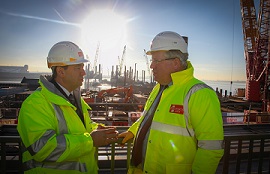
Photo shows: Mark Whitworth, Chief Executive of Peel Ports (left) and Patrick McLoughlin MP, Secretary of State for Transport overlooking the port.


Rotterdam remains the largest European port for China

0

Port of Rotterdam Authority CEO Allard Castelein announced this on 3 February, during the first quarterly meeting of the
Rotterdam Port Promotion Council (RPPC). At the meeting he analysed the throughput figures for 2014 and indicated trends for a large group of port entrepreneurs.

In 2008, Hamburg, in northern Germany, still handled the most ‘China containers’: 2.6 million against Rotterdam’s 2.2 million. The German port suffered greatly during the crisis of 2009, whereas Rotterdam’s throughput only declined moderately. Since then, Rotterdam has been the main European port for ‘China containers’, though the lead on Hamburg remains small. In 2013, Hamburg handled 2.3 million TEU; Rotterdam handled 2.4 million. Anticipating the definitive figures, the Port of Rotterdam Authority expects an increase of at least 10% over 2014.

The Chinese share of Rotterdam’s throughput will be significant and likely increase again in 2015. There are currently 18 container services per week between Chinese ports and Rotterdam.

Port of Fujairah maps out future

0

The main objective of this study is to be recognized as a World Class Port, known for efficient and safe operations and vessel handling. Independent (inter)national tank terminal operators with a combined storage capacity approx. 8 mln cbm in 2015 are sharing the same berth infrastructure, owned and operated by the Port/FOTT. This capacity is expected to further grow up to 14 mln M3 by 2018 out of which 12 mln M3 connected with FOTTs’ waterfront infrastructure. To accommodate this growth, the Port is gradually expanding the waterfront infrastructure that
includes 2 large scale matrix manifolds and related pipeline infrastructure connecting the tank terminals with the 9 deep-sea berths (up to Suezmax) or 17 berths for smaller vessels (up to Handymax) or any combination of the two. At least one deep-sea berth for VLCC’s up to 350,000 DWT will be operational by Q1 2016. In 2014, FOTT alone handled more than 3,000 tankers.

Over the past months Systems Navigator has analyzed numerous infrastructure scenarios under different operational conditions using its advanced simulation technology in combination with vast experience in port logistics. This has resulted into a good understanding of the impact of necessary enhancements on the overall Ports’ performance. Furthermore, it has given the Port of Fujairah and the terminal owners operating in the port a clear view how to improve the turn-around time of vessels and what additional infrastructure is required over time.