Saturday, December 13, 2025
spot_img
Home Blog Page 549

CMA CGM announces services from West Africa to DP World London Gateway Port

0

The CMA CGM EURAF2 service is calling direct to Nigeria, Ghana, and the Ivory Coast providing some of the fastest transit times in the market. Via transhipment, the service also offers an extensive range of West African ports with competitive transit times to key markets, including a wide range of inland destinations.

The service, which will be provided through partnership with Hapag-Lloyd and MOL, started with the Frisia Helsinki calling at DP World London Gateway on January 29 2015.

With competition still tough in the logistics world, efficiency and reliability is increasingly a key factor in supply chains. Shippers want goods to be consistently delivered on time and the technology at DP World London Gateway is helping to reduce delays in supply chains.

Trucks calling at Britain’s newest container terminal enter the port’s gates, pick up containers and exit the port in less than 30 minutes thanks to automated truck handling systems. DP World London Gateway’s superior ability to stay open in bad weather, further enhances reliability for British businesses. This technology is leading the industry to change to more efficient methods of distribution. The port, located less than 30 miles from the city of London, also combines Europe’s largest logistics park, which will see its first
distribution centre open in May.

Tabare Dominguez, Port Commercial Manager for DP World London Gateway, said: “We are delighted to be able to serve CMA CGM and we are very pleased they have chosen our state-of-the-art port for their West Africa service. We now welcome new cargo owners to Britain’s new global port and remain focused on delivering service excellence to our customers.”

Liebherr mobile harbour crane quartet for Katoen Natie

0

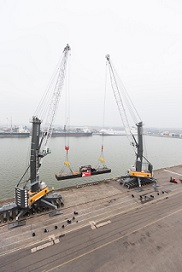
In January 2015, both family-owned companies Katoen Natie und Liebherr celebrated the handover of the strongest Liebherr mobile harbour cranes (LHM) on Antwerp’s Left Bank in a festive ceremony. Ordered twice by Katoen Natie in 2014, the LHM 600 model is the strongest mobile harbour crane available in the market and provides a maximum lifting capacity of 208 tonnes and an outreach of up to 58 metres. The first LHM 600 was delivered fully assembled in November 2014. The second crane became operational just one month later. Due to this investment in two LHM 600s, Katoen Natie can offer high-capacity tandem lifts to its customers. In this regard, innovative technology from Liebherr plays a major role. Thanks to the installation of Sycratronic®, one crane operator can safely handle heavy loads of up to 416 tonnes in tandem operation.

Manufactured by Liebherr Maritime Cranes in Rostock, these cranes will increase Katoen Natie’s competitiveness in break bulk cargo, including steel and forest products. This significant investment also demonstrates Katoen
Natie’s confidence in their operations in Antwerp. It also shows their strong focus on the expansion of the market share for heavy lift and project cargoes, which are large, non-standard pieces like wind turbines.

“Thanks to our two new LHM 600s we have expanded our portfolio and are now capable of lifting loads as heavy as 416 tonnes, which is unique in Belgium. We are very optimistic that these state-of-the-art giants in combination with our long-term experience in safe and efficient cargo handling will attract new customers. Our existing customers will also highly benefit from this significant investment as we have speeded up our vessel turnaround times,” said Joos Melis, Commercial Director of Katoen Natie.

In addition to both LHM 600s, Katoen Natie has invested in an LHM 550, which started operation in summer 2014. The LHM 550 is the most-in-demand Liebherr mobile harbour crane model and has proven its capabilities across the globe. Katoen Natie’s new machine is equipped with the unique Pactronic® hybrid power booster. This cutting-edge hydraulic hybrid drive for cranes allows for a plus of 30% regarding turnover capacity. At the same time, Pactronic® leads to a reduction of fuel/energy consumption (litre/ton) as well as CO2 and exhaust emissions in the range of 30% depending on the operation. The tasks of this new LHM 550 in Antwerp include highly efficient container and bulk handling.

Antwerp has been an important market for Liebherr mobile harbour cranes for more than 20 years. In 1990, the first unit was delivered to Westerlund Corporation in Antwerp. Over the years, the population of Liebherr mobile harbour cranes has substantially grown in the Belgian port. In 2009 Liebherr Maritime Cranes proudly opened a new office in Antwerp. Today there are eight service engineers based in Antwerp, to ensure quick response times and excellent service. Due to a notable market growth in recent years, Liebherr
is optimistic that the demand for state-of-the-art mobile harbour cranes will
further increase in Antwerp.

In addition to their major investment in Belgium, Katoen Natie has opted for another Liebherr mobile harbour crane, type LHM 420, for their facilities in Radicatel at the northern coast of France. Delivered in 2014, the new all-purpose crane will be used for general cargo operation, container and bulk handling. The LHM 420 is Liebherr’s latest model, providing an outreach of 48 metres and a maximum lifting capacity of 124 tonnes. Katoen Natie’s very positive experience with an existing LHM 250 in Radicatel was a main reason why the logistics company opted for another LHM. This LHM 420 delivery underlines the positive trend of demand for Liebherr mobile harbour cranes in France.

Caption

Two LHM 600s demonstrate their capabilities in Antwerp
Port of Hamburg achieves best-ever throughput in 2014

0

Up by 6.1 percent at 102.7 million tons, general cargo throughput was outstanding. A 1.7 percent increase in bulk cargo throughput to 43.0 million tons also contributed to the new record for Germany’s largest universal port. “Internationally, Hamburg belongs in the Champions League of world ports, achieving above-average growth compared to its European competitors,” said Axel Mattern of Port of Hamburg Marketing (HHM)’s Executive Board in presenting the port’s results. “I am very pleased with the annual result. It shows how important it is to develop and implement intelligent solutions for the port. With our smartPORT strategy, we are set on precisely the right course for the future of the Port of Hamburg,” says Jens Meier, CEO of Hamburg Port Authority.

At 9.7 million TEU (20-ft standard containers), Hamburg’s container throughput achieved a gain of 5.1 percent, above average for ports in Northern Europe while remaining just below a fresh record 10 million TEU mark that is now the aim for 2015. Strong growth in
container throughput is primarily attributable to a 9.8 percent jump in container services with China. With around 3.0 million TEU, the Middle Kingdom is Hamburg’s most significant partner for container transport. Among Hamburg’s Top Ten trading partners, Poland with 395,000 TEU (up by 22.6 percent) and India with 232,000 TEU (up by 14.9 percent) both posted fresh throughput records for container traffic. Overall, the development of trans-shipment services in the Baltic region, that in 2014 only reached slight
growth of 0.5 percent, was affected by the anticipated downturn in container traffic with Russia. Hamburg’s second largest market partner on container services may have held its place. However, the weakness of the rouble and the repercussions of trade sanctions meant that throughput in 2014 did not exceed 662,000 TEU (down 7.8 percent). “In 2014 Hamburg’s feat of boosting container throughput by 5.1 percent meant that it did extremely well by comparison with its European competitors. Hamburg is gaining market share in this segment. Average container throughput in the major ports of Northern Europe was up by 4.2 percent. Hamburg has thus consolidated its position as Europe’s second largest container port. In the worldwide ranking of container ports, Hamburg remains in 15th place,” explained Axel Mattern. Mattern also pointed out that in handling 8.5 million TEU of loaded containers (up by 5.5 percent), Hamburg has been able to report an additional record in 2014. At 87.0 percent, of Europe’s major container ports Hamburg achieved the highest proportion of loaded boxes in its throughput totals.

Throughput of non-containerised general cargo reached 2.0 million tons (up by 3.8 percent) in 2014. Growth was fuelled by exports of iron, steel, paper and timber, and a notable 19.6 percent increase in imports of tropical fruit that reached 188,000 tons.

In 2014 bulk cargo throughput rose by 1.7 percent to a total of 43.0 million tons, contributing with a share of 29.5 percent of total throughput to the Port of Hamburg’s excellent result on the year. Suction cargo at 8.2 million tons (up by 1.5 percent) and grab cargo at 20.4 million tons (up by 3.5 percent) helped to produce a fresh rise in throughput of seaborne cargoes in 2014. Growth was powered mainly by coal imports at 6.1 million tons (up by 6.9 percent) and ore imports at 9.9 million tons (up by 4.4 percent). The positive development of throughput in the suction cargo segment was attributable to grain handling, rising by 6.7 percent to reach 3.7 million tons. Grain was exported to North and West Africa in growing quantities. Throughput in the liquid cargo segment totalled 14.4 million tons (down 0.8 percent), just failing to match the previous year’s good figure. Apart from lower imports of crude oil, the downturn here was caused by slight falls in imports of palm and soya oil as well as chemical products, and restructuring at a leading Hamburg refinery. So 12.8 percent growth in exports to 4.5 million tons was not sufficient to offset decreases in liquid cargo imports.

For 2015 the Port of Hamburg’s marketing organization reckons with a further climb in throughput of seaborne cargoes. By the end of the year the total could reach 149.0 million tons, with the 10 million TEU mark achieved for containers. Further growth in seaborne foreign trade with core markets is however essential for achievement of these figures.

Khalifa Port Container Terminal achieves double-digit growth in 2014

0

This represents a 26% year-on-year growth and sets a new standard in regional growth rates.

ADT secured the exclusive right to manage and operate the first Khalifa Port Container Terminal (KPCT) by signing a 30-year concession in 2012 with Abu Dhabi Ports. The port operator garnered a number of achievements in 2014 and its more than 20% year-on-year growth over the past five years can be attributed to the strong relationships with the shipping industry and the trade community. It’s expected that this growth rate will be built on in 2015, and continued strong performance will be reached by year’s end.

Besides handling a record number of containers, 2014 saw productivity rise to an average of thirty-four GMPH (crane moves per hour) and KPCT named in the top ten growing container terminals in the world. For December 2014 alone, KPCT handled 132,339 TEUs – the highest number of containers handled in a single month in the emirate – and an increase of 26.7% compared to 2013.

“2014 has been the busiest year at Khalifa Port Container Terminal and the fifth straight year that our compound year-on-year growth has risen more than 20%,” according to Martijn van de Linde, Chief Executive Officer, ADT. “While we are incredibly pleased with this progress and everything we have achieved, we continue working on more expansion plans and further automation of our operations in 2015,” he added.

In November 2014, ADT signed a loan agreement of AED 300 million with Abu Dhabi Commercial Bank (ADCB) for the ongoing development of KPCT, showing the sustained commitment to long-term investment in the facility.

A contract signed with Borouge in June 2014 will see ADT design, construct and operate a state-of-the-art packaging facility for Borouge’s export products at KPCT, set to begin operating this March. Supporting these milestones of achievement is ADT’s diversification of supply chain services that sees it offer a full suite of logistics services to benefit trade and shipping lines. This includes the packing facility for polymers as well as an offshore depot for empty container inspection and repair.

“We are fully committed to constantly and consistently investing and improving our operations at KPCT. Our achievements and success in 2014 proves the quality of our services, our commitment to the health and safety of employees and compliance with client and legal requirements,” says Martijn van de Linde, Chief Executive Officer, ADT. “We are delighted to be setting a new standard of excellence and our mission is to continue this into the future,” he added.