


Wednesday, December 10, 2025
spot_img
Home Blog Page 552

Milestone reached after 28 years of service at Port of Brunswick

0

“On behalf of the GPA, I would like to congratulate IAP, a long-time partner at the Port of Brunswick,” said Georgia Ports Authority Executive Director Curtis Foltz. “This important milestone exemplifies IAP’s reliability and the trust automakers have in their service.”

International Auto Processing began its Colonel’s Island operation in 1986, with its first shipment of 567 Yugos (all in red). “Over the years, more and more carmakers have seen the value in using Colonel’s Island as a gateway to the Southeastern U.S. market, helping IAP and the Port of Brunswick to achieve phenomenal growth over three decades as a ro/ro facility,” said Robert Miller, president and CEO of International Auto Processing. Having grown to employ 250 full-time workers and up to 100 in flexible staffing, IAP
now serves Audi, Bentley, General Motors, Honda, Hyundai, Kia, Mercedes-Benz, Toyota and Volkswagen. In addition to receiving and storing new vehicles, IAP acts as an extension of the factory floor. The company performs quality checks, installs over 100 various accessories, and washes and prepares the vehicles for transportation to dealers.

“In 2014, we handled more than 450,000 vehicles,” Miller said. “Most of the import vehicles handled by IAP are delivered to the six-state Southeast area, although some customers serve dealerships as far west as Texas and as far north as the mid-Atlantic states.”

Imports arrive from Europe, Asia and Mexico. Exports account for about a third of IAP’s volume.

“These are vehicles manufactured in the U.S. and then exported to Europe, Asia, Central and South America,” he said, adding the vehicle handling process has evolved from its start three decades ago.

The port now ranks as the busiest in the nation for the import of new vehicles and the No. 2 U.S. port in total import-export trade. By the end of 2014, GPA terminals in Brunswick and Savannah surpassed 7 million vehicles moved since 1986.Other changes at the Port of Brunswick include additional ship berths, and the new, higher Sydney Lanier Bridge spanning the Brunswick River, which cleared the way for today’s larger roll-on/roll-off vessels.

Since the inception of the Brunswick autoport, IAP has been joined by three other auto processors: AMPORTS, Atlantic Vehicle Processors, and Mercedes-Benz USA. In FY2014, four processors served 20 automotive manufacturers, moving 674,327 vehicles over Colonel’s Island – an 8.3 percent (51,625-unit) improvement over fiscal year 2013. Including Port of Savannah Ro/Ro, Georgia deepwater ports moved 700,702 units in FY2014.
Shipping industry should be prepared for global sulphur cap in 2020 say ICS

0

Speaking after an ICS Board meeting in London, ICS Chairman, Masamichi Morooka, explained: “While postponement of the sulphur global cap until 2025 is still a possibility, the shipping and oil
refining industries should not assume that this will happen simply because they are unprepared. ICS has concluded that, for better or worse, the global cap is very likely to be implemented in 2020, almost regardless of the effect that any lack of availability of compliant fuel may have on the cost of moving world trade by sea”.

ICS members have therefore agreed that they will continue to work with the bunker refiners to help ensure that they will be ready, if necessary, to supply sufficient quantities of compliant fuel by 2020. Annex VI of the IMO MARPOL Convention allows for the possibility that implementation of the global sulphur cap – which will dramatically increase the cost of marine fuel for the shipping industry worldwide, perhaps by as much as US$50 Billion a year – can be deferred until 2025. This decision is meant to be subject to the results of a fuel availability study that IMO is legally required to complete before the end of 2018.

Despite repeated ICS requests, IMO Member States have so far refused to bring forward the conduct of the fuel availability study. If supply problems are identified at the end of 2018 this will be far too late for governments to take action. ICS member national shipowners’ associations have therefore concluded that a political decision may in effect already have been taken, at least by the United States and the European Union which view the global cap as a public health issue.

ICS’s position is influenced by the fact that the EU has already agreed, regardless of any decision by IMO, to postpone the global cap that a 0.5% sulphur limit will apply to international shipping within 200 miles of the coast of all EU Member States. In theory, if the global cap was not implemented until 2025, this would create a narrow corridor along the coast of North Africa in which ships could continue to burn less expensive residual fuel with a sulphur content of 3.5%.

ICS believes that the EU Member States will be unlikely to permit this and will therefore push hard at IMO for global implementation of the 0.5% requirement in 2020.

The ICS Board also reviewed implementation of the 0.1% sulphur in fuel requirements that have applied in Emission Control Areas, in North America and North West Europe, since 1 January. It was agreed that ICS will continue its close liaison with governments and Port State Control authorities in order to ensure a harmonised approach to implementation and enforcement that avoids unfair treatment or market distortion. ICS is particularly concerned by reports that some Port States are charging ships for the analysis of fuel samples.

Global CO2 Data Collection System

The ICS Board reviewed the negotiations at IMO towards the establishment of a global system of data collection on CO2 emissions from international shipping. ICS members expressed deep concern about the European Union’s decision to pre-empt the IMO negotiations by adopting a unilateral regional Regulation on the Monitoring, Reporting and Verification of individual ship emissions, in advance of IMO completing its work. Mr Morooka commented “The EU Regulation will have major implications for the IMO negotiations on a global data collection system which, until now, have been progressing well. There is a real danger the EU initiative will be seen by non-EU States as an attempt to present them with a fait accompli which includes controversial elements, such as the
publication of individual ship efficiency data, which had previously been rejected, for the moment at least, by the majority of governments at IMO.”

ICS members agreed that when the IMO negotiations resume at the IMO Marine Environment Protection Committee in May, it will be vital for EU Member States to explain how the new EU Regulation can be implemented in a way which is compatible with
whatever may be agreed by IMO for global application. ICS remains concerned that the ultimate motive behind the EU Regulation is to establish a mandatory ship efficiency indexing system that will be used to penalise ships financially, in a manner that could lead to a serious market distortion throughout the global shipping industry.

Operations in full swing at ICTSI's Basra terminal

0

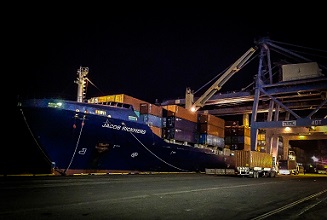
According to Phillip Marsham, BGT Chief Executive
Officer, “We are attracting plenty of interest from container lines and have enjoyed a good pace of cargo build-up since we opened the doors after full takeover in November 2014.” “Our focus is on performance, employing purpose-builtcontainer handling gear and rolling out state-of-the-art IT systems that include value-added links for customers. STS crane performance is now peaking at over 30 moves per hour and considerable attention is being focused on training staff, improving terminal security and creating a strong health and safety environment,” he added.

In a statement emphasizing BGT’s commitment to providing exceptional customer service, Munther Al-Saiegh, BGT Chief Commercial Officer, explained that “The underlying drive is to ensure superior customer experience exceeding all our clients’ requirements.”

In addition to cargo handling and IT systems deployment, BGT’s investment plans include a general upgrade of the existing facilities at Berth 20 and construction of an entirely new container/multipurpose facility, with the first phase consisting of a 250 metre berth and 20 hectares of backup land. Piling for the new quay is also underway, with ICTSI being the first active company in the sector to undertake new berth development. Upon completion, the new facility will have a 600 meter berth and 55 hectare backup area.

BGT also possesses comprehensive general, ro-ro and project cargo handling capacity. “General cargo is also healthy,” says Marsham, adding that “given the extensive terminal and supporting land areas we possess, we are keen to support our clients’ needs on specialised project cargo opportunities. We are already talking to a number of companies in this respect.”

Southern Iraq is home to some of the largest oilfields in the world. This fact, as well as other trade factors, drives a strong project cargo potential. BGT is also investing, as part of a US$130 million investment program, to accommodate this particular requirement.

BGT is a subsidiary of ICTSI, an international operator of common-user container terminals serving the global container shipping industry. ICTSI is the largest port operator in the Philippines and has a portfolio of 29 container terminal operations in 21
countries across six continents.

Kalmar introduces a new member of the Gloria reachstacker

0

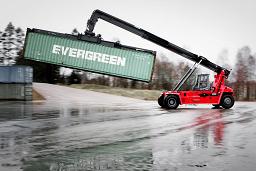
With the ability to handle all types of containers, flat racks and single loads of up to 10 tonnes, the DRG100 is the latest addition to Kalmar’s highly successful Gloria range of reachstackers. Available in two models, the DRG100-S6 stacks 6 containers high in the first row and theDRG100-S8, which has the capacity to stack containers 8 high in the second row, an option that only Kalmar is currently offering to the market.

Commenting on the launch, Stefan Johansson, Director, Sales & Marketing, Reachstackers and Empty Container Handlers at Kalmar said, “Following on from the popularity of Gloria, it was strategically important for Kalmar to develop a new reachstacker specifically for empty and semi-laden container handling. With customers now demanding higher productivity and versatility from their equipment, whilst also looking at ways to significantly reduce the costs of ownership, the time is exactly right to introduce this machine.

“So, we are delighted that the DRG100 adds another dimension to empty container handling. Containers can now be transported at full width, turned 45° or lengthwise at 90°, making it possible to deliver “end-on” into and through low workshop doors, port sheds and other confined spaces.

“Our goal was to provide the most outstanding operator experience with safety also high on our agenda. The new Kalmar Gloria is extremely stable being the only reachstacker on the market with the high-capacity 5.4m wheelbase. It has the best combined lift capacity in rows 1-2-3, a spreader with the biggest side shift and 4 extra lift hooks. Additionally, it benefits from front and reverse tilts, twistlock status indicators, plus dual rotation motors and brakes.

“In the drive train, we’ve introduced highly efficient Volvo diesel engines that comply with EU Stage 3A and 4 (EPA Tier 3 and 4 Final) emissions, provide optimum power while keeping fuel costs to a minimum. The operator is able to select from three ECO Drive Modes, effectively matching the performance of the machine to the type of application and contributing up to a 20% saving on fuel.

“Naturally, we have retained many of the features that have proved so popular in our Gloria family. For example, we have the same EGO operator cabin that provides an outstanding working environment. The DRG100 also comes fully equipped with electronic tools and an easy to use Kalmar information colour display with intuitive Human-Machine Interface. A distributed and redundant CAN-bus technology constantly monitors the engine, transmission, hydraulics and spreader functions to provide the operator with real-time data to help maximise uptime.

“Kalmar built the first commercial reachstacker thirty years ago and we’ve been stacking up innovations ever since. Our Generation G with the Kalmar Gloria DRG100 reachstacker is the latest development that takes productivity, efficiency and safety to a new level of excellence”, Stefan concluded.