

Monday, December 8, 2025
spot_img
Home Blog Page 553

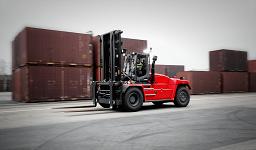
Kalmar lifts performance standards with launch of new heavy forklift

0

With a clear commitment to boosting productivity, yet reducing operational costs, Kalmar has designed this machine from the ground up, using customer feedback as an integral part of the development process. This machine is designed especially for heavy cargo handling in industrial applications, such as steel and manufacturing industry, as well as ports and terminals.

The Kalmar DCG180-330 now includes features that set new standards of performance and safety. The EGO cabin provides the operator with exceptional visibility, low noise levels and intelligent ergonomics, representing one of the most user-friendly environments available. The operator console is the operator’s extended arm as it is easy to understand, use and adjust. Providing maximum flexibility, the console puts controls, switches and indicators within easy reach, ensuring the most efficient forklift operation possible.

The operator can also select three different drive modes using the control panel. Each optimised to meet operational requirements, the operator simply shifts between modes to adapt the forklift to every type of application. The ‘Power’ setting maximises performance by increasing the number of tonnes moved per hour. ‘Normal’ setting balances power and economy to optimise profitability. If total cost of operations outweighs the need for performance, then the ‘Economy’ mode is preferred.

Compared to the previous model, the new DCG180-330 consumes up to 15% less fuel in standard configuration. By using the ‘Economy’ mode, another 15% of fuel savings can be reached. Add Kalmar’s renowned product quality and reliability, improved efficiency and higher uptime, and you see the true value of Kalmar equipment.

Lift speeds have been boosted thanks to variable hydraulic system that senses the load in every operation and adjusts the oil flow accordingly. Lifting cycles are now up to 40% faster compared to the previous model, preparing the machine faster for the next lift.

The Kalmar DCG180-330 features Cummins and Volvo engines which provide optimum power, yet contribute to a significant overall reduction in fuel consumption whilst ensuring compliance with the latest EPA Stage IV/EU Tier 4 Final emission standards.

Thomas Malmborg, Vice President, Forklift Trucks, said, “Kalmar continues to set the standard for forklift productivity, safety and low ownership costs. Purchase price is only one of many factors affecting total cost of ownership. In fact, price is a minor cost factor over the lifetime of a forklift. What truly matters in the long run is cost control and operational efficiency and they will show clearly on the customer’s bottom line.”
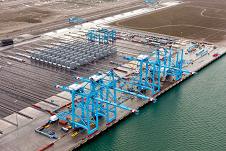
Rotterdam is the coolest

0

The rise with 50% can be contributed to the new Maasvlakte 2 terminals Rotterdam World Gateway (1,700 reefer plugs) and APM Terminal MV2 (4,500). The total is 2-3 times the capacity of the number two in the Hamburg-Le Havre Range. Also compared to the, in total handling capacity, larger container ports in Asia, Rotterdam takes a top position.

By far the largest number of reefer points, 17,600, can be found at the eight main sea terminals. The other 1,000 are distributed over specialised inland shipping terminals (300) and depots for container storage (800). For all container terminals, capacities and locations click here.

Sea terminals
About 80% of the connections at the sea terminals are concentrated at the five terminals on the Maasvlakte, although the two deep-sea terminals in the Waal/Eemhaven area have relatively many connections. Uniport still ranks two in this respect, after APMT MV2. The total capacity/connections per terminal is:

Most of the services that call in at ECT City and Uniport terminals arrive from Latin-America, South and West Africa, Oceania and Iceland/Norway. These are the source areas for meat, fish and fruit; by far the most important products for reefer containers.

Market
These frozen or refrigerated products are stored temporarily very close (Eemhaven, Maasvlakte) to the terminals in coldstores and/or have a final destination on the continent a relatively short distance from Rotterdam, up to 500 kilometres.

There is a large:
-direct substantial demand from consumers, whether or not via wholesale points such as those from Brussels, Paris/Rungis, Venlo and Barendrecht. Consolidation with Dutch horticultural products takes place at the latter locations.
– indirect demand from the traditionally strong regional/national food processing industry. These also generate re-export in reefer containers and export of Dutch products, especially dairy and potato products. Onions, flower bulbs and seed are important export products too.

In addition there is increased
sea-to-sea transit from the southern hemisphere especially to Russia, and from
Scandinavia to Asia (fish).

The favourable supply and demand situation is reinforced by the fact that many services, of which almost all those from Latin-America, call in at Rotterdam as the first port of unloading.

Handling capacity
Mostly forty-foot containers are connected to the 17,500 connections at sea terminals. With a multiplying factor of 1.8, the static capacity is over 30,000 TEU. With an average connection time of 3 to 4 days, the points’ maximum output could amount to 3 million TEU per year. Of course the actual results are reduced by seasonal influences (harvest and consumption patterns) while being stimulated by the value of the cargo and the higher costs of terminal spaces.

Dynamics
Consumption and production patterns are shifting, shipping lines change system (large Asia-services loading African cargo in Southern Europe) and others shift cargo from Waal/Eemhaven westward. It all means that Maasvlakte is becoming increasingly important for cargo in reefer containers. The increase in shipping between the southern hemisphere and North Western Europe works in the same way.

The dynamics aren’t limited to the sea side. Food has a strong emotional component and its transportation also needs to meet increasingly stricter quality requirements. Sustainability is an element of this and that is why more inland shipping is being used to and from Rotterdam for hinterland transport.

The dynamics for both sea and land mean that on the hubs, the terminals, there is a rising demand for interim storage and reefer points. The hinterland also changes in this respect. Traditionally, the Netherlands have an enormous coldstore capacity in the hinterland. Since a few years, the cool chain is extended up to and including the inland terminals as well. Barge transport of reefers will grow more important for intra-port transport too. Rotterdam Cool Port, which is expected to be kicked off this year, will be supplied from Maasvlakte by barges. In Cool Port (Waal/Eemhaven area) the cargo is reloaded in trucks, trains, barges again and short sea vessels. The latter transport mode also supplies cargo from Iceland, Scandinavia, the Iberian Peninsula and Mediterranean.

Macro
The export of seasonal fruit from South America and South Africa starts in February, which means almost all the fruit, with the exception of bananas which are produced all year. In Rotterdam, the container share in this is now full reefer vessels with pallets in their holds and containers as deck load.

The structural demand for fruit in Western Europe is hardly increasing but it is in Central Europe. The strongest growth, however, is taking place in the Middle East and Asia (taste development plus increased buying power). As a result, and reinforced by the euro/dollar ratio, more fruit flows to Asia. Increasing supply is expected but it takes time before new trees and plants are productive.

(1) The total
handling capacity of ECT City, ECT Delta and Euromax terminals in 2014/2015 is not supplied. The numbers in the table are those of February 2012 as published
in public sources.

Konecranes Financial Statement Bulletin 2014

0

Figures in brackets, unless otherwise stated, refer to the same period a year earlier.

FOURTH QUARTER HIGHLIGHTS
– Order intake EUR 513.3 million (422.2), +21.6 percent; Service +21.2 percent and Equipment +23.1 percent.
– Service contract base value EUR 196.0 million (178.2), +10.0 percent; +5.9 percent at comparable currency rates.
– Order book EUR 979.5 million (893.5) at year-end, +9.6 percent compared with a year before.
– Sales EUR 608.1 million (580.9), +4.7 percent; Service +4.4 percent and Equipment +3.4 percent.
– Operating profit excluding restructuring costs EUR 47.1 million (42.8), 7.7 percent (7.4) of sales.
– Restructuring costs EUR 1.6 million (3.1).
– Operating profit including restructuring costs EUR 45.5 million (39.7), 7.5 percent of sales (6.8).
– Earnings per share (diluted) EUR 0.51 (0.38).
– Net cash flow from operating activities EUR 66.4 million (79.6).
– Net debt EUR 149.5 million (187.3) and gearing 33.3 percent (42.1).

FULL-YEAR 2014 HIGHLIGHTS
– Orders received EUR 1,903.5 million (1,920.8), -0.9 percent; Service +4.9 percent and Equipment -4.3 percent.
– Sales EUR 2,011.4 million (2,099.6), -4.2 percent; Service +0.7 percent and Equipment -8.1 percent.
– Operating profit excluding restructuring costs EUR 119.1 million (115.5), 5.9 percent (5.5) of sales.
– Restructuring costs EUR 3.2 million (30.9).
– Operating profit including restructuring costs EUR 115.8 million (84.5), 5.8 percent of sales (4.0).
– Earnings per share (diluted) EUR 1.28 (0.85).
– Net cash flow from operating activities EUR 148.4 million (120.2).
– Dividend proposed by Board of Directors is EUR 1.05 (1.05) per share.

MARKET OUTLOOK
European customers are still cautious about investing. The Purchasing Managers’ Indexes are giving a reason for the continued optimism regarding the U.S. market. The near-term market outlook in emerging markets remains uncertain. Continued contract base growth bodes well for the future of the service business.

FINANCIAL GUIDANCE
Based on the order book, service contract base and the near-term demand outlook, the year 2015 sales are expected to be higher than in 2014. We expect the 2015 operating profit, excluding restructuring costs, to improve from 2014.

President and CEO Pekka Lundmark: “Year 2014 ended with a good quarter. Noteworthy is that both our business areas – Service and Equipment – improved from the fourth quarter 2013 in all key aspects: orders, sales, operating profit, and operating margin were all higher than a year ago. Service operating margin excluding restructuring costs increased to 12.1 percent and also Equipment improved to 5.4 percent. In addition, service contract base continued to grow and it now stands at EUR 196 million, 10 percent up from a year ago.

Summarizing full year 2014, we can be reasonably satisfied with the fact that our operating profit excluding restructuring costs improved, in spite of net sales dropping by EUR 88 million, to EUR 2,011 million. The operating margin excluding restructuring costs improved from 5.5 percent in 2013 to 5.9 percent in 2014, which is a good achievement in a volume decline, though still way below our target 10 percent.

The twofold development between our two businesses sustained throughout the year. Service business continued on the steady path it has had for the last three years and the operating margin excluding restructuring costs climbed to 10.0 percent from 9.1 percent the year before. This was the third consecutive year of operating margin improvement. Systematic restructuring of non-performing units, introduction of new services, and focus on sales management were the principal contributors to the improvement. The main issue in the Service business has been the weak topline growth, but the promising order intake in the second half of the year combined with strong contract base development bodes well for both growth and profitability prospects in 2015.

While the Equipment business was able to lower the cost and improve the project execution to mitigate the effects of the lower volume, we obviously cannot be satisfied with the 3.8 percent operating margin excluding restructuring costs. There were, however, big performance differences between the different product lines and geographical market areas. I want to highlight the excellent performance of our lifttruck business that posted both good growth and result. The new management of the Equipment business launched a comprehensive turnaround plan in the second half of 2014. As part of the plan, we decided to simplify our operational model and reduce our cost base by a further EUR 30 million by the end of the first quarter 2016.

Cash flow was strong and it helped to lower our gearing to 33.3 percent and improve return on capital employed to 17.0 percent from 11.6 percent the year before. Earnings per share grew to EUR 1.28 from EUR 0.85 in 2013.

I am cautiously optimistic about the year 2015. We started the year with an order backlog that was 9.6 percent higher than a year ago. The funnel of new opportunities we are working on is also promising. The weakening euro is increasing the competitiveness of our European manufacturing units. Our newly launched products provide new growth opportunities, and cost efficiency programs are moving forward. The continuous improvement of skill sets, knowledge, and expertise of our employees through new tools and processes, extensive training and best work practices gives us a solid base for capturing the new era of digitalization. We are of course always dependent on the general economic and geopolitical development, but I am confident that these matters that we can affect are developing in the right direction.”

Pilbara Ports reveals shipping figures for January 2015

0

The Port of Port Hedland achieved a monthly throughput of 37.3Mt, an increase of 8.5Mt or 30% from the same month in 2014.

Iron ore exports for the month totalled 36.7Mt, an increase of 8.5Mt or 30% from the same month in 2014.

Imports totalled 200,000 tonnes, a slight decrease of 7,000 tonnes or 4% from the previous year.

The Port of Dampier delivered a total monthly throughput of 12.8Mt, a slight decrease of 236,000 tonnes or 2% from the previous year.

Imports totalled 72,000 tonnes, an increase of 4,000 tonnes or 6% from the same month in 2014.