

Monday, December 8, 2025
spot_img
Home Blog Page 566

Slight increase in cargo throughput at the port of Rotterdam

0

Oil products fell the most, by 8.1%. An extra 4.8% of crude oil passed through the port. Dry bulk fell by 0.7%. “In 2015 we expect the same growth in throughput as last year: 1%. This year too, the main growth is expected in the container sector. In the coming years, we will nurture the large, existing sectors in the port, whilst also focusing strongly on innovation and broadening the range of activities in the port. We need both for a healthy future,” said Allard Castelein, Port of Rotterdam Authority CEO.

During this annual presentation,
Castelein also paid plenty of attention to the challenges facing the port. “We are seeing major changes not only in the energy sector and the chemical industry, but also in logistics,” according to Castelein. “So that the port can continue to be a strong pillar of our prosperity in the long term, we are working with business on innovation and on broadening the range of activities in the port. We can already see evidence of this in the increase in offshore activities, but the energy and chemical sector also need to become more sustainable. We are focusing on increasing efficiency in industry and on developing bio-based industry. For the container sector the development of the hinterland connections is particularly important. This year the new container terminals on Maasvlakte 2 will be busy starting up; from 2016 onwards, however,
there will actually be extra capacity for further growth”.

Containers and breakbulk show sharp growth
There was a 5.8% increase in container throughput, to 12.3 million TEU (numbers) and a 5.2% increase to 127.6 million tonnes (weight). This sharp rise can be explained by a combination of factors. The economy in both the Eurozone and the United Kingdom is improving. As a result, there has been an increase particularly in the deepsea volumes on the shipping routes to Asia and North America. Moreover, the initial effects of the increase in scale in container shipping became visible: Rotterdam is an attractive port for the ever larger ships.

Breakbulk is a combination of roll on/roll off (ro/ro) traffic and other mixed cargo. Throughput in this category increased by 12.1%, to 26 million tonnes. Ro/ro traffic was up by 8.1%, thanks largely to the improvement in the British economy. In the category other mixed cargo, steel, non-ferrous metals and project cargo did particularly well. Other mixed cargo, for years on the decline as more and more cargo disappeared into containers, did exceptionally well, with 28.1% growth.
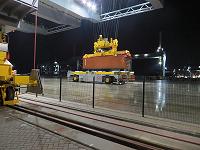
First commercial test ship for RWG

0

About half of the containers were unloaded the following day onto a barge.

In the coming months RWG will regularly receive commercial ‘test’ vessels, which will further increase the volume and functionalities. In the second quarter of 2015 RWG will welcome their first weekly service.

The loading and unloading is carried out through a fully automatic process, where the containers on a lift-AGV are placed. This fully electric Lift AGVs have performed transportation to the stacker cranes of RWG. The containers are then loaded via an automatic process onto a barge. In subsequent tests other modalities will be used for further transport to the hinterland.

Contship's Marine Terminals first to welcome the 2M (East – West) network service calls in Italy

0

The ZAMBIA departed MCT January 16th, being the debut call in Italy for 2M, kicking off the network. The ship is deployed in the Mediterranean – US Gulf string and is followed by the SEALAND ILLINOIS serving the Mediterranean to US
East Coast ports. LSCT steps up today with the ZAMBIA berthed early morning on Fornelli East, followed by the SEALAND ILLINOIS. Both terminals have been gearing up to ensure a reliable service to the new networks, including 2M.

MCT
Managing Director, Domenico Bagalà comments “…. given the word class infrastructure here in Gioia Tauro the usual focus is on ULCC ships and high volume transhipment, whether this be relay to other network strings and/or pure transhipment to connecting ships. But here, I am happy to note that our customers are highlighting the benefits of serving local markets in South Italy, something that is not always recognized, as MCT is well located to serve both import and export traffic regionally:
Bari, Sicily, Naples and its’ extensive hinterland even as far as Rome using rail connections. MCT has always handled local traffic, but clearly transhipment dominates as we shall see in the new networks when the first Asia
–Mediterranean calls arrive shortly…”

Michele Giromini, LSCT Managing Director, adds ” …we thank the 2M network to including the La Spezia System in its’ planning and offer a warm welcome return to Maersk Line direct services between La Spezia and the USA. It is a privilege to count on the world’s top shipping lines to be amongst our valued customers here in LSCT. In the North Tyrrhenian port range, there is a choice of port calls from which the market may select. Why La Spezia? We like to think that it is all about the ability to serve multiple
markets, consistent performance and reliability not only to the ship but also and most vitally to the cargo. The La Spezia System does not overlook this important element. Cargo flows through the System and we are now adding to the number of weekly trains in 2015 compared to 2014. It is well known that the actual market of origin and destination is not in the local city ports, but in the hinterland behind the ports. The La Spezia System extends north, south into the Italian import consumer and export markets as well as Switzerland and beyond. I am sure, like all of our valued customers, that the 2M network will be able to take advantage of what La Spezia provides in the market to support its’ own evolution with reliable and fast transit times to its’ customers.”

The Port of Kiel can post positive results for 2014

0

The port turned over 6.43 million tons of cargo, 1.6 % more than in the previous year. Stena Line’s Kiel-Gothenburg route recorded the biggest increase in general cargo handling while Color Line’s Kiel-Oslo service posted the strongest growth in passengertransport. During the year a total of 1.98 million passengers started or ended a ferry or cruise ship journey in Kiel – an increase of 1.9 %. Dirk Claus,
Managing Director of the Port of Kiel (SEEHAFEN KIEL GmbH & Co. KG) said:”along with the growth in transport to and from Scandinavia and a rise in bulk cargo handling, there was, however, a decline in business with eastern Europe.The port currently finds itself in a situation adversely affected by the crisis in the Ukraine, a weak Russian currency and new environmental regulations.” While ferry traffic to and from Scandinavia rose by a good 5 % to more than 2.7 million tons, eastern Europe transport showed similar decline to only just about 2.4 million tons. An important growth factor in 2014 has been bulk cargo handling – especially the handling of building materials. Thanks to the expansion of outdoor storage areas in the Scheerhafen, the port was able to handle 370,000 tons of loose gravel for the first time. “Kiel is ideally located to supply the construction industry in the whole of Schleswig-Holstein and as far as Hamburg”, said Dirk Claus. “The Scheerhafen is of great regional importance”, he declared. On the eastern bank of the Kiel Fiord work is meanwhile underway to expand the Ostuferhafen – Kiel’s cargo and logistics hub. Six hectares of additional area are being reclaimed there. Among other things, a new drainage system for the area is being created, interlocking concrete paving laid, lamp posts being erected and the site fenced in to comply with ISPS regulations. “We are creating urgently needed operational and outdoor storage areas to promote further growth in sectors such as forestry products”,
says Dirk Claus. The SEEHAFEN KIEL with the support of the federal state of Schleswig-Holstein, is investing a total of about 12 million Euros in the Ostuferhafen. The work will be completed in the summer of 2015.