


Since its opening in 2013, the Freight Village Kaluga, located in the industrial area Vorsino in the southwest of Moscow, has been one of the most heavily frequented multimodal transport & logistic centres in this region. On a total area of around 500 hectares, the high-performance rail terminal handles up to 500,000 TEUs annually. In order to ensure efficient container handling, the freight centre has been using Liebherr reachstackers for two years now. At the beginning of 2019, the management decided to expand the fleet by two additional Liebherr LRS 545-31 reachstackers. In addition to its sophisticated technology, Liebherr was also able to impress with a particular short delivery time. Only three months passed between the initial negotiations and commissioning of the two new machines. Despite the 24/7 operation, the reachstackers still operate fully efficiently – even after 12,000 operating hours. One reason for this is the excellent service provided by Liebherr- Russia OOO. The vast majority of reachstackers offered on the market operate with an outdated mechanical drive system. This type of mechanical power transmission has not been further developed for many years and is therefore no longer up to date. Liebherr relies on a hydrostatic drive for many machines, such as the Liebherr wheel loaders, which have already been sold more than 50,000 times. The Liebherr Reachstacker LRS 545 is also equipped with a hydrostatic drive. This type of drive requires neither a torque converter nor a differential. The result is at least 25% lower diesel consumption compared to equivalent reachstackers from other suppliers. In the Freight Village Kaluga, experience has shown that fuel consumption is between 12 and 13 litres per working hour. The hydrostatic drive also provides significantly better and more sensitive handling, which is indispensable when handling valuable freight in the containers. In addition, the drive wheels of the LRS 545 are individually powered. This leads to a small turning radius, an extended service life of the tyres and, above all, to a great deal of driving pleasure.
Cyber security is a technical issue not a human one
In agreement with comments made recently in Dubai during a Cyber Risk and Data Theft seminar, that cyber security is still considered by shipping companies and terminal operators as an after-thought, Sela does not agree that better cyber awareness, crew training or the implementation of crew guidelines alone will have a lasting positive effect. “When the cyber-criminal will always need the unwitting assistance of an unsuspecting crew member, technician or employee to activate or spread the virus, irrespective of the level of their cyber training or awareness, it is not enough to put it under the ‘human factor’ umbrella or apportion individual blame when a critical system has been breached. “A cyber incident happens because systems are not protected, and hackers will continue to develop innovative ways and sophisticated solutions intended to take advantage of any weak spots in human nature. The implication, therefore, is that any cyber awareness training is a waste of time and money.”
The sophisticated methods hackers use is evident by the deployment of a new, previously unknown malware trojan called xHunt, which researchers at Palo Alto Networks’ Unit 42 say is being used to specifically target the shipping industry. It is alleged that xHunt and Hisoka – a backdoor used to facilitate trojan delivery – were successful in infiltrating the networks of two shipping companies operating out of Kuwait. “The attackers have added some fun capabilities to Hisoka and its associated toolset. The attackers are aware of probable security measures in place at their targets and have attempted to develop ways to get in undetected,” Ryan Olson, Vice President of threat intelligence at Unit 42, told ZDNet. Given that hackers will always find a way in, Sela believes attributing blame to individuals is pointless. It is also problematic because of the potential legal proceedings envisioned should a virus result in damage to the ship, its systems, personnel or the environment.
“It would be very easy to point the finger at an individual crew member, technician or employee for inadvertently spreading malware or other viruses, but this would not prevent further system breaches. What it will do is create unnecessary friction between employers and employees.” He adds that limiting crew members’ access to the internet, social media or mobile phone charging facilities will also create problems. “Prohibiting internet access is not the answer. This is now considered a basic human right and with many seafarers away from loved ones for months at a time, if they are unable to maintain regular contact with those at home, then not only could it adversely affect their well-being but deter others from a maritime career.”
Sela says the maritime sector – shipping companies and port operators – needs to adopt technical solutions to prevent system hacking, rather than simply implementing a culture change.Recalling incident where a Mobile Offshore Drilling Unit lost control of its Dynamic Positioning system while drilling in the Gulf of Mexico, Sela says the investigation found that various crew members introduced malware when they plugged in their smart phones, and other devices. “Would this have been considered human error if the DP and associated OT systems were adequately protected and the hack thwarted? I doubt it. If cyber-crime continues to be designated a human factor event, then the industry does not fully grasp the cyber problem.”
GPA opens 40 dockside acres to auto processing
“The Coast Guard and our Brunswick maritime community came together in an impressive display of teamwork, focused first on the safety of the crew, and now on protecting the natural environment and the safety of vessel operations,” Lynch said. “In only four days, we were able to reopen the port, protecting the livelihoods of our direct employees and thousands of others across the region. On behalf of the Georgia Ports Authority, I would like to thank all those involved in the rescue and salvage operations.”
Georgia Gov. Brian Kemp said U.S. Coast Guard Cmdr. Norm Witt of the Marine Safety Unit in Savannah and Captain John Reed are to be commended for the Coast Guard’s quick rescue of the ship’s crew and river pilot, and for their continuing work to restore normal operations.
“I applaud the quick action of the Coast Guard, tugs, maritime engineers and emergency responders in the rescue of the ship’s entire crew and the river pilot on the Golden Ray,” Kemp said. “We all felt tremendous relief as the last sailor was brought to safety. Now that the mission has shifted to recovery, we appreciate the Coast Guard’s efforts to accommodate river traffic while salvagers work to right the vessel and clear the channel. The Port of Brunswick is an important asset to Georgia, supporting employment across an array of industries.”
Port activity in Glynn and the five surrounding counties supports nearly 11,000 jobs in business sectors such as forest products, automobile processing, retail and other services according to an economic impact study conducted by the University of Georgia’s Terry College of Business. Statewide, Georgia’s deepwater ports support more than 440,000 full- and part-time jobs, yielding $25 billion in personal income each year. The growth at Colonel’s Island autoport is thanks in part to its logistical advantage, including immediate access to Interstate 95, and from there, I-10 and I-16.
“Brunswick’s proximity to Southeastern dealerships and auto manufacturers, combined with its ability to reach important inland markets via CSX and Norfolk Southern, makes it an ideal hub for the import-export of vehicles,” said GPA Board Chairman Will McKnight. “Service from nine ocean carriers means Brunswick has the global connections to efficiently move exports and imports.”
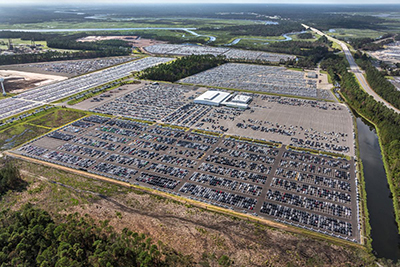
During the event hosted by the Brunswick Golden Isles Chamber of Commerce, Lynch also announced the development of a 40-acre dockside parcel dedicated to auto processing at the Roll-on/Roll-off port at Colonel’s Island Terminal. “Construction is complete and the new space is now open for Ro/Ro operations,” Lynch said. “With this expansion, the Port of Brunswick is ready to take on substantial new business.”
The development increases the car storage area by approximately 6,000 spaces, and provides a 9-acre staging area for high and heavy equipment being loaded or unloaded from vessels. The benefits will include additional capacity and speedier vessel processing.
The new dockside expansion will increase GPA’s rail capacity for autos at Brunswick, adding 14,100 feet of track. This, in turn, will allow Brunswick to expand service in markets west of the Mississippi River and into the American Midwest. In FY2019, more than 110,000 vehicles were transported to inland markets from Brunswick by rail.
GPA has also added a second access road between the docks and the island’s south side. This provides a more direct route to existing auto processing lots and new development on the south end of the terminal. Also at the Brunswick State of the Port, Lynch thanked BMW for signing a new 20-year contract to move vehicles through Colonel’s Island Terminal. The German carmaker has tapped Georgia Ports for vehicle logistics since 1988. In the last 15 years, BMW has moved 612,000 vehicles via Brunswick. In FY2019, the Port of Brunswick handled a total of nearly 614,000 units of Roll-on/Roll-off cargo, an increase of 4 percent, or 23,000 units. Including the 36,000 units moved via Ocean Terminal in Savannah, Georgia is the second busiest hub for the import-export of vehicles, machinery and other types of Ro/Ro cargo in the U.S. At East River Terminal in Brunswick, terminal operator Logistec moved 1.2 million tons of bulk cargo in FY2019, an increase of 203,000 tons, or 20 percent. The improvement was largely associated with an increase in wood pellets, peanut pellets and perlite.
Cyber protection – IEC Telecom urges maritime sector
Forget images of James Bond-style villains hijacking tankers or cruise ships – the biggest threat to cyber security for the majority of vessels at sea is the hapless downloading of a virus by staff members not following proper procedures.“Too many companies treat digital security as an after-thought and do not have suitable policies and procedures in place,” warned Nabil Ben Soussia, Vice President Maritime of IEC Telecom. “There is a lack of awareness of how one silly slip-up, like downloading a virus from the internet or a memory stick, can destroy your working environment.”Maritime sector firms need to adapt their methods of working to encompass cyber issues, he advised. “They need to redefine their rules to take account of cyber security. The tools are there to protect their data and equipment but they need to take responsibility and manage the risks,” he said, explaining that tech companies like IEC Telecom have the solutions available. “We can do everything the company policy requires – but they have to define the policy first.”Mr Ben Soussia says ‘upskilling’ is needed across the maritime sector to enable everyone from senior management and ships’ captains to crew members to fully understand cyber risk and correctly implement good cyber practices.The shipping industry is currently debating whether to extend or limit the amount of access crew members have to online services such as the internet, social media or even third-party training tools. Mr Ben Soussia explained that it is easy to provide crew with access to online activities without risking the security of the vessel. “It’s a case of managing the corporate environment,” he said. “You need to secure critical systems in a closed network with limited and protected access from certain terminals only, strictly implement proper policies and properly train crew.”Accessing the internet in their personal time is a natural expectation from today’s new recruits. “The new generation are hopeless without the internet,” he said “they find everything via google or YouTube.” A variety of solutions are available to enable ship operators to keep crew happy without risking critical networks, including data ‘scratch cards’ to access internet facilities, and even limits to switch off personal wifi access during official socialisation periods.Speaking in Dubai ahead of this year’s Seatrade ShipTech Middle East conference, where he will take part in a panel discussion considering cyber risk, Mr Ben Soussia said: “Vessel digitalisation is an essential part of tomorrow’s shipping industry but we need to be careful of putting all our information ‘eggs’ in one ‘basket’ without proper implementation of systems and policies to protect them.”