

A draft assessment was released in April. It examined the current state of technology, operational characteristics, economic considerations, infrastructure availability and commercial readiness relating to cleaner cargo-handling equipment. The CAAP also has a goal to transform its fleet of drayage trucks to zero-emissions by 2035. As part of this strategy, the ports committed to developing feasibility assessments every three years for terminal equipment and drayage trucks to determine a path toward meeting those goals. The first drayage trucks assessment was released earlier this year.The ports plan to continue demonstrating advanced technologies and collecting information to prepare the future studies.Updated in 2017, the CAAP contains a comprehensive strategy to accelerate progress toward a zero-emissions future while protecting and strengthening the ports’ competitive position in the global economy. Since 2005, port-related air pollution emissions in San Pedro Bay have dropped 87% for diesel particulate matter, 58% for nitrogen oxides and 97% for sulfur oxides. Targets for reducing greenhouse gases (GHGs) from port-related sources were introduced as part of the 2017 CAAP Update. The document calls for the ports to reduce GHGs to 40% below 1990 levels by 2030 and 80% below 1990 levels by 2050. The CAAP was originally approved in 2006.The Port of Los Angeles and Port of Long Beach are the two largest ports in the nation, first and second respectively, and combined are the ninth-largest port complex in the world. The two ports handle nearly 40% of the nation’s total containerized import traffic and 25% of its total exports. Trade that flows through the San Pedro Bay ports complex generates more than 3 million jobs nationwide.
GPA achieves busiest month ever for containers
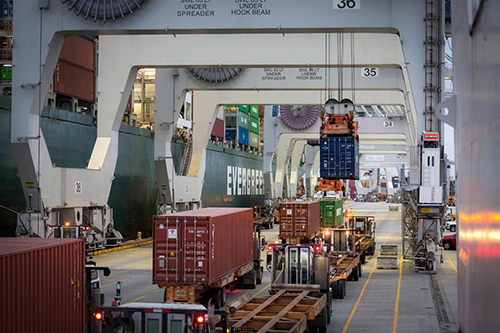
At the GPA Board meeting recently, Executive Director Griff Lynch reported August volumes grew by 62,000 TEUs or 16.5 percent compared to the same month last year. “We’re seeing an early and strong start to peak season at the Port of Savannah,” said GPA Executive Director Griff Lynch. “In addition to expanding trade on our regular weekly services, shipping lines are adding calls by sweeper ships to meet rising demand.” In August, GPA handled eight extra ships over its regular 37 weekly vessel calls, adding nearly 20,000 TEUs to the month’s volume. Lynch noted increased business through the Port of Savannah is driving private investment, but the industrial vacancy rate remains low. Of structures offering 100,000 square feet or more, the vacancy rate is 1.42 percent.
“At GPA, we’re making a call to action for private developers to enter or expand in this very active market,” said GPA Board Chairman Will McKnight. “Within a 30-mile radius of the Port of Savannah, there are more than 20,000 acres of industrial park space ready for development.” Over the past two years, property that the Georgia Ports Authority put on the market within its Savannah River International Trade Park has been developed, adding 5 million square feet of distribution space for companies such as Shaw, Safavia, Wayfair and others. At its September meeting, the GPA Board approved $3.75 million in road improvement projects to avoid truck congestion at the trade park. New construction in Fiscal Year 2019 added 10.7 million square feet of industrial space across the Savannah market, for a total of 67.7 million square feet. Thanks to the fastest net absorption as a percent of inventory in the nation, most of that new construction has already been occupied, according to Colliers International.
In April, California-based Plastic Express, in conjunction with Capital Development Partners, announced plans to invest $172 million in a new 2.4 million square-foot Savannah facility. The first phase of the rail-served location is scheduled to open for operation in November.
To better accommodate the growth in cargo crossing Garden City Terminal docks, the Authority is making port improvements, such as:
Commissioning four new Neo-Panamax ship-to-shore cranes in FY2019, bringing its Garden City fleet to 30 – the most of any single terminal in North America.
Six more ship-to-shore cranes will arrive by early March. The new cranes will be commissioned in the first half of Calendar Year 2020, allowing GPA to move up to 1,200 containers per hour.
Increasing Savannah’s rubber-tired gantry crane fleet to 158. Another 20 RTGs will arrive in shipments of five in June, July, August and September 2020. Growing the fleet to 178 will ensure efficient terminal operation and the free flow of cargo.
Building new RTG rows to add 400,000 TEUs in annual capacity. This will bring Garden City Terminal’s total yearly capacity to almost 6 million TEUs by March.
82.4% surge in Abu Dhabi Ports’ container volume in the first half of 2019
The agreements have seen an increase in the number of vessels taking advantage of Khalifa Port’s strategic location and world-class facilities, as well as significant further investment in state-of-the-art technology and infrastructure. Container volume at Khalifa Port rose from 620,974 TEUs in H1 2018 to 1,135,021 TEU in H1 2019 – an increase of 82.4%. This growth was fuelled predominantly through the MSC concession agreement, which was signed last year. Abu Dhabi Ports anticipates further growth thanks to completion of the CSP Abu Dhabi Container Terminal, which was built in partnership with COSCO SHIPPING Ports and which began trial operations in Q2 2019 – ahead of the start of full commercial operations in Q4 2019. Both agreements are part of Abu Dhabi Ports’ five-year strategy to boost the UAE’s trade and investment flows, and drive the diversification of the UAE economy. As a result, Abu Dhabi Ports will be expanding the capacity of Khalifa Portto 9.1 million by 2024. The port is capable of handling the world’s largest vessels withtwo 21,000 TEU mega-vessels, the COSCO SHIPPING SOLAR and PISCES, having already called at CSP Abu Dhabi Terminal earlier this year.
H.E. Falah Mohammad Al Ahbabi, Chairman of Abu Dhabi Ports, said: “Despite a challenging international environment for the trade and logistics sectors in recent years, our industry continues to grow from strength to strength in the UAE. I am delighted that Abu Dhabi Ports is playing a key role in ensuring that our nation is at the heart of trade, industry and logistics in the Middle East. “Our strategy to collaborate with some of the world’s top industry players is proving to be a huge success and is a reflection of the vision of the UAE’s leadership, whose support and guidance continue to enhance our success.”
Captain Mohamed Juma Al Shamisi, CEO of Abu Dhabi Ports, said: “Our half-year figures illustrate the outstanding growth we are witnessing in our business, from containers to cruise ships. With the commencement of commercial operations at CSP Abu Dhabi Container Terminal and the rejuvenation of Port of Fujairah on track through our joint venture with Fujairah Terminals, we expect our strong growth to continue. Our success is a testimony to the fact that more and more firms are realising the opportunities that Abu Dhabi offers across the Middle East, Africa and Asia, as well as along China’s Belt and Road maritime route.”
In addition to the increase in container volume, Abu Dhabi Ports also witnessed a significant increase in the total volume of cargo handled across its ports, which also include Fujairah Terminals, Zayed Port and Mussafah Port. Total cargo increased to just under 9.7 million tonnes in the first half of 2019, a rise of 10% compared to the same period in 2018. In June, the first fully-laden Capesize vessel to ever call at a GCC port arrived at Khalifa Port after Abu Dhabi Ports modified the approach channels to accommodate Capesize vessels. The channels have been deepened from 16.5 metres to 18.5 metres draft and widened from 250 metres to 280 metres. Meanwhile, KIZAD continues to attract more investment, with agreements signed with DHL Global Forwarding and Gulf Compound Blending Ind. Ltd in H1 2019, while work was also started on the AED 2.2 billion Roadbot Tyre Project. Once completed, the 275,000 square metre facility will have a production capacity of 10 million Passenger Car Radial (PCR) tyres and 1 million truck and bus radials by 2022. To date, Abu Dhabi Ports has attracted more than 500 companies to KIZAD and more than AED 65 billion in investment across multiple sectors, including metals, polymers, oil and gas, automotive, food, energy, and logistics.
Abu Dhabi Ports attributed the slight drop in Roll-on Roll-off (RORO) figures, from 78,163 units in H1 2018 to 73,590 unit this year, to a drop in new car sales. However, Abu Dhabi Ports saw a significant increase in cruise passengers in the first half of the year, with the total number increasing from 237,169 in H1 2018 to 321,277 for the same period this year – an increase of 35%. This was reflected in the number of cruise vessels calling at either Zayed Port, Fujairah Terminals or Sir Bani Yas Cruise Terminal, with total calls increasing from 93 to 129 – an increase of 38%. Fujairah’s cruise passenger numbers almost tripled from 5,931 to 14,441. Abu Dhabi Ports attributed the significant rise in passenger numbers due to investment in cruise facilities at the three terminals, as well as strategic partnerships with organisations such as Etihad Airways, which serve to improve the cruise passenger experience and render Abu Dhabi a destination of choice within the region.
Jacksonville’s maritime community supports The Bahamas
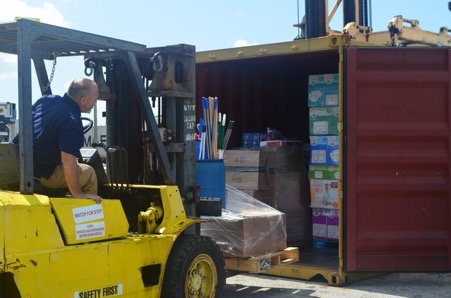
The container was donated by Mediterranean Shipping Company (MSC) and shipped to Freeport from JAXPORT aboard an MSC vessel. The donated items, which include first aid kits, emergency blankets, food, toiletries, clothes, diapers and more, were collected, packed and shipped during a donation drive organiszed by SSA Atlantic, with support from other Blount Island Marine Terminal tenants, Jacksonville labour unions and maritime service providers. “It’s going to be a marathon, not a sprint – and there’s much more work to be done,” said SSA Atlantic Vice President Florida Operations Frank McBride. “We are thankful to MSC and our maritime partners here in Jacksonville for taking action and helping us get these much-needed supplies to the island as quickly as possible.” Other participants in the effort included TraPac Jacksonville, ILA Local 1408, ILA Local 1593, C&K Trucking, AMPORTS, Marine Repair Service, BJ’s Wholesale and the Jacksonville Maritime Association. SSA and MSC will be shipping two more containers to the island over the next couple of weeks – one of those will include 10 pallets of rice donated by Mars Food US LLC and the second to include donations collected from Fernandina Beach High School and others in the community. The American Red Cross and JAXPORT have also established a website for cash donations to help victims of Hurricane Dorian. JAXPORT offers regular containerised cargo service to Nassau and Freeport in The Bahamas, as well as year-round cruise service to the island aboard Carnival Cruise Line’s 2,056-passenger Carnival Ecstasy.