

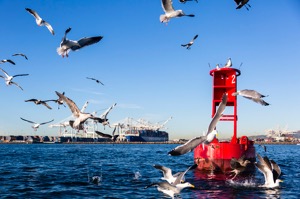
In addition to diesel particulates, the study found the port’s aggressive actions to curtail pollution have decreased smog-forming nitrogen oxides by 56% since 2005. Sulfur oxides were down 97% and greenhouse gases are 16% lower.“We’re seeing the results of the hard work by the Port and the goods movement industry, and we’re showing the world that sustainable cargo movement is possible,” said Long Beach Harbour Commission President Bonnie Lowenthal. “There’s work to be done to get to our ultimate goal of zero-emissions operations, but I’m confident we will get there together.”While emissions remain dramatically lower than they were in 2005, the port-funded study for 2018 found a small increase in diesel particulates and greenhouse gas emissions from the previous year’s inventory. The 2017 inventory measured an 88% decrease in diesel particulates and an 18% reduction in greenhouse gases compared to the 2005 baseline year. Port officials attributed the change to record throughput of 8.1 million twenty-foot equivalent units in 2018.“We’ve accomplished these reductions even while container traffic has risen 21% since 2005,” said Port of Long Beach Executive Director Mario Cordero. “We are proud of what we’ve done in cooperation with our many partners, but we’re not finished. The port is managing USD150 million in projects all across our port, all in the name of cleaner air. This includes USD80 million in grant funding to demonstrate zero emissions equipment and advanced energy systems in port operations.”Learn more about the projects at polb.com/zeroemissionsgrants.The purpose of the emissions inventory is to measure and track the overall cumulative progress of Clean Air Action Plan measures and ensure the port is on track to meet emission reduction goals. The study calculates the amount of pollution coming from all the ships, trucks, locomotives, harbour craft and yard equipment working at the port, with the help of terminal operators and other businesses. The results are reviewed by the U.S. Environmental Protection Agency, the California Air Resources Board and the South Coast Air Quality Management District.
Konecranes wins order from Texas, USA for mobile harbour cranes
The Port of Brownsville, the only deepwater port located on the U.S./Mexico border, is currently experiencing an increase in cargo volume across its range of services. The two new cranes will be delivered to the port fully assembled and commissioned, ready to begin work as early as December 2019. The cranes will handle a wide variety of cargo including breakbulk, bulk products, heavy project cargo and steel products. The Model 6 cranes have advanced mobile harbour crane drive technology from Konecranes that meets EPA Tier 4f emission standards, helping Brownsville reduce its environmental footprint.
“The Port of Brownsville continues to invest significantly in its continued growth, including expansion of our on-dock lifting capacity,” said Eduardo Campirano, Port Director and CEO of the Port of Brownsville. “We look forward to the operational and environmental performance that the Konecranes Gottwald Model 6 offers as we continue to serve our rapidly growing customer base.”
Giuseppe Di Lisa, Sales and Marketing Director of Konecranes’ Business Unit Mobile Harbour Cranes: “The two new cranes are the right choice for the Port of Brownsville, which needs to increase its handling performance while reducing its impact on the environment without sacrificing versatility and flexibility. These mobile harbour cranes will come into their own in this port, which handles many different types of cargo.”
The new Konecranes drive concept for mobile harbour cranes combines, depending on the crane model, Volvo Penta 625 kW diesel engines and 125 kW ultracap modules. This concept includes SCR exhaust technology as an option, meeting EPA Tier 4f and EU Stage V emission standards. This pacesetting drive technology with its downsized diesel engine will be introduced in phases across the entire Konecranes Gottwald mobile harbour crane portfolio. “All the current drive configurations will remain available as the new technology is introduced”, Di Lisa added.
The Port of Brownsville’s new Model 6 cranes will be G HMK 6507 two-rope variants featuring a powerful lifting curve with a maximum lifting capacity of 125 tons and an outreach of up to 51 meters. To maximise uptime, the cranes will be equipped with a remote access function giving the customer and the Konecranes service team access to operating and diagnostics data around the clock without interrupting crane operation.
Cemex unveils marine aggregate dredger in Europe
The Cemex Go Innovation is the first of Damen’s new Marine Aggregate Dredger class, a 103.5 meter MAD 3500. It is designed to extract aggregates from the sea bed up to depths of 55 meters, including in the challenging conditions experienced in the North Sea, the company adds. Mark Darren Williams, fleet engineering manager for Cemex: “For Cemex UK Marine, its management and personnel, today is a milestone in our company history. This new ship represents a significant investment and the first new vessel both in the Cemex fleet and that of the UK aggregate industry in over 20 years. Today we convert a lot of hard work, technical drawings, calculations, ideas, energetic discussions and exchange of point-of-views, into a physical floating object, by the highly skilled women and men of Galati and Mangalia.” The Cemex Go Innovation has been developed to offer environmental savings while ensuring safety. It is expected to have a 25% increased capacity, nearly double the dredging depth and discharge rate increase of 20%. Further design features include optimal balance between payload and efficiency, overall length of 103.5 meters, a deadweight of just under 7,000 tonnes and a maximum loaded speed of approximately 12 knots. Following its launch, the Cemex Go Innovation will complete its fitting out with commissioning due to begin at the end of the year, and delivery expected in the early spring of 2020.
Port of Cork creates Brexit customs stronghold
After examination of historical data and several simulation studies, the Port of Cork concluded that if the UK leaves the EU single market and customs union without an agreement it is likely that more intensive checks and declarations will be required. Such an outcome is likely to substantially increase processing times at the border, the port said. Brendan Keating, chief executive of the Port of Cork, commented: “The Port of Cork, including the new Cork Container Terminal, has made extensive preparations to ensure that importers’ and exporters’ operations from the Port run smoothly when the United Kingdom leaves the European Union. “Larger customs facilities will ensure that we can continue to ensure prompt vessel turnarounds and efficient supply chains without extended interruption from any additional administrative formalities.” As well as the Port of Cork’s investment in additional customs facilities, it has recently invested €80m on a new container terminal that will help secure Cork as an international gateway for trade. The Cork Container Terminal will become operational in 2020. In 2018, the Port of Cork handled traffic of 10.66m tonnes, including total container traffic of 228,762 TEUs.