Monday, December 8, 2025
spot_img
Home Blog Page 76

Ukrainian Sea Ports Authority starts dredging works at Berdyansk Seaport

0

“The start of operational dredging is an important event for the Berdiansk seaport. A decrease in depth negatively affects the competitiveness of our port and the efficiency of port operators. The contractor has a large-scale task: to dredge with a total volume of 1.85 million cubic meters. The first dredger has already begun work in the port’s water area, we expect that in September the contractor’s fleet will begin to work in full force in the Berdiansk port,” a press service of USPA regional office in Berdiansk quotes its Chief Oleksandr Barchan as saying.

At the end of May 2019, USPA for the restoration of passport depths in the port of Berdiansk, following a tender in the ProZorro electronic procurement system, signed an agreement with Azimut Specialized Technical Bureau LLC. According to USPA, the savings following the results of the tender amounted to more than UAH 75 million.


According to the agreement, the total amount of works to be performed by the contractor in the port of Berdiansk is 1.85 million cubic meters. It is necessary to carry out major works with an amount of 1.39 million cubic meters on the access channel, and 466,000 cubic meters in the port water area. The contractor should complete half of the contract by the end of 2019.


On a par with contractor’s fleet, Meotida dredger continues its works at Berdiansk port operating on the certain parts of the access canal.

As reported, in 2019 USPA plans to carry exploitation dredging at seven seaports: Mariupol, Berdiansk, Izmail, Chornomorsk, Mykolaiv, Odesa, Kherson, and two major dredging projects at Chornomorsk and Yuzhny ports.

Port of Baltimore sets cargo records for second quarter and 2019 fiscal year

0

“The Port of Baltimore continues to demonstrate why it is one of Maryland’s leading economic engines,” said Governor Larry Hogan. “These records are directly attributed to the thousands of hardworking men and women who support this incredible state asset each and every day.”

Among the nation’s ports, the Port of Baltimore ranks first for autos and light trucks, roll on/roll off heavy farm and construction machinery, imported sugar and imported gypsum. It ranks 11th among major U.S. ports for cargo handled and ninth nationally for total cargo value.

The 11,001,234 tons handled last fiscal year surpassed the previous mark of 10,969,308 tons set in FY2018. The latest records follow new monthly benchmarks set in March for general cargo (1,018,274 tons), the most 20-foot containers handled (95,862), and most cars and light trucks handled in a month (59,052).

The second quarter of 2019 was aided in part by the May visit of the largest ship ever to come to the port, the Evergreen Titan, with a capacity of 14,424 TEUs. The Port of Baltimore is one of the few U.S. East Coast ports with the necessary water depth and infrastructure to accommodate the world’s largest container ships. A second deep berth is being planned by Ports America Chesapeake, which operates the Port’s Seagirt Marine Terminal, and will allow the Port to handle two supersized ships simultaneously. Construction on this new 50-foot deep berth will begin later this year and is expected to be operational in 2021.

Recently, it was announced that Maryland will receive USD125 million in federal grant funding toward the reconstruction of the 125-year-old Howard Street Tunnel. This project will accommodate double-stacked container trains to and from the Port of Baltimore, a capacity improvement that’s expected to grow the port’s container business by about 100,000 containers annually. The project also will generate 6,800 tunnel construction jobs and another 7,400 jobs as a result of the Port’s increased business.

In 2018, a record 43 million tons of international cargo was handled by the combined state-owned public and privately-owned marine terminals at The Port. The value of that cargo was also a benchmark: $59.7 billion. Last year the state-owned public terminals handled a record 10.9 million tons of general cargo and more than a million TEU containers. The port also handled a record 850,147 cars and light trucks in 2018, the most in the U.S. for the eighth consecutive year.

Hyster reachstacker boosts efficiency in Bamberg

0

Four container trains connect the baymodal terminal in Bamberg with ports in Hamburg, Bremerhaven and Wilhelmshaven every week. Two 360-meter loading tracks receive a block train and can load and unload it directly. 

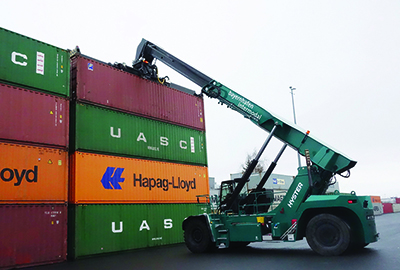
“By using a Hyster reachstacker with an elevating cabin it is considerably easier for the driver to lift containers from the second track,” says Project Engineer Christoph Kiener from bayernhafen. “For example, intermodal container handling from train to truck is simpler, as the driver can raise the cab at any time to get a better view.”

With the adjustable, elevating cabin drivers have a direct view of containers in the second row – even if there are high-cube containers or wagons in the first row. This avoids damage and helps make handling more efficient. The Hyster reachstacker can stack up to five containers high in the first row, four in the second and three in the third. 

Optimal driver comfort

The Hyster RS46-41LSCH reachstacker is particularly popular among operators at the Bamberg Terminal because it provides a good view and is comfortable, even in demanding applications. “The movable cab can be raised and lowered using the elevating arm,” says Rainer Marian, Head of Big Trucks at Hyster Europe. “The system we have developed does not work with a mast – the joint sits directly on the chassis. This keeps the cab almost vibration-free, even when the reachstacker drives long distances.”

“Drivers benefit from an ergonomic workplace, as there are fewer impacts and vibrations. Plus, as the cab is located on the side, next to the boom, the rear view is also particularly good,” he continues, explaining that the cab can also be equipped with a 10-degree tilt function, which makes it possible to handle high stacked containers even more comfortably.

Extendable supports provide stability

To increase the stability of the reachstacker, the truck has two hydraulically extendable stabilisers on the front axle, which press firmly onto the ground. They also increase the load capacity in the second and third row, as well as when offloading trains. 

“An important factor when designing the reachstackers was to minimise wear and maintenance,” explains Marian. “We help port and terminal operators control their costs and maximise uptime.”

Hyster Tracker simplifies maintenance

The Hyster Tracker telematics system also contributes to this. The fleet management system can record operating hours and support service checks and customer service through error analysis. 

“With the help of Hyster Tracker, we can help rectify errors as quickly as possible and plan our service proactively,” says Jochen Kotschenreuther of local Hyster dealer Kotschenreuther Systemtechnik, which has been working with baymodal since 2017. “Seven days a week, we can make sure we’re on-site within two hours to repair the machine. This keeps downtime to a minimum.”

“We are very satisfied with the service and know-how of Kotschenreuther Systemtechnik,” says baymodal’s Christoph Kiener. “They also advised us on helpful add-ons for the reachstacker – our RS46-41LSCH has a total of six cameras to provide additional visual support for the operator.”

Attachments ready for the future

At present, mainly 20ft, 30ft and 40ft containers are handled directly from the truck to the waiting trains in Bamberg. Up to 17 lorries can be parked on the pre-storage area, which is, on average, loaded and unloaded in 10 minutes. In total, around 30,000 TEUs is handled annually in the combined transport terminal, which opened in 2008, but bayernhafen Bamberg could handle up to 80,000 TEUs per year.

“We don’t currently handle many semi-trailers and swap bodies,” says Kiener, who sees greater potential for this type of handling in the coming years and is technically prepared for it – the spreader of the reachstacker can, if required, be supplied with a clip-on attachment with legs for swap bodies.  

“Known as a ‘piggyback’ or slave attachment, this allows us to use the Hyster reachstacker flexibly for all of the different tasks in the terminal,” he continues.


Kalmar hybrid straddle carriers to improve eco-efficiency at Lineas Intermodal’s Antwerp hub

0

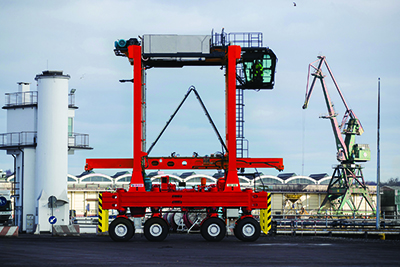
Being the largest private rail freight operator in Europe, Lineas operates the intermodal rail connected terminal ‘Main Hub’ in Antwerp-North. The company’s Green Xpress network concept offers customers a door-to-door solution with daily, fast and reliable rail connections between Europe’s economic hubs, significantly improving the supply chain and the ecological footprint of its customers. Lineas Intermodal’s equipment fleet already includes four Kalmar straddle carriers.

The Kalmar Hybrid Straddle Carriers will help Lineas Intermodal significantly reduce both fuel consumption and CO2 emissions when compared to using traditional diesel-powered machines. Hybrid machines also generate much less noise than their diesel counterparts. The Kalmar Hybrid Straddle Carrier also features a maintenance-free regenerative energy system that converts braking and spreader lowering energy into electrical power and stores it in a state-of-the-art on-board lithium-ion battery system.

The machines delivered to Lineas Intermodal will have a four-high stacking capacity and a lifting capacity of 40 tons.

Joris Gielen, Head of Supply Chain Management, Lineas Intermodal: “Kalmar is a long-term partner of ours and an industry leader in eco-efficient cargo-handling technologies. We have been extremely satisfied with the Kalmar straddle carriers in our fleet and the local service support, and are looking forward to taking advantage of the fuel and cost efficiencies the new machines will bring.”

Damien Cols, Director, Global Customers, Kalmar: “We’re extremely pleased that our straddle carrier solutions will continue to play a key role in Lineas Intermodal’s daily operations in Antwerp. Eco-efficient hybrid machines offer a fast-track to a more sustainable future for cargo handling operations and are becoming an increasingly popular choice for terminals of all kinds. We’re proud to be able to help the Antwerp hub claim the title of Europe’s first intermodal terminal to adopt hybrid technology.”