

Tuesday, December 16, 2025
spot_img
Home Blog Page 92

Green C Ports Project at Valencia

0

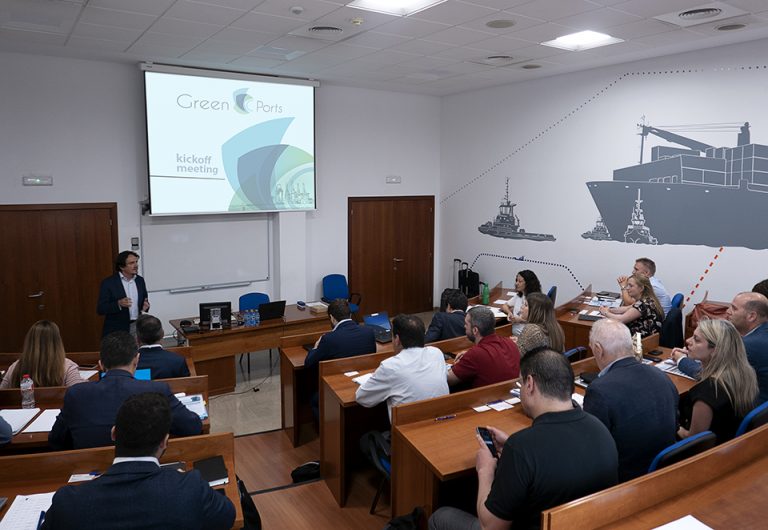
Last June, the Green and Connected Ports project (GREEN C PORTS), led by the Fundación Valenciaport and funded by the European Commission’s Connecting Europe Facility (CEF) programme, was launched.

GREEN C PORTS aims to provide a suitable array of digitalisation tools and technologies to support port environmental sustainability and performance of port operations in the TEN-T Core Network.

This project will address six business cases consisting of prototypes and pilot tests that will be implemented in different European ports and that will serve as a basis to test innovative technologies such as IoT, big data or predictive analysis using artificial intelligence models.

The first business case, which will be held in the port of Valencia, seeks to integrate different platforms, sensor networks and sources of information to predict the date and time of entry and departure of trucks using predictive analytics and business intelligence tools. In this way, and by achieving high accuracy in the predictions made, it will be possible to determine how many trucks/hour will leave and enter the port at a certain future date and time.

The second business case aims to predict the closure of the Port of Venice due to tide, wind, fog, and consequently to optimise date and time of entry and departure of ships using predictive analytics and big data tools This prediction system will allow the ships a safer and more efficient organisation of their trip, avoiding the only solution currently put in place: to close the port with very short notice entailing consequent changes of navigation routes or long waiting times for vessels that were about to call at it and as a result, economic and port performance loss..

On the other hand, business cases 3 and 4 aim to improve air quality and noise in both the Greek port of Piraeus and the port of Valencia. In this regard, a series of sensors, meteorological databases, optical-imaging cameras and other equipment will be deployed, in order to predict air and noise quality levels in a near future date and time. These predictions will be of great interest to the port authority, city council and other government institutions so that they can take certain decisions that mitigate these impacts.

Likewise, the fifth business case will evaluate, in the German ports of Bremerhaven and Wilhemshaven, how ship to shore (STS) crane productivity is affected by wave agitation, currents and wind. Wilhemshaven). By being able to model together big data originated by different port IT systems (i.e. PCS, PMS, TOS…) a set of warnings will be sent to affected parties such as terminal operators and sea carriers when expected reductions in port productivity are expected. Once this information is reported, shipping companies will be able to adjust the “berth window” in which they call at the ports, reducing as far as possible the length of the ship’s stay in port and the number of polluting emissions that these ships generate. 

Finally, the sixth and last business case will evaluate the impact in terms of emissions of a series of goods from the time they are loaded in the warehouse of origin to the time they are unloaded in the warehouse of destination. A series of sensors and emission cameras will be installed so that carbon emissions can be determined for each of the products that are transported. Thanks to this pilot case study, companies in the retailing sector will be able to inform their customers about the door to door carbon footprint of the products to be purchased in the company’s supermarkets. 

In short, this project will reduce the impact of port operations in cities, control emissions from ports and ships and optimise cargo handling in the main European ports. In this sense, the project will promote ecological, viable, attractive and efficient maritime transport links, integrated throughout the transport chain, and its application will contribute to rebalancing the EU transport system towards a more sustainable system.
Konecranes wins another Flow Drive reachstacker order from Dutch terminal Alpherium

0

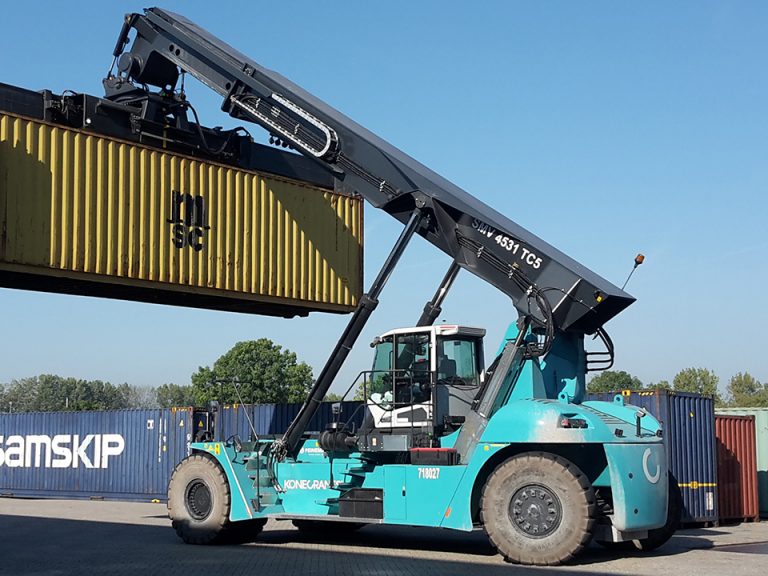
All the three units are being used for container handling around the site.

Located almost halfway between Amsterdam and Rotterdam, the inland terminal has a capacity of more than 200,000 TEUs per year. Keen to manage environmental issues more effectively, Alpherium in 2018 invested in their first two Konecranes Flow Drive reachstackers, aiming to reduce fuel consumption and costs, as well as carbon emissions and noise within the terminal.

Almost immediately, truck drivers gave direct feedback to terminal manager Ivo Hilhorst. They told him that the Flow Drive lift truck gave then a smooth ride, with no issues affecting the transmission. Braking and reversing were simpler and manoeuvrability was excellent. In addition, the truck ran at a lower noise level that made operating the vehicle at any time more pleasant, and a better choice during night shifts. They also noticed that fuel consumption was down by around 25%.

”We were very happy with our first Flow Drive machine,” says Mr Hilhorst. “It performed so well, we decided to get another one less than a year later. We plan to replace all of our old reach stackers with Konecranes Flow Drive vehicles, and that’s why we have one additional order in the pipeline”

Peinemann Mobilift Group was responsible for brokering the deal. As one of Rotterdam’s premier heavy lift solution providers, the company offered Alpherium their “total terminal maintenance concept”, by which they mean a complete service and maintenance package. “Together with Alpherium. we are continuously improving on environmental issues, including the reduction of fuel consumption,” said Marcel Toepoel of Peinemann. “All the machines have also been equipped with TRUCONNECT for close monitoring.”

Konecranes has developed three ECOLIFTING concepts – Power, Flow, and Hybrid – that employ innovative engineering solutions to help customers save money, maintain performance and benefit the environment. Flow Drive uses a combination of hydrodynamic and hydrostatic technology to improve efficiency at high speed and precision at low speed. The result is its impressive performance for customers including Alpherium.

“We’re excited to hear how much our customers like Flow Drive,” says Tobias Åkesson, Area Sales Manager, Konecranes Lift Trucks. “ECOLIFTING helps them make better choices for their businesses and the future.”

NWSA Terminal 5 ground-breaking begins new era for region

0

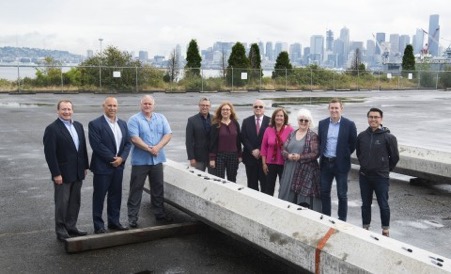
“Four years ago this August, our two ports announced the joining of our operations in order to better compete on a global scale. Today is proof that we made the right decision as our efforts here at Terminal 5 provide us new opportunities for cooperation and the creation of family-wage jobs,” said Clare Petrich, Port of Tacoma Commission President and Co-Chair of The Northwest Seaport Alliance.

“Today we begin the modernization of Terminal 5, the best container handling terminal in the Pacific Northwest. When complete, it will be a cornerstone of our region’s economic activity for decades to come,” said Stephanie Bowman, Port of Seattle Commission President and Co-Chair of The Northwest Seaport Alliance.  

Modernising Terminal 5 will allow the NWSA to handle some of the largest container vessels calling at West Coast ports today. As container vessels in the 14,000 TEU size regularly call at terminals in the North and South harbours, modernisation of Terminal 5 will allow for vessels up to 18,000 TEU.

“ILWU Local 19 understands the importance of keeping container operations thriving in this region – thousands of families depend on these maritime and industrial assets – and how critical it is to work together to ensure these assets continue to provide for our region. We must maintain these finite resources for industrial use,” said Rich Austin, President of Local 19 longshore union.

It is estimated that Terminal 5 activity will result in 6,600 new direct jobs and more than $2 billion in business activity. Managing Members of the NWSA voted to fund the project in April, pledging $340 million in construction funds, with private partner SSA Terminals contributing up to $160 million toward the project. The 185-acre terminal is expected to open in two phases, with one major berth ready to handle international container cargo in spring of 2021, and the other berth ready in 2023. 

“As a local terminal operator in Seattle for the past 50 years, SSA Terminals is proud to be part of making Terminal 5 a modern asset in this harbour. We see this investment as part of a long-term growth strategy and look forward to its development,” said Ed DeNike of SSA Terminals.

“As an exporter and importer utilising both ports, it is critical that we have access to efficient first-class infrastructure to move goods through these ports,” said Jan Koslosky, Vice President of supply chain management for Ocean Beauty Seafoods. “We applaud The Northwest Seaport Alliance as they invest in the future with Terminal 5.”

British Ports Association welcomes Clean Maritime Plan

0

Commenting, Mark Simmonds, Head of Policy, at the British Ports Association said: “We welcome the Government’s Clean Maritime Plan, which is a solid foundation on which the industry and Government must build. Industry will be responsible for delivering on the ambitions in this plan and the wider ‘Net Zero’ targets. As the Plan rightly sets out, success will depend on long-term close collaboration. The British Ports Association is ready to work closely with Government on these challenges. The UK has enjoyed a decades-long consensus that a market-led ports sector delivers world-class infrastructure and services to the international shipping industry which carries 95% of our trade. We believe that approach, in collaboration with Government, can be brought to bear to tackle humanity’s greatest challenge. For many, there will be opportunities in tackling these issues. Ports are already quite literally on the front line of climate change – dealing with rising sea levels and more extreme weather events and the ports industry will play a pivotal role in tackling these huge challenges. We are pleased that one early commitment is for the Government to review the environmental and economic case for coastal shipping, which we believe has a role to play in taking lorries off UK streets and reducing emissions. We also note the forecasts in this document that set out some possibly enormous growth in demands for energy that may need to flow through ports, whether it be shore-side power or bunkering cleaner fuels and we relish the challenge of tackling these in the coming months and years.”