
Saturday, December 13, 2025
spot_img
Home Blog Page 99

Hyster talks zero emissions and double reefer handling

0

Jan-Willem van den Brand from Hyster explains this project, and more, at this years’ TOC Europe Show.

Electrified laden container handlers

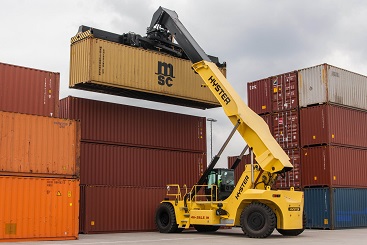
Terminals are expected to be able to electrify their Big Truck fleets and produce zero emissions, while achieving full shift performance comparable to a diesel-powered truck in the near future. A 52-tonne capacity Hyster® laden container handling truck with an electric motor will shortly be entering the test phase.

Innovative, high-voltage big electric trucks will be able to support continuous operation with operator-friendly re-charge, or, at a later date, quick H2 (hydrogen fuel) refill options. The Hyster team will be available at TOC to talk about how the company plans to move the industry forward with electrification.

New 11T empty container handler

Hyster is also launching the H11XM-ECD9 Empty Container Handler which enables double handling capabilities for any empty container, even 40ft reefers carrying the refrigeration units on the same side causing a severe offset load. With a capacity of 11 tonnes, it offers significant productivity advantages, as empty containers nowadays regularly exceed a tare weight of 5 tonnes, particularly reefers with wet floors.

Alongside the tough new H11XM-ECD9, there are four other new models in the H8-11XM-ECD9 series, which replaces the popular H18-23XM-12EC series, and will suit both current and future empty container handling requirements.

The size and number of reefers are growing around the world. This lift truck offers more flexibility so operators don’t have to handle 40ft reefers separately, saving throughput time. Hyster has been a key player in the growing “empty” market for many years and has further improved the product to help reduce the cost per container moved.

Container weighing for VGM

To enable operations to easily obtain this Verified Gross Mass (VGM) for SOLAS*, especially in areas where Legal for Trade regulations are applied, the Hyster® Static Plus weighing system is now available on new and existing Hyster® ReachStackers and Laden Container Handlers.

Operators simply pick a container and lift the load. There is no workflow disruption as the container weighing can occur during truck manoeuvring and the system is highly accurate with a weighing error of approximately 1 per cent of load weight. Furthermore, with the system custom field entries are possible, including container I.D., destination, location and more.

As well as providing VGM data, the Static Plus system provides accurate information for logistics compliance and reporting. Analysis of this information can also help operations to improve efficiency in container handling applications.

Connected machines

Smart terminals can boost their efficiency and save money by analysing truck usage data, restricting truck access and controlling daily checks. Hyster Tracker is a telematics system that can help identify under or over-utilised equipment, by truck, fleet or location. Hour meter, cost of operation, periodic maintenance, fault codes and impacts can all be tracked and additional functionality includes operator access control.

To drive down fuel or power costs, the idle shutdown function can also be set to power off a truck after a pre-determined amount of time. Operator Pre-shift Checklist Tracking is also possible, providing the quickest way to determine any issues with a truck so that downtime is reduced.

Virtual reality experience

On the Hyster® stand at TOC, visitors will be able to try a virtual reality simulator which accurately re-creates the experience of using a 3 tonne Hyster® Fortens® counterbalance lift truck. Anyone can get behind the wheel for an immersive 3D experience of even the toughest operating conditions.

The simulator has the same seat as featured on the Hyster® Fortens® model plus the same pedals, steering wheel, CANBus and hydraulic controls. The user wears a VR headset and as the head turns it gives different views through the mast, up, down and to the side, while spectators watch the activity on a screen.

Special engineering and support for efficient port and terminal handling

Most Hyster® Big Trucks have some sort of customised engineering, because every operation is different. Hyster creates solutions that efficiently overcome specific challenges.

With a full range of handling equipment suitable for ports and terminals, from ship to port-side store, Hyster offers support globally via its network of strong partners. Hyster® product managers and specialists will be on stand F74 at TOC Europe.
The PAV and Adif sign two agreements for the improvement of the Valencia-Zaragoza railway line and the rail access to the port of Sagunto

0

All these actions will involve an investment by the PAV of 33.6 million euros. The agreements have been signed by the President of Puertos del Estado, José Llorca, the president of ADIF, Juan Bravo; and the president of the PAV, Aurelio Martínez.

During the meeting, which was held this morning in the Estación del Norte de Valencia, the Minister of Development has highlighted that with the signing of these agreements “the Ministry complies with a commitment acquired last February at the AVE assembly, in which it was announced the signing of two very important agreements for the connectivity of the valencian ports “. In this sense, he stressed that “these agreements respond to the will of the Ministry of Development to improve the connectivity of Spanish ports and the improvement of rail infrastructure.” De la Serna also stressed “the importance of the Cantabrian-Mediterranean corridor for the government of Spain” and has put in value the effort of the PAV and the entire port community to improve the “much needed accessibility of the port of Sagunto with railway infrastructures “.

Rail Access to Sagunto

The agreement signed today includes the creation of a direct rail access to the port of Sagunto – not including the beach of tracks – that meets a series of technical functional requirements such as access of trains of goods up to 750 linear meters, or compatibility with the technical requirements established by the Trans-European Network for the Mediterranean Corridor. The works are expected to be tendered at the beginning of 2018 and have duration of 24 months, and the action will be completed in 2020. Once the works are completed, ADIF will transfer to the PAV the ownership of the infrastructure that will become part of the service area of the port of Sagunto.

Specifically, an investment of € 31.5 million is planned, of which 20 million euros will be provided by the Port Authority of Valencia and the remaining € 11.5 million will come from the Sustainable Growth Operational Program of the FEDER funds.

The financing corresponding to the PAV will cover the costs of drafting of the construction project and the execution of the works corresponding to the performance. Among these costs are those associated with possible expropriations, safety pilots, materials and other costs associated with the investment. For its part, Adif will tender and execute the corresponding works.

Improvement of the Sagunto-Teruel-Zaragoza line

Regarding the Sagunto-Teruel-Zaragoza railway line, the agreement signed today will allow the improvement of seven sidings that allow the efficient operation of trains up to 750 meters in length. The works will also facilitate the increase of the average speed of travel of the trains of goods that circulate along the line as well as the increase of the capacity available for trains of goods. This action will allow an improvement of at least 15% in the operating conditions of the line.

The bidding of these works – which can be carried out joint and unitary – is planned to take place during 2018, so that works are completed by the end of 2018 or early 2019.

The signing of this agreement will involve an investment by the PAV of 13.6 million euros from the Financial Fund for Land Accessibility. The PAV also plans to allocate another 40 million euros for actions to improve this railway line, which are still pending.

Evergreen Line's Ever Sigma container ship discharges 9 millionth TEU to pass through the POLA

0

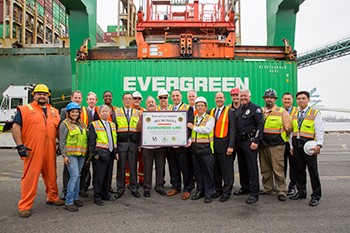
“Nine million TEUs is a major milestone for Los Angeles, and it’s only fitting that Evergreen Line, a longstanding customer, discharged the box that set this new Western Hemisphere record,” said Port Executive Director Gene Seroka. “Their operation in Los Angeles is an example of how our customers and supply chain partners are continually adapting to the changing dynamics in the marketplace.”

“As a Port of Los Angeles tenant and partner for more than 50 years, Evergreen is proud to be the shipping line that delivered the 9 millionth TEU during this 12-month period,” said Evergreen, Roy Amalfitano, Vice Chairman of Evergreen Shipping Agency (America) Corporation. “Congratulations to everyone involved, including captain and crew of the Ever Sigma, the ILWU labor workforce, and the Everport terminal management team in Los Angeles. Los Angeles remains an important and strategic gateway for Evergreen, and we look forward to growing our business via the Port of Los Angeles.”

The 12-month period for this new record corresponds with the Port’s July 1, 2016 through June 30, 2017 Fiscal Year, and the Port is on track to end the 2017 calendar year exceeding last year’s record volumes. In 2006, Los Angeles was the first port to surpass an annual throughput of 8 million TEUs, a decade-long record that was broken with CY 2016 volumes of 8.8 million.

The Port of Los Angeles is America’s premier port and has a strong commitment to developing innovatively strategic and sustainable operations that benefit Southern California’s economy and quality of life. North America’s leading seaport by container volume and cargo value, the Port of Los Angeles facilitated $272 billion in trade during 2016. San Pedro Bay port complex operations and commerce facilitate one in nine jobs in the five-county Southern California region.

Maersk Line launches Remote Container Management for customers

0

For customers of Maersk Line and the Maersk family of container shipping lines, that ends on 24 July with the commercial launch of the “Remote Container Management” system, RCM.

Data driven supply chain visibility
With RCM, both customers and Maersk Line have complete access to the reefer’s current location, temperature and atmospheric conditions inside as well as the power status, at all times and no matter where it may be in the world. Meanwhile, Maersk Line’s RCM experts are to manage the container, either remotely or through notifications to local technicians if a hands-on fix is required.

RCM has the capabilities that our customers have wanted from us for a very long time. It is going to insert an unprecedented level of visibility and reliability into their supply chains that will make their business better,” says Vincent Clerc, Chief Commercial Officer for Maersk Line.

“The old days of waiting, hoping and reacting are over. Our customers can now monitor and make decisions about their supply chain as their cargo moves, as well as use the data to study and improve their entire supply chain. Particularly for our customers with very sensitive, higher value refrigerated cargo, RCM significantly raises the total value proposition of refrigerated container trade.”

Identify critical supply chain weaknesses
If the impact of RCM is powerful, the technology behind it is relatively simple. A GPS, a modem and a SIM card on all 270,000 of Maersk’s refrigerated ‘reefer’ containers enables location, temperature, humidity and power status readings to be continuously collected and stored. That information then reaches customers and RCM global support teams via satellite transmitters on 400 of Maersk Line’s owned and chartered ships.

With clarity about the location and condition of the cargo at all times, not just during the ocean transport but throughout the journey of the container, RCM will help identify problem areas in customers’ supply chains and ways to improve them.

For example, if a customer’s reefer is not being pre-cooled as agreed at the farm, the customer can easily see this in the temperature graph on their screen and can contact or follow up with the supplier and the farm. Likewise, if a truck driver or port worker turns off the power to the reefer, this will be visible. RCM ensures the customer has the information they need to improve their processes.

In the unlikely event that the container malfunctions and local technicians are not able fix it, RCM’s automatic notifications give our customer time to notify their affected customers and plan alternatives such as unloading the container at an earlier port for a discounted sale.

In the first six months of 2017, RCM has alerted Maersk Line to more than 4,500 incorrect temperature settings on customers’ reefers. In 200 of those cases, the setting inaccuracy was severe enough that had RCM not notified Maersk Line personnel which then made the necessary changes, the cargo—collectively worth several million dollars to our customers—would have been lost.

Big potential in agricultural and pharma markets
Maersk Line has shipped chilled cargo since 1936 and has been a market leader in the reefer segment for many years, shipping a range of perishable cargo from bananas and other agricultural products to fish, meat and pharmaceuticals.

These types of commodities in particular are highly sensitive to temperature fluctuations which can be caused by any number of human or technical errors at any moment in a long supply chain which can drastically reduce the shelf life and final sales price of the product.

“Our customers have always wanted to know where their products are and if they are being properly cared for from the very beginning to when their customer receives them. Now with RCM, they will always know,” says Anne Sophie Zerlang, Head of Reefer for Maersk Line.

“We expect we will see an increase in our traditional perishable reefer volumes like agriculture as a result of RCM, but also new opportunities in sectors like pharmaceuticals where there is also a need for the kind of supply chain integrity RCM provides. As we receive feedback and learn more from our customers, we will look for ways to improve and expand the value of RCM.”